

Welcome to your study guide on the key quotes for Chinonyerem Odimba’s vibrant and politically charged play, Princess & The Hustler.
Because your GCSE English Literature exam is closed-book, you cannot take a copy of the play into the exam room. This means memorizing quotes is essential. However, the secret to a high grade isn’t memorizing massive chunks of text; it is memorizing short, explosive "micro-quotes" that you can unpack in detail to show your understanding of characters, themes, and historical context.
What you'll learn
- How to select and memorize highly versatile "micro-quotes"
- The key quotes that unlock the play’s core themes: Identity, Protest, and Family
- How to analyze a quote's language, structure, and historical context step-by-step to satisfy examiners
The Art of "Active Analysis"
Before we look at the quotes themselves, let's establish what the examiners are looking for when you use a quotation. They do not just want to see that you can remember a line; they want to see you analyze its methods (how the writer uses language or structure) and its meanings (how it reflects the historical context and the play's deeper messages).
Active Analysis
Active Analysis is the practice of breaking a quotation down into its smallest linguistic parts (individual words, punctuation, or structural devices) and explaining how those parts create meaning, reveal character psychology, or critique society.
Instead of writing: Princess says she wants to be a princess, which shows she wants to be beautiful, you should aim to look at specific words:
The Power of 'Micro-Quotes'
Favour short, 2-to-5-word quotes. They are easier to remember under exam pressure and encourage you to analyze specific words (zoom-in analysis) rather than repeating the plot.
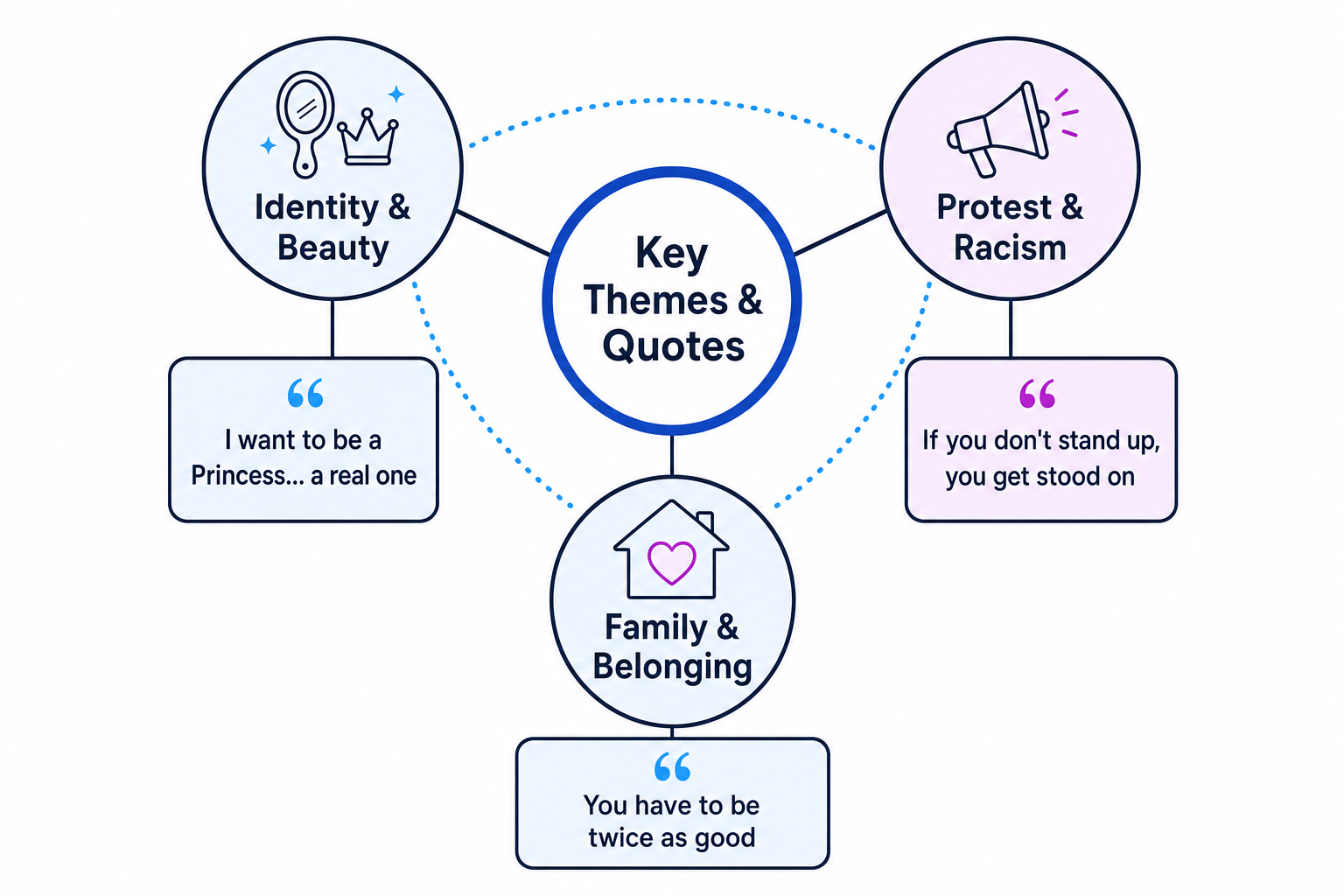
To help you visualize how these quotes connect across the different thematic demands of your exam, look at this thematic map:
Category 1: Identity, Beauty, and Self-Worth
These quotes track Princess’s journey of self-discovery, exploring her internalized perceptions of race, beauty, and representation in 1960s Britain.
"I want to be a Princess... a real one." (Princess, Act 1)
- The Context: Princess is expressing her desire to win the local beauty pageant. She is captivated by the traditional, Eurocentric images of royalty and beauty she sees around her.
- The Method: The noun "Princess" carries connotations of royalty, purity, and fairytale perfection—images historically dominated by white figures. The adjective "real" reveals her deep-seated belief that her current self is somehow inadequate or "unreal" because she does not match these white societal standards.
- The Deeper Meaning: Odimba uses Princess's childhood innocence to expose how deeply systemic racism and lack of representation affect a young Black child's self-esteem.
"Why can’t my hair be straight like the girls on the television?" (Princess, Act 1)
- The Context: Princess is struggling with the pain of having her hair hot-combed by her mother, Marge.
- The Method: The rhetorical question highlights Princess's internal conflict and confusion. The noun "television" acts as a symbol of media representation, highlighting how the media in 1963 excluded Black beauty and reinforced Eurocentric standards.
- The Deeper Meaning: This line represents the physical and emotional pain associated with conforming to white beauty standards. It shows how young Black girls were taught to reject their natural features.
Punctuation is a method!
Don't forget that structural features like question marks and ellipses (...) are choices made by the playwright. A question mark often signals a character’s internal doubt, vulnerability, or search for identity.
Category 2: Protest, Racism, and Agency
These quotes explore the societal tensions of the 1963 Bristol Bus Boycott, showing how different characters respond to systemic exclusion and fight for their civil rights.
"If you don't stand up, you get stood on." (Wendell/The Hustler, Act 1)
- The Context: Wendell is justifying his involvement in the Bristol Bus Boycott and the broader civil rights struggle to his family.
- The Method: Odimba uses parallelism and a play on the verb "stand" ("stand up" vs "stood on"). The active verb phrase "stand up" represents political action and dignity, while the passive "stood on" symbolizes oppression and erasure.
- The Deeper Meaning: This aphoristic (saying-like) phrase serves as a rallying cry. It captures the transition from passive endurance to active resistance within the British Caribbean community during the Windrush era.
"They don’t want us on the buses, they don’t want us in the houses, they don’t want us." (Leon, Act 1)
- The Context: Leon, Princess’s older brother, expresses his growing anger and disillusionment with the racism he encounters daily in Bristol.
- The Method: The use of anaphora (repeating "they don't want us") builds a rhythmic, escalating sense of alienation and claustrophobia. The vague pronoun "they" emphasizes the division between the white establishment and the Black community.
- The Deeper Meaning: Odimba highlights the structural nature of British racism. It wasn’t just about the buses; it affected housing ("No Irish, No Blacks, No Dogs" signs were common) and daily survival.
Ignoring the Play's Format
Students often analyze plays as if they are novels. Remember, these lines are spoken aloud to an audience! Consider how the delivery of a line like Leon’s repetitive "they don't want us" would sound on stage—it should convey a rising, breathless sense of panic and outrage.
Category 3: Family Dynamics and Survival
These quotes show how the pressures of living in a racially hostile society affect the family unit, exposing the generational differences in how they cope with racism.
"You have to be twice as good to get half as far." (Marge, Act 1)
- The Context: Marge is giving advice to her children, trying to prepare them for the harsh realities of living as Black immigrants in Britain.
- The Method: Odimba uses a mathematical contrast ("twice as good" versus "half as far") to create a stark, balanced sentence structure. This structural balance reflects the rigid, unfair social contract imposed on the Windrush generation.
- The Deeper Meaning: This quote highlights the psychological burden of respectability politics. Marge believes that survival requires perfection and quiet endurance, contrasting sharply with the younger generation’s desire for loud, disruptive protest.
The 'Twice as Good' Scale
Think of a scale where one side is loaded with heavy weights (systemic racism). To make the scale balance, the Black characters have to put twice as much effort on their side just to reach a level of baseline survival.
Putting Analysis Into Action
To get the highest marks in your essay, you must weave your quote, its linguistic analysis, and its historical context into a single, cohesive paragraph.
Here is a step-by-step example of how to build an analytical paragraph using Marge's famous quote.
Analyzing Marge's advice on racial survival
Analyze how Chinonyerem Odimba uses the character of Marge to present the challenges of the Windrush generation.
- State your thesis clearly (AO1/AO3): Odimba presents Marge as a maternal figure whose parenting style is deeply shaped by the harsh, discriminatory realities of 1960s Britain. She seeks to protect her children by teaching them to navigate systemic racism through perfectionism rather than protest.
- Introduce and embed your micro-quote smoothly (AO1): This survival strategy is encapsulated in her warning to her children that they must be "twice as good to get half as far."
- Analyze the writer's methods and language choices (AO2): Odimba uses a striking numerical contrast between the multiplier "twice" and the fraction "half". This structural juxtaposition highlights the unequal ratio of effort to reward for Black immigrants, creating a sense of systemic unfairness. The flat, pragmatic tone of the statement suggests that Marge views this injustice not as a temporary hurdle to be protested, but as an absolute, unchangeable law of British society.
- Connect your analysis to historical and social context (AO3): This reflects the real-world experiences of the Windrush generation, many of whom faced severe employment discrimination and felt they had to adopt "respectability politics"—becoming quiet, hard-working, and flawless—to minimize hostility from the white British public. Odimba highlights the tragic psychological toll of this existence, showing how racism forces Black mothers to strip away their children's room for error.
In the exam
- Choose three versatile quotes per character/theme: Do not try to memorize fifty quotes. Memorize ten to twelve highly flexible quotes that can apply to multiple essay questions (e.g., Marge’s "twice as good" quote can be used in essays about Marge, family, racism, or generational divide).
- Weave context into your analysis: Never dump context in a separate paragraph at the end. As shown in the worked example, tuck historical details (like the Windrush generation or the Bristol Bus Boycott) directly inside your language analysis.
- Use active verbs to describe the writer's intent: Instead of "This quote shows...", use analytical verbs like "Odimba exposes", "the dialogue crystallizes", "this metaphor critiques", or "the repetition accentuates".
Check yourself
- Which quote best demonstrates the psychological impact of a lack of Black representation on television in 1963?
- How does Wendell's quote ("If you don't stand up, you get stood on") contrast structurally and thematicially with Marge's advice ("twice as good")?
- Can you identify two separate literary methods used in Leon's quote: "They don’t want us on the buses, they don’t want us in the houses..."?
