To score top marks in your GCSE English Literature exam, you cannot just write about what happens to Beatrice, Benedick, Hero, and Claudio. You must analyze how Shakespeare constructs their world. This means looking closely at his choices of language (the words and imagery characters use), form (the dramatic genre and choice of prose or verse), and structure (how scenes are ordered and mirrored).
By understanding these elements, you will be able to explain how Shakespeare transforms a simple story of deception into a profound commentary on gender, social pressure, and the vulnerability of love.
What you'll learn
- How to distinguish between prose and blank verse and explain why Shakespeare switches between them.
- How Shakespeare uses symmetrical plotting and parallel scenes to create comic mirroring and dramatic irony.
- How to analyze Shakespeare's linguistic devices, from the combat-themed metaphors of the "merry war" to Dogberry's comedic malapropisms.
1. Form: Prose vs. Blank Verse
One of the first things you will notice when reading Much Ado About Nothing is that it does not look like many of Shakespeare's other plays. Most of Shakespeare’s plays are written primarily in verse, but Much Ado About Nothing is written predominantly in prose.
Prose
Prose is ordinary, conversational language that does not follow a strict rhythmic pattern or metric structure. On the page, it looks like a standard block of text, running all the way to the right-hand margin.
Blank Verse
Blank verse is unrhymed poetry written in iambic pentameter. It has a strict, steady rhythm of ten syllables per line, alternating unstressed and stressed syllables (da-DUM, da-DUM, da-DUM, da-DUM, da-DUM). On the page, it has a jagged right margin because each line must stop after ten syllables.
In Much Ado, approximately 70%70\%70% of the play is written in prose—the highest percentage of any Shakespearean play. Shakespeare uses the tension between prose and verse to highlight different social classes, emotional states, and attitudes toward love.
The Social Dynamics of Prose
Prose is the language of realism, wit, domesticity, and skepticism. It is perfectly suited to Beatrice and Benedick. Because they reject the standard, idealized "rules" of courtly courtship, they also reject the poetic verse associated with it.
When Beatrice and Benedick engage in their "merry war," their prose is sharp, fast-paced, and intellectually rigorous. Prose allows for rapid-fire banter (repartee) because it is not constrained by a poetic meter.
The Courtly Elegance of Blank Verse
Conversely, blank verse is reserved for high-status characters, formal courtly settings, and intense emotional gravity.
Claudio and Hero initially speak to or about each other in verse. This reflects their adherence to social conventions; they are playing the traditional roles of the chivalric soldier and the modest, passive maiden. For example, when Claudio first confesses his feelings for Hero to Don Pedro, he shifts from prose into romantic blank verse:
"Lord, i'm glad that you forestall me write, And i'll be sworn that she's my love. But now I am returned and that war-thoughts Have left their places vacant, in their rooms Come thronging soft and delicate desires..." — (Act 1, Scene 1)
Thematic shifts in form
Pay close attention to moments where characters switch from prose to verse, or vice versa. These shifts always signal a profound change in emotional intensity, status, or psychological state.
When the Form Shifts: Crucial Transitions
- Benedick’s Shift to Verse: In Act 2, Scene 3, after Benedick is tricked into believing Beatrice loves him, he delivers a soliloquy in prose. However, as his love deepens and he is forced to defend Hero's honor in Act 5, his language begins to absorb elements of verse. This shows that real, vulnerable love is pulling him out of his cynical, prose-bound world.
- The Wedding Scene (Act 4, Scene 1): The sudden, horrific accusation of Hero at the altar is written almost entirely in blank verse. The formal, rhythmic structure of the verse amplifies the horror, dignity, and tragic weight of Claudio's betrayal and Leonato’s intense grief. Prose would feel too casual here; the high-stakes drama demands the weight of iambic pentameter.
2. Structure: Symmetry, Parallelism, and Irony
Shakespeare structures Much Ado About Nothing around pairs: two sets of lovers (Beatrice/Benedick and Hero/Claudio), two main deceptions (one benevolent, one malicious), and two contrasting social worlds (the masculine world of war/honor and the feminine domestic sphere).
Symmetrical Plotting: The "Gulling" Scenes
The most famous structural device in the play is the symmetrical layout of the two "gulling" (tricking) scenes. In Act 2, Scene 3, Benedick is tricked into believing Beatrice is dying of love for him. In the very next scene (Act 3, Scene 1), Beatrice is tricked in exactly the same way.
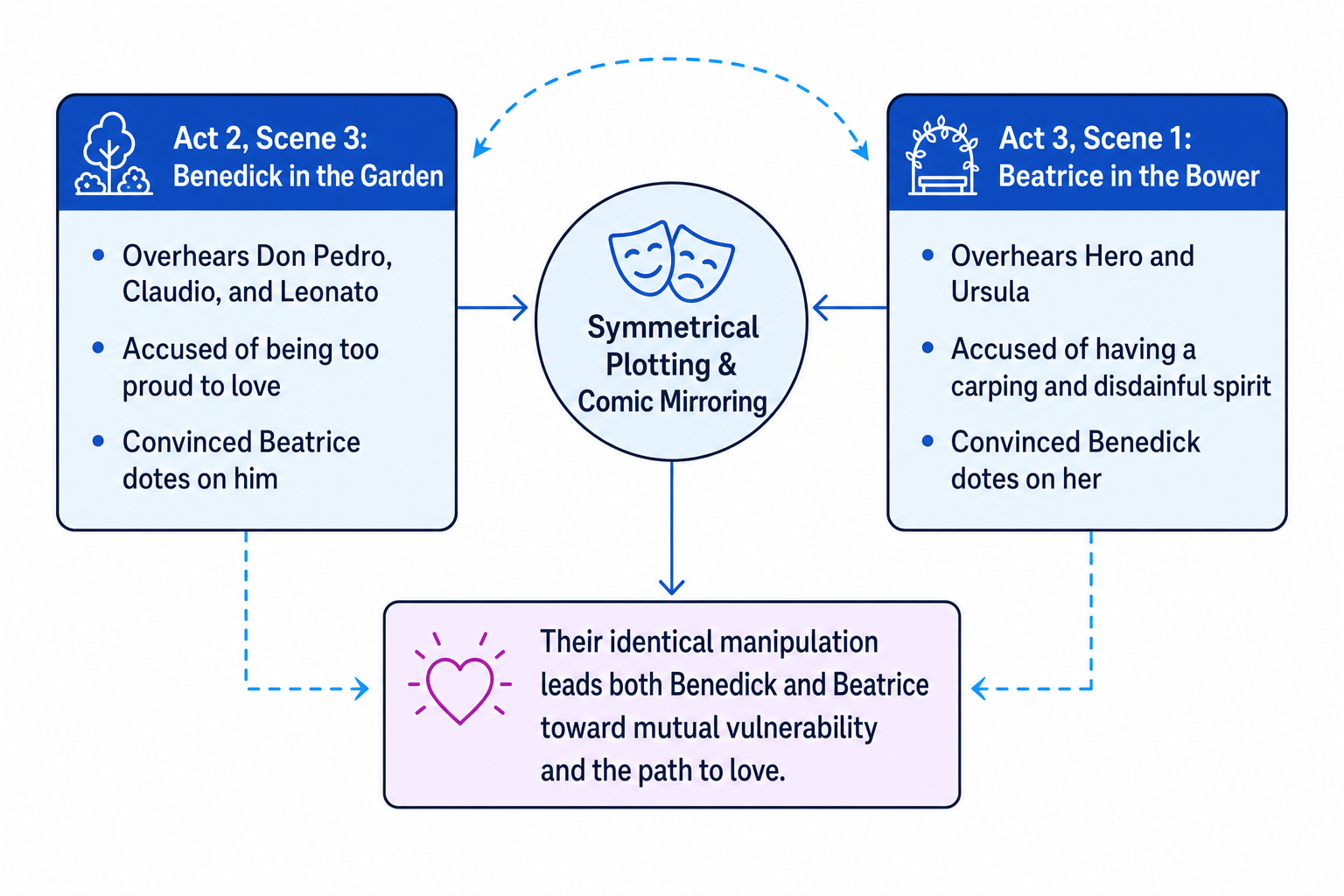
This deliberate mirroring serves several structural purposes:
- Comedic Parallelism: The humor is doubled because the audience watches both self-proclaimed cynics fall into the exact same trap.
- Thematic Balance: It shows that despite their verbal fencing, Beatrice and Benedick are intellectual and emotional equals. Both are vulnerable to the exact same vanity and longing for connection.
- Pacing: This rapid back-to-back structuring accelerates the plot, moving the two reluctant lovers from mutual hostility to a shared readiness for love just before the tragic interruption of the wedding scene.
Parallel Deceptions
Structure is also used to compare good deceit (the "honest slanders" used to unite Beatrice and Benedick, and Friar Francis's plan to fake Hero's death) with evil deceit (Don John's slander of Hero).
By structuring the play around these parallel deceptions, Shakespeare invites the audience to consider the ethics of lying. In Messina, language is a tool that can be used to construct a joyful reality (love) or destroy a human life (Hero's reputation).
Ignoring the parallel plots
Many students write essays focusing solely on Beatrice and Benedick because they are the most entertaining characters. However, you will lose marks if you do not analyze how their story is structurally dependent on Hero and Claudio. Beatrice and Benedick only confess their love openly because they are brought together by the crisis of Hero’s public humiliation.
3. Language: Combat, Deception, and Malapropisms
Shakespeare uses highly specific language patterns to establish the psychological landscape of Messina.
The Language of Warfare and Courtship
From the very beginning of the play, love is framed not as a gentle emotion, but as a violent conflict. Leonato notes in Act 1, Scene 1 that "There is a merry war betwixt Signior Benedick and her."
Beatrice and Benedick continuously use military, hunting, and wounding metaphors to describe their relationship:
- Beatrice claims Benedick's wit is like "a jade's trick" (getting thrown from a horse).
- Benedick complains that Beatrice "speaks poniards [daggers], and every word stabs."
- Don Pedro promises to play the role of a hunter, saying he will "bring Signior Benedick and the Lady Beatrice into a mountain of affection."
These metaphors reveal their deep fear of vulnerability. If love is a battle, then falling in love means surrendering and getting hurt. Using language as armor allows them to guard their hearts.
Dramatic Irony
Because the audience is constantly kept "in the know" about the various schemes, Shakespeare relies heavily on dramatic irony.
Dramatic Irony
Dramatic irony occurs when the audience has vital information that one or more characters on stage do not have. This creates tension, anticipation, and comedy.
For example, when Benedick hides in the arbor and complains about Claudio falling in love, the audience laughs because we know that Don Pedro and Claudio are standing just a few feet away, fully aware of Benedick's presence, preparing to trick him. The irony deepens our engagement because we are co-conspirators in the deception.
Dogberry and Malapropisms
To provide comic relief, Shakespeare introduces the bumbling constable Dogberry and his Watch. Dogberry’s language is defined by his constant use of malapropisms.
Malapropism
A malapropism is the mistaken use of an incorrect word in place of a similar-sounding one, often with an amusingly inappropriate effect.
For example, Dogberry proudly declares, "Our watch, sir, have indeed comprehended [apprehended] two auspicious [suspicious] persons."
While this is funny, it also serves a crucial structural and social purpose:
- Social Satire: Dogberry desperately wants to sound like an educated, upper-class gentleman. His failed attempts at elevated language expose the vanity and pretentiousness of the Messinian nobility.
- Thematic Irony: While the clever, highly articulate nobles are easily fooled by Don John's lies and end up falsely accusing an innocent girl, the illiterate, foolish watchmen are the ones who actually uncover the truth. Shakespeare uses this language barrier to suggest that intellectual sophistication does not equal moral wisdom.
Worked Example: Analyzing a Passage
Analyzing Benedick's soliloquy
Analyze how Shakespeare uses language and form to show Benedick’s transformation at the end of Act 2, Scene 3, after he has overheard his friends claiming that Beatrice loves him.
The Passage: "This can be no trick: the conference was sad; they have the truth of this from Hero. They seem to pity the lady: it seems her affections have their full bent. Love me! why, it must be requited. I hear how I am censured: they say I will bear myself proudly, if I perceive the love come from her; they say too that she will rather die than give any sign of affection. [...] I must not seem proud: happy are they that hear their detractions and can put them to mending."
- Identify the form of the passage and its structural context. Observe that the passage is written entirely in prose, not verse. Even though Benedick is speaking about his newfound love, he has not yet completely abandoned his signature linguistic style. He is still using the language of logic, reasons, and evidence ("This can be no trick", "the conference was sad"). He is attempting to intellectualize his sudden shift in feelings.
- Analyze the syntax and sentence structure. Look at the rapid, fragmented sentences at the start: "This can be no trick: the conference was sad; they have the truth of this from Hero." The semicolons and colons show his brain working overtime to rationalize what he has heard. He is trying to construct a logical argument to justify changing his mind. The short exclamation "Love me!" followed by the immediate conclusion "why, it must be requited" shows how quickly his defenses collapse when his vanity is stroked. The modal verb "must" indicates that he now views loving her as an absolute duty, showing how thoroughly he has been duped.
- Unpack the key vocabulary and thematic links. Look at the words "proud" and "detractions." His friends accused him of being too "proud" to love Beatrice. Now, he says "I must not seem proud" and "happy are they that hear their detractions and can put them to mending." This is a massive structural turning point. Benedick, who began the play mockingly immune to criticism, is now eager to self-correct because of what others think of him. This highlights the themes of social reputation and deception—he is altering his entire identity based on a fabricated conversation.
Quick Terminology Check
When analyzing prose in your essay, don't just say "Shakespeare uses prose." Explain the effect: "Shakespeare employs prose to capture the colloquial, naturalistic rhythm of Beatrice and Benedick's banter, emphasizing that their relationship is built on intellectual equality and realistic friction, rather than the artificial, idealized conventions of courtly love."
In the exam
- Never analyze a device in isolation: If you spot a metaphor or a malapropism, do not just label it. You must explain why Shakespeare used it at that exact moment, and how it connects to a wider theme (like the fear of vulnerability or social status).
- Track the transitions: In your essay, try to discuss at least one moment where the form shifts (e.g., from prose to verse, or from playful banter to tragic accusations). Pointing out these structural pivots shows the examiner that you are thinking about the play as a piece of theater.
- Use the AQA Assessment Objectives to guide you: Remember that analyzing language, form, and structure directly targets your ability to explain the writer's craft. Support your points with short, precise, memorized quotations, and maintain an academic, analytical register throughout.
Check yourself
- Why is it structurally significant that Beatrice and Benedick's "gulling" scenes happen back-to-back?
- Give one example of a character switching from prose to verse, and explain the emotional reason behind this change.
- How does Dogberry’s use of malapropisms reflect the wider themes of language and social class in Messina?
