In your GCSE English Literature exam, you are assessed on your ability to construct a cohesive argument supported by precise textual evidence. Because the exam is closed-book, you must memorise short, versatile, and high-impact quotations.
This guide breaks down the most powerful quotes from Much Ado About Nothing, grouping them by theme and character, and demonstrating how to deconstruct their deeper literary and historical meanings.
What You'll Learn
- How to select "high-yield" quotations that work for multiple exam questions.
- Techniques for close-word analysis (looking at methods, rhythm, and connotations).
- How to link Shakespeare's language to Elizabethan social contexts, including patriarchy, honour, and courtly love.
The Art of Selecting "High-Yield" Quotations
To make the most of your revision, you should focus on quotes that are dense—meaning they contain multiple literary devices and link to more than one theme.
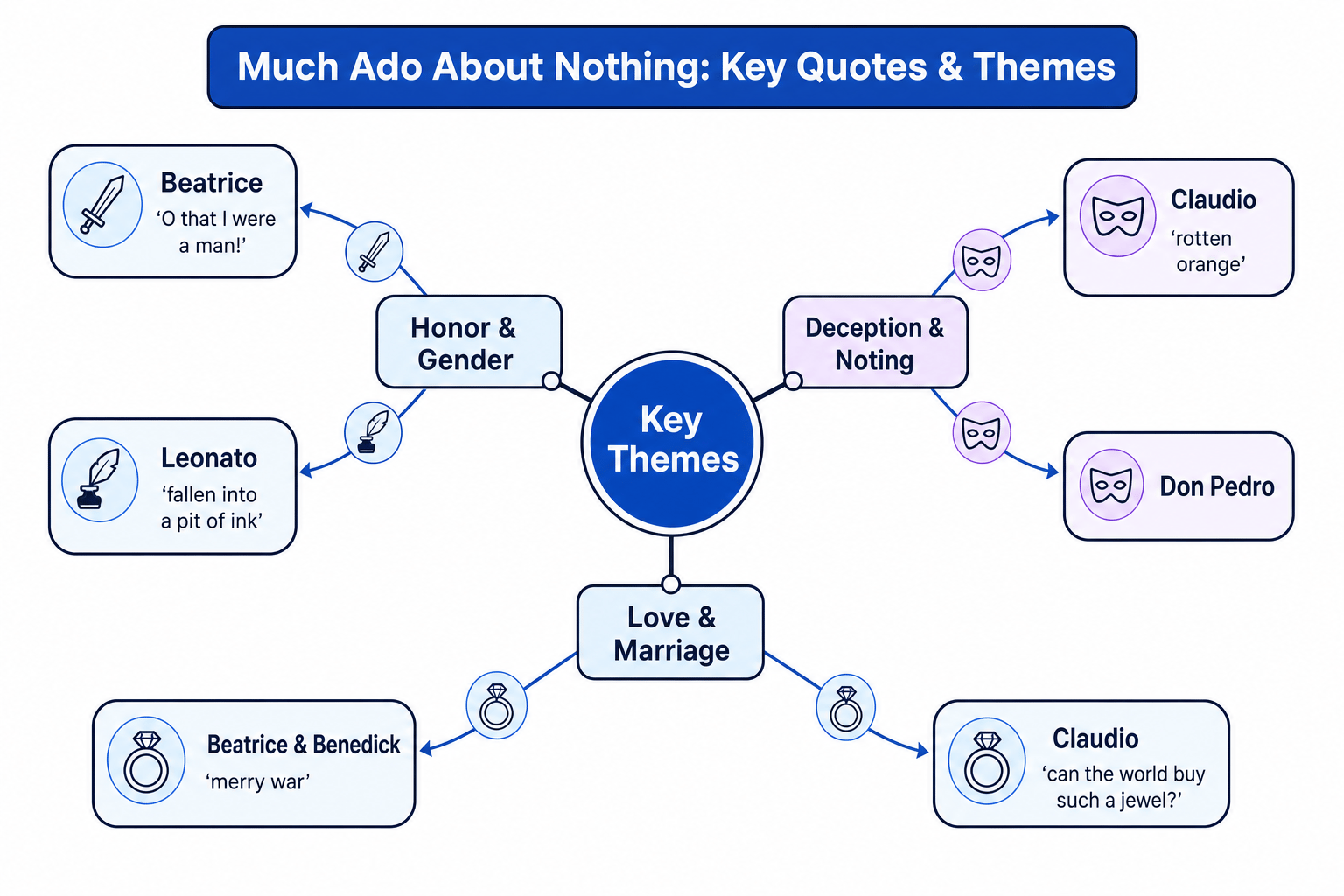
For instance, a quotation about Beatrice and Benedick's "merry war" does not just tell us about their relationship; it also reveals ideas about gender conflict, societal expectations, and the protective masks characters wear to avoid emotional vulnerability.
High-Yield Quotation
A short, memorable phrase or sentence from a text that contains rich literary features (such as metaphors, motifs, or structural contrasts) and can be used to answer questions on characters, relationships, and broader thematic concepts.
Theme 1: The "Merry War" of Beatrice and Benedick
The witty sparring between Beatrice and Benedick is one of the play's defining features. Their dialogue is written primarily in prose, which reflects their conversational spontaneity, intelligence, and refusal to conform to the artificial, poetic conventions of courtly love.
Quotation 1: "There is a kind of merry war betwixt Signor Benedick and her." (Leonato, Act 1, Scene 1)
- The Method: Oxymoron ("merry war").
- The Analysis: Leonato highlights that while Beatrice and Benedick appear to be hostile, their conflict is also a source of mutual amusement. The military language ("war") frames their relationship as a battle of wits. It suggests that their mutual teasing is actually a safe way to interact without risking the emotional vulnerability of real love.
- The Context: In Elizabethan England, courtship was expected to be formal and polite. By engaging in a "merry war", both characters reject traditional gender roles and the typical passivity expected of young women and men in love.
Quotation 2: "I had rather hear my dog bark at a crow than a man swear he loves me." (Beatrice, Act 1, Scene 1)
- The Method: Hyperbole and animalistic imagery.
- The Analysis: Beatrice uses a harsh, cacophonous image (a dog barking at a crow) to show her disdain for romantic declarations. The scraping, unpleasant sounds imply she views courtly sweet-talk as irritating and insincere. This establishes her sharp wit and her cynical protective armor.
- The Context: Beatrice's resistance to marriage was highly unconventional for an Elizabethan woman, whose social status and financial security depended entirely on finding a husband.
The function of wit
For Beatrice and Benedick, wit is not just entertainment—it is a defensive shield. By mocking marriage and each other, they protect themselves from the vulnerability of rejection and the strict, trapping expectations of Elizabethan courtship.
Theme 2: Courtly Love, Honour, and Deception
In contrast to Beatrice and Benedick, Claudio and Hero represent the traditional, idealized model of courtly love. However, this model is highly fragile, relying heavily on outward appearances, patriarchal ownership, and fragile reputations.
Quotation 3: "Can the world buy such a jewel?" (Claudio, Act 1, Scene 1)
- The Method: Rhetorical question and objectifying metaphor ("jewel").
- The Analysis: Claudio immediately views Hero as a precious commodity. While "jewel" suggests high value and purity, it also reveals that his love is superficial—he values her as an ornament or possession rather than a complex human being. This financial language ("buy") highlights how marriage in the upper classes was often treated as a business transaction.
- The Context: In the Elizabethan era, marriages among the nobility were arranged to secure wealth, land, and social alliances. Hero's "value" is tied directly to her chastity and her father’s status.
Quotation 4: "She is fallen into a pit of ink." (Leonato, Act 4, Scene 1)
- The Method: Metaphor of staining and pollution.
- The Analysis: When Hero is falsely accused of infidelity at the altar, her own father, Leonato, instantly believes the accusation. The "pit of ink" is an extended metaphor for disgrace and ruined reputation. Ink is black and permanent; once spilled, it cannot be cleaned. This shows how easily a woman's honor could be permanently ruined by a single accusation.
- The Context: In a patriarchal society, a daughter's sexual purity was tied directly to her family's social standing. If Hero is "stained", Leonato's family honor is destroyed, which explains his immediate, violent rejection of her.
Ignoring the characters' flaws
Students often treat Claudio as a purely romantic hero who was simply tricked by Don John. Avoid this! Claudio's quickness to believe the slander and his public humiliation of Hero reveal his obsession with external reputation over real trust. Use quotes like "such a jewel" and "rotten orange" to expose this flaw.
Theme 3: Gender Roles and Patriarchal Constraints
The limitations placed on women are central to the play's tragicomedic tension. While Beatrice is highly independent, she is ultimately trapped by her gender when crisis strikes.
Quotation 5: "O that I were a man! ... I cannot be a man with wishing, therefore I will die a woman with grieving." (Beatrice, Act 4, Scene 1)
- The Method: Repetition (epistrophe) and parallel sentence structure.
- The Analysis: This is Beatrice's emotional climax. Following Hero’s public humiliation, Beatrice is consumed by fury but frustrated by her physical and social powerlessness. She cannot challenge Claudio to a duel because she is a woman. Her repetition of "man" emphasizes her deep frustration with the patriarchal rules that silence women and deny them justice.
- The Context: Women in the Elizabethan era had no legal standing independent of their fathers or husbands. They could not fight in duels, hold public office, or defend their own honor in court, meaning they had to rely entirely on male champions.
Deconstructing a Quotation: Step-by-Step
To get the highest marks (AO2), you must go beyond simply identifying a device. You need to perform a "micro-analysis" of specific words, explaining how they construct meaning and impact the audience.
Deconstructing Claudio's metaphor
Analyze the linguistic devices and structural implications of Claudio’s accusation in Act 4, Scene 1: "Give not this rotten orange to your friend."
- Identify the core method and contrast: Claudio uses a sensory metaphor ("rotten orange") at the wedding altar to describe Hero. This creates a shocking contrast between the expected sweetness and beauty of a bride and the hidden decay of corruption.
- Examine the connotations of specific words: The noun "orange" has associations with freshness, vibrant color, and luxury. However, the adjective "rotten" subverts this completely, implying hidden filth, decay, and spoilage beneath a deceptive, beautiful skin. This captures Claudio's obsession with appearance versus reality.
- Analyze the wider dramatic and structural context: By presenting Hero as a gift to his "friend" (Don Pedro), Claudio frames the marriage as an exchange of goods between men. The verb "give" reduces Hero to a piece of defective property, reinforcing the patriarchal view of women as tradable assets.
- Connect the analysis to the play's central themes: This quote represents the dark side of "noting" (misinterpreting what is seen). Claudio believes he has "noted" Hero's infidelity, and his brutal public shaming of her shows how fragile the social order of Messina really is when honor is threatened.
Integrating Quotations
Never drop a quotation in as a standalone sentence (e.g., Claudio says, "Give not this rotten orange." This shows...). Instead, embed it smoothly into your own sentence: Claudio's deep-seated misogyny is exposed when he demands Leonato "give not this rotten orange" to his noble friend, reducing his bride to ruined property.
In the exam
- Focus on short fragments: You do not need to write out long, three-line passages of Shakespeare. Focus on memorising three- to five-word fragments (like "merry war," "pit of ink," or "rotten orange") that you can easily weave into your sentences.
- Track character changes: Choose quotations that show how characters develop over time. For instance, compare Benedick's early cynicism ("I will live a bachelor") with his final realization that "man is a giddy thing" to show his emotional growth.
- Always link language to context: When discussing words like "jewel" or "pit of ink," always remind the examiner why these words carried such heavy stakes for an Elizabethan audience (chastity, patriarchal ownership, family lineage).
Check yourself
- Can you name the two contrasting metaphors used to describe Hero's purity/corruption, and identify which characters speak them?
- Which quote best demonstrates Beatrice's frustration with the physical and social limitations placed on her gender?
- Why does Shakespeare have Beatrice and Benedick speak mostly in prose, while Claudio and Hero speak in blank verse? How does this structural choice relate to the themes of authenticity and courtly love?
