

When studying a play like Chinonyerem Odimba’s Princess & The Hustler, it is easy to treat it like a novel and focus only on what the characters say. However, a play is a blueprint for live performance. To score highly in your GCSE English Literature exam (specifically targeting AO2), you must analyze how Odimba uses dramatic methods—the unique theatrical tools a playwright uses to bring a story to life on stage.
What you'll learn:
- How Odimba structures the play to balance intimate family drama with large-scale political history.
- The symbolic meaning behind physical objects and stage actions, such as cocoa butter and the beauty pageant.
- How sound, music, and dialect are used as physical and cultural languages on stage.
- How to write high-impact exam paragraphs analyzing stage directions and theatrical choices.
1. Prerequisites: What is a Dramatic Method?
Before diving into the play itself, we must define what we mean by "dramatic methods."
Dramatic Method
A dramatic method is any literary or theatrical device used by a playwright to convey meaning, evoke emotion, or develop themes on stage. This includes dialogue, but also extends to non-verbal elements like stage directions, lighting, set design, sound/music, structure, and physical action.
In Princess & The Hustler, Odimba does not just rely on words to tell the story of the 1963 Bristol Bus Boycott and its impact on a West Indian immigrant family. She relies heavily on how characters move, what they wear, what they hear, and how the physical space of the stage is organized.
2. Structural Contrast: The Domestic vs. The Political
One of Odimba's primary structural methods is the juxtaposition (placing two contrasting things close together) of the domestic sphere and the political sphere.
- The Domestic Sphere: Inside the family home. This is the domain of Mavis, household chores, child-rearing, and personal dreams (like Princess’s desire to win a beauty pageant). It represents safety, warmth, and the immediate reality of daily life.
- The Political Sphere: The streets of Bristol, where Hustler (the father) and eventually Lorna (the older sister) engage in the Bristol Bus Boycott. This sphere represents racial tension, civil rights, and systemic injustice.
By shifting the action rapidly between these two spaces, Odimba shows that for a Black British family in 1963, the political and the personal were completely inseparable. The outside world constantly leaks into the home.
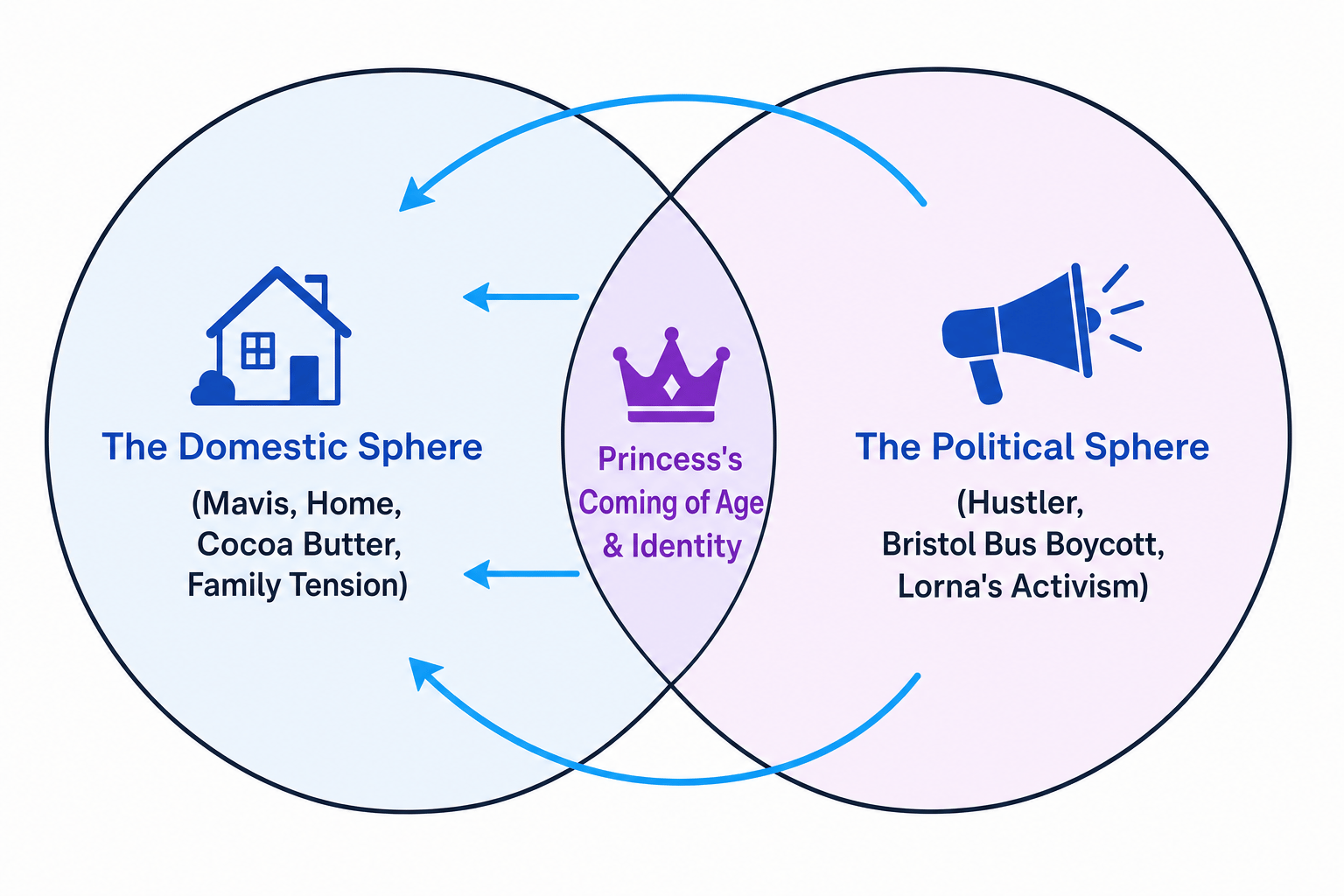
The Permeable Home
Odimba uses the physical boundaries of the stage to show how racism and political struggle invade private spaces. The home is not a fortress; it is vulnerable to the external pressures of a racially hostile society.
3. Visual and Physical Symbolism
Stage props and physical actions are powerful visual metaphors. Because the audience can see them continuously, they carry deep thematic weight throughout the play.
The Beauty Pageant
Ten-year-old Princess’s obsession with the beauty pageant is a major plot driver, but it is also a vital dramatic method.
- The Symbol: The pageant represents the white, Eurocentric standards of beauty dominant in 1960s Britain.
- The Drama: When Princess mimics the contestants or wears a make-believe crown, the visual image is bittersweet. The audience feels dramatic irony because they understand, far better than the innocent Princess, that the society she is trying so hard to please does not value her Blackness.
Cocoa Butter
The act of applying cocoa butter is a recurring physical motif (a repeating element with symbolic significance).
Motif
A motif is a recurring image, sound, action, or figure in a work of literature or drama that has a symbolic significance and helps to develop the theme.
- The Symbol: Applying cocoa butter is an act of love, survival, and cultural heritage. It is a sensory ritual passed down through generations.
- The Drama: When Mavis rubs cocoa butter into Princess's skin, it is a tender, physical manifestation of maternal protection. The cream acts as a literal and metaphorical barrier against the harsh, dry British cold and the "dryness" of racial hostility outside.
The Bucket of Water
Throughout the play, Mavis is frequently seen carrying, using, or emptying a bucket of water.
- The Symbol: This physical action anchors the play in the reality of working-class domestic labor. It symbolizes the heavy load of emotional and physical work Mavis carries to keep her family clean, presentable, and safe.
Ignoring Stage Directions
Many students only quote dialogue in their essays. To get top marks for AO2, you must write about the stage directions. When Mavis is described as "vigorously scrubbing" or "wringing out a cloth," Odimba is telling us about Mavis's internal anxiety and her fight for control without Mavis saying a single word.
4. Aural Stagecraft: Sound and Music
Princess & The Hustler is a highly musical play. Odimba uses sound as a structural transition tool and an emotional amplifier.
- Ska, Calypso, and Motown: The music played between scenes is not just background noise; it is historical and cultural geography. It marks the transition of the West Indian diaspora in Britain, blending the traditional rhythms of the Caribbean (Ska and Calypso) with the contemporary Black American civil rights soundtrack (Motown).
- Rhythm of Speech: Odimba utilizes the contrasting rhythms of her characters' speech. Hustler speaks with a lyrical, persuasive cadence (the "hustle"), whereas Mavis speaks with a grounded, rhythmic pragmatism. Princess and her brother Wendell use a youthful, blending Black British vernacular that signals a shift in identity from their immigrant parents.
Sound as a Character
Think of the music in the play as an extra character. It expresses the collective mood of the community and acts as a bridge between the historical reality of 1963 and the audience in the theatre.
5. Worked Example: Analyzing a Stage Direction
Let's look at how to construct a high-grade analytical response focusing on Odimba's dramatic methods. We will walk through how to analyze a specific physical action from the play: the scene where Mavis applies cocoa butter to Princess.
Analyzing the dramatic effect of physical action
Analyze how Chinonyerem Odimba uses physical action to present the relationship between Mavis and Princess.
-
Identify the method and the quotation/stage direction: Locate a specific physical action. In Act 1, Scene 3, Mavis applies cocoa butter to Princess. The stage direction notes Mavis is “firmly but gently rubbing the cream into Princess’s skin.”
-
Establish the immediate meaning (AO1): Explain what this action shows on a surface level. This physical interaction displays Mavis's maternal care, showing her desire to protect her daughter from physical discomfort (dry skin caused by the British climate).
-
Analyse the deeper symbolic and contextual significance (AO2/AO3): Examine why the cocoa butter and the physical touch matter in 1963 Britain. The cocoa butter is a sensory connection to their Caribbean heritage. The action of "rubbing" acts as a metaphor for preparation and protection. Mavis is physically preparing Princess's body to face a hostile, white-dominated world that is currently protesting against Black people on the buses of Bristol.
-
Link back to the writer's purpose and the audience's reaction: Conclude by explaining why Odimba chose to show this physically rather than through dialogue. By making this a quiet, domestic ritual, Odimba contrasts the gentleness of maternal love inside the home with the political violence outside. The audience witnesses a physical shield being built around Princess, emphasizing the vulnerability of Black childhood during this period.
In the exam
- Name the drama-specific method: Do not just write "the writer says." Use drama terminology: stage direction, physical theatre, sensory motif, set design, juxtaposition, structural transition.
- Balance dialogue and stage directions: Aim to analyze at least one non-verbal element (like a character's physical movement or the presence of a prop) for every piece of spoken dialogue you write about.
- Connect to Context (AO3): Explain why the dramatic method was necessary to convey the historical reality. For example, the off-stage sounds of protesting represent the inescapable pressure of the Bristol Bus Boycott on this immigrant household.
- Use the "What, How, Why" structure: What is Odimba showing us about the characters? How does she use stagecraft (props, movement, sound) to show it? Why did she want the theatre audience to experience it this way?
Check yourself
- Why does Odimba place the beauty pageant preparations alongside the Bristol Bus Boycott? What is the structural effect of this juxtaposition?
- What does Mavis's constant washing and cleaning tell us about her character's psychological state and her role in the family?
- How does the change in language style (dialect) between Hustler and his children (Lorna and Wendell) dramatize the generational divide in immigrant families?
