What you'll learn
- What “context” means for Much Ado About Nothing and how it links to the AQA Shakespeare question.
- How early modern ideas about gender, honour, marriage and reputation shape the play.
- How Shakespeare uses comic conventions such as disguise, eavesdropping and mistaken belief.
- How to include context in essays without turning your answer into a history lesson.
What “context” means
In English Literature, context is the world around the text: the historical, social, cultural and literary conditions that shape how it was written and received.
For Much Ado About Nothing, context helps you understand why Hero’s reputation matters so much, why marriage is treated as a public event, and why Beatrice’s anger at male power is so striking.
Context
Context means the relevant circumstances surrounding a text’s creation and reception, such as beliefs about gender, class, religion, theatre, family, marriage and honour.
AQA rewards context when it is connected to Shakespeare’s choices. You are not being asked to write a separate history essay. You are being asked to explain how context deepens your reading of the play.
Here is a quick map of the main context areas you should keep returning to.
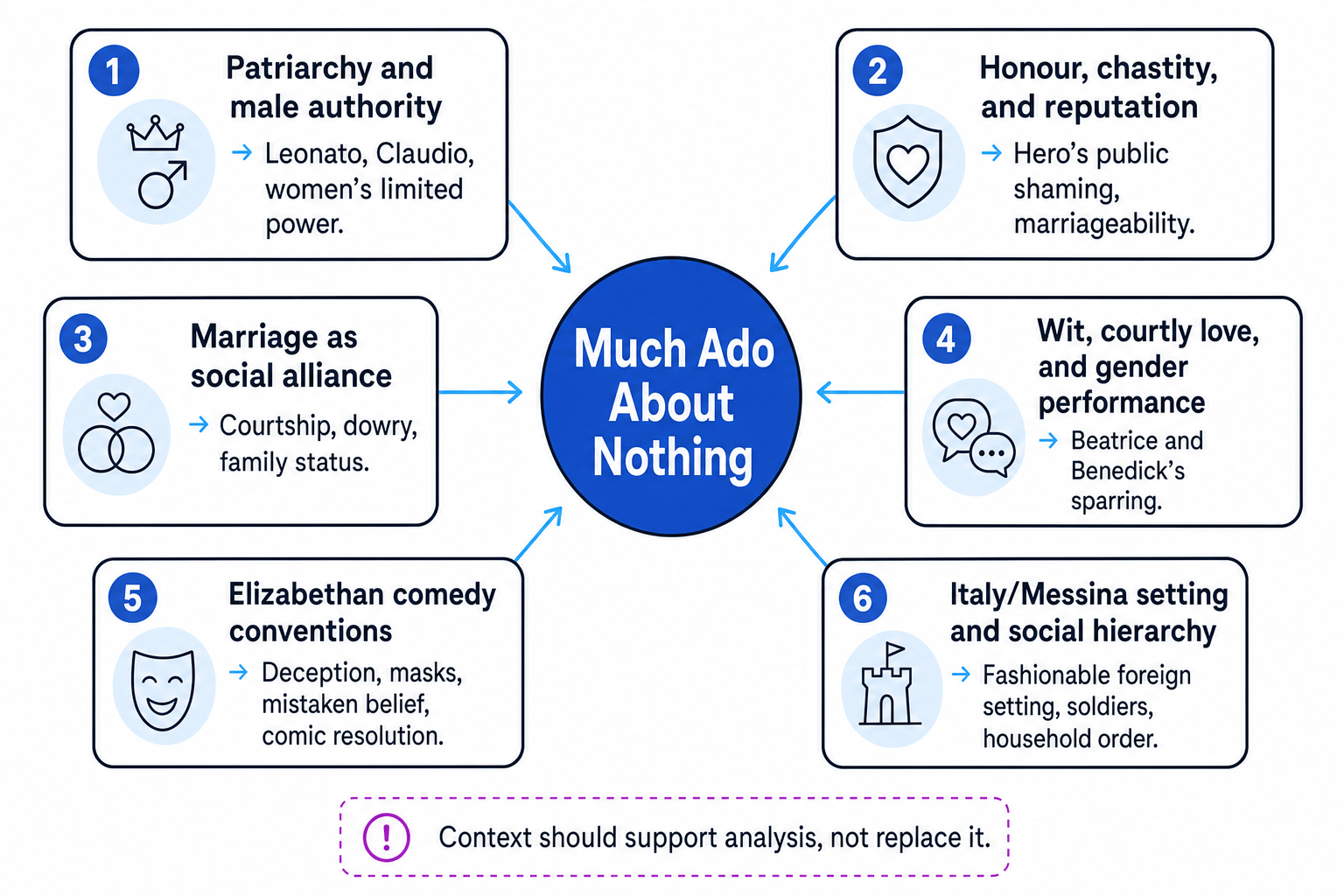
The big idea
Context should help you answer why something matters in the play: why a word, scene, relationship or dramatic choice would feel significant to Shakespeare’s audience and to us.
Shakespeare’s world: early modern comedy
Much Ado About Nothing was probably written in the late 1590s, during the early modern period. “Early modern” refers to the period after the medieval era but before the modern world, roughly from the 1500s to the 1700s.
The play is also an Elizabethan play because it was written during the reign of Queen Elizabeth I. Shakespeare’s audience would have watched it live in the theatre, not studied it silently from a printed book.
Comedy
In Shakespeare, a comedy is not simply a play that is funny. It is usually a play that moves from confusion, conflict or threat towards social restoration, often ending in marriage.
This matters because Much Ado contains genuinely dark moments. Hero is publicly humiliated. Leonato wishes she were dead. Claudio behaves cruelly. Yet the play still ends with marriages, music and dancing. Shakespeare’s comedy can include pain before resolution.
Comedy does not mean harmless
Do not write as if Much Ado is “just a funny play”. The comedy often exposes serious problems: public shame, male control, unreliable appearances and the damage caused by gossip.
Patriarchy and male authority
A patriarchy is a society in which men hold most public, legal and family power. In Shakespeare’s England, fathers and husbands had authority over women’s lives to a degree that feels restrictive to a modern audience.
Patriarchy
Patriarchy means a social system where men have greater authority than women, especially in family life, law, politics and public reputation.
This context shapes the way Hero is treated. Leonato, Claudio and Don Pedro discuss marriage arrangements around her. When Claudio accuses her, the men’s voices dominate the scene. Hero has very little power to defend herself publicly.
Beatrice is different because she challenges male expectations through language. Her wit gives her a kind of power, but not the legal or physical power men possess. This is why her cry, “O God, that I were a man!”, is so important: she recognises that justice in her world is controlled by men.
Reading Beatrice’s anger through gender context
-
Beatrice’s exclamation, “O God, that I were a man!”, shows that her frustration is not only personal but social: she wants access to male power because Hero has been wronged.
-
Her command to Benedick, “Kill Claudio”, transfers action to a man, showing that even a bold woman depends on male agency in a patriarchal society.
-
Shakespeare makes Beatrice morally forceful here: her anger challenges a culture where men can publicly shame a woman while women struggle to defend themselves.
-
This means the scene does not simply present Beatrice as “emotional”; it exposes the limits placed on female justice in the world of the play.
Honour, chastity and reputation
A central context for Much Ado is honour culture. Honour is public reputation: how society judges your worth. For women in the play, honour is closely tied to chastity, meaning sexual purity before marriage.
Chastity
Chastity means sexual purity, especially the expectation that an unmarried woman should not have sex before marriage.
This explains why the accusation against Hero is so devastating. Claudio does not privately ask for the truth. He shames her at the wedding, in front of her father and the community. Her supposed sexual dishonour becomes a public stain on her whole family.
Claudio’s insult, “Give not this rotten orange to your friend”, is especially cruel. The metaphor presents Hero as something that looks attractive outside but is corrupt inside. In context, this reflects a fear that female appearance may hide sexual “dishonour”.
Leonato’s reaction is also shaped by this culture. His line, “Death is the fairest cover for her shame”, shows that he sees Hero’s reputation as so damaged that death seems preferable to social disgrace.
Using reputation context with Hero’s shaming
-
Claudio’s metaphor “rotten orange” presents Hero as outwardly appealing but inwardly spoiled, so his language turns her into damaged property rather than a person.
-
In an early modern honour culture, a woman’s chastity was linked to her family’s status and her future marriage prospects, so the accusation threatens Leonato as well as Hero.
-
Shakespeare stages the accusation at the wedding, making the shame public and theatrical; the community witnesses Hero’s reputation being destroyed.
-
The context helps us see that Shakespeare is exposing the danger of a society where men’s assumptions can ruin a woman before the truth is known.
Marriage, inheritance and social status
In the play, marriage is romantic, but it is also social and economic. A dowry is money, property or wealth brought by a bride’s family into a marriage. Marriage could strengthen families, protect inheritance and improve social position.
Claudio’s interest in Hero is not presented as purely emotional. Early in the play, he asks, “Hath Leonato any son?” Don Pedro replies, “No child but Hero; she’s his only heir.” This does not mean Claudio is definitely pretending to love Hero, but it shows that love and status are closely connected.
This context makes the ending more complicated. The marriages restore social order, as Shakespearean comedies often do, but the audience may still remember how fragile Hero’s position has been.
Useful sentence frame
Try: “In the context of early modern marriage, Shakespeare presents love as both emotional and social, because…” Then connect the idea to a short quotation.
Wit, courtly love and gender performance
Wit means quick, clever and often playful use of language. Beatrice and Benedick are defined by wit. Their relationship is described as “a kind of merry war”, which makes love sound like verbal combat.
Courtly love
Courtly love is a literary tradition where a lover idealises the beloved, often using exaggerated praise, formal devotion and poetic language.
Beatrice and Benedick mock this tradition. Beatrice says, “I had rather hear my dog bark at a crow than a man swear he loves me.” Her comic exaggeration rejects conventional romantic devotion. Benedick similarly performs the role of the proud bachelor who claims he will never marry.
This is where gender performance matters. Gender performance means the way people act out socially expected ideas of masculinity or femininity. Benedick performs masculine independence; Beatrice performs verbal resistance to marriage. Shakespeare uses their wit to show that love is partly a social role people learn to play.
Deception, “noting” and theatre
The title Much Ado About Nothing contains a famous pun, which is wordplay based on similar sounds or multiple meanings. In Shakespeare’s pronunciation, “nothing” could sound like “noting”, meaning observing, noticing or overhearing.
Much of the plot depends on people “noting” things badly. Claudio believes staged evidence against Hero. Beatrice and Benedick are tricked into overhearing conversations about each other. Don John’s plot works because appearances seem more persuasive than truth.
Shakespeare’s audience would have enjoyed this theatrical pattern. They are watching actors play characters who watch, overhear and misread each other. The comedy comes from deception, but the darker scenes show that deception can destroy reputations.
Noting and misreading
The play repeatedly asks whether people can trust what they see and hear. Shakespeare turns overhearing into both a comic device and a serious warning about judgement.
Don John, illegitimacy and hierarchy
Early modern society placed great importance on birth, rank and inheritance. Don John is called “the Bastard”, meaning he is an illegitimate son: a child born outside marriage. The word is harsh, but in Shakespeare’s context it was also a legal and social category.
Illegitimate
An illegitimate child is a child born to parents who are not married to each other. In Shakespeare’s society, this could affect inheritance, status and social acceptance.
This context helps explain Don John’s bitterness. He says, “I cannot hide what I am”, suggesting that society has already labelled him. He is still responsible for his villainy, but Shakespeare links his resentment to a world obsessed with rank and legitimacy.
Italy, Messina and the foreign setting
The play is set in Messina, in Sicily, rather than in England. For Shakespeare’s audience, Italian settings often suggested sophistication, courtship, intrigue and danger. A foreign setting also gave Shakespeare distance: he could explore sensitive issues such as female honour, male authority and social deception without setting them directly in England.
The soldiers’ return from war also matters. Claudio, Benedick and Don Pedro enter a household after military success, bringing with them ideas of loyalty, masculine honour and public reputation. The shift from war to courtship is comic, but the language of conflict remains: Beatrice and Benedick have a “merry war”, and Beatrice later demands violent justice from Benedick.
Religion, law and public ceremony
Marriage in the play is not just private romance. It is a public and religious ceremony. That is why the wedding scene is so powerful: Claudio’s accusation happens at the exact moment when Hero should be publicly confirmed as honourable.
Friar Francis is important because he represents religious authority. A friar is a member of a Catholic religious order. In the Italian setting, this would feel believable to Shakespeare’s Protestant English audience. The Friar’s plan to pretend Hero is dead is dramatic and risky, but it also gives time for truth to emerge.
Dogberry and the Watch represent civic law and social order. They are comic because they misuse language, but they still uncover the truth. Shakespeare often allows foolish characters to reveal what clever people miss.
How to use context in essays
The best context is brief, precise and attached to analysis. Start with the play, not with a general historical fact.
A weaker sentence would be: “Women had no rights in Shakespeare’s time.” This is too broad and not fully accurate.
A stronger sentence would be: “Shakespeare presents Hero as vulnerable within a patriarchal honour culture, because Claudio’s public metaphor ‘rotten orange’ allows male suspicion to destroy her reputation before she can defend herself.”
That sentence works because it combines quotation, method, context and interpretation.
Bolted-on context
Avoid adding context as a separate final sentence, such as “This links to patriarchy.” Instead, make context explain the effect of Shakespeare’s language, structure or characterisation.
In the exam
-
Use context to explain the play’s meanings, not to show off random historical knowledge.
-
Link every context point to a precise moment: a short quotation, a scene, a dramatic method or a character choice.
-
Show complexity: Shakespeare may reflect early modern attitudes, but he can also question or criticise them.
-
Keep quotations short and accurate, and check your spelling, punctuation and expression because the Shakespeare question also rewards clear writing.
Check yourself
-
How does honour culture help explain the severity of Hero’s public shaming?
-
Why is Beatrice’s line “O God, that I were a man!” more than just a personal complaint?
-
How does the idea of “noting” connect the play’s comedy with its darker treatment of reputation?
