

In Pigeon English, Stephen Kelman presents a vibrant yet tragic portrait of modern urban life through the eyes of eleven-year-old Harrison "Harri" Opoku. By examining how key themes intersect, you will learn how to write analytical essays that satisfy the assessment objectives (AO1, AO2, and AO3) for your GCSE English Literature exam.
What you'll learn:
- How innocence acts as a lens through which dark social realities are viewed.
- The conflict between cultural identity and the pressure to belong.
- How Kelman uses the theme of violence to critique systemic failures in urban society.
Core Theme 1: Innocence vs. Experience
At its heart, Pigeon English is a modern coming-of-age story that tracks the loss of childhood innocence. This type of narrative is often referred to in literature as a bildungsroman.
Bildungsroman
A bildungsroman is a literary genre that focuses on the psychological and moral growth of the protagonist from youth to adulthood. In Pigeon English, this journey is tragically cut short.
Harri’s narrative perspective is the novel's primary tool for exploring this theme. Kelman uses a first-person naive narrator. Because Harri is young and unfamiliar with the dangers of the London estate, he describes dark, adult situations with a sense of wonder, confusion, or casual acceptance.
The Contrast of Light and Dark
Harri is preoccupied with typical childhood joys: running fast, collecting coins, and playing with his friends. However, this innocent play is continuously overshadowed by the threat of violence.
- The murder investigation: Harri treats the search for the dead boy's killer as a playful detective game, inspired by television. He does not grasp the real-world danger of investigating a gang.
- The pigeon motif: The pigeon represents a pure, detached perspective on human behaviour. While Harri sees the pigeon as a friend and protector, the adults and older boys around him ignore or abuse nature.
Dramatic Irony
Kelman uses dramatic irony (where the reader understands more than the character) to expose the vulnerability of children. When Harri describes the older boys' actions, we recognize the danger even when Harri thinks it is "cool" or exciting.
Core Theme 2: Identity, Immigration, and Belonging
Harri is a Ghanaian immigrant living in a London council estate. His daily life is a constant negotiation between two distinct cultures, and his language reflects this tension.
The Hybrid Language
To show Harri's struggle for belonging, Kelman constructs a unique dialect for him. Harri blends Ghanaian vocabulary and customs with London inner-city slang.
- Ghanaian roots: Harri frequently calls on God using the Twi word "Awurade", eats traditional foods like kenkey, and recalls his grandmother’s superstitions (such as the belief that shadows can steal your soul).
- London street slang: To fit in, Harri adopts local slang like "chvays", "safe", and "heavy". He is deeply concerned with the "rules" of being cool, such as having the right trainers (even drawing a Nike tick on his school shoes).
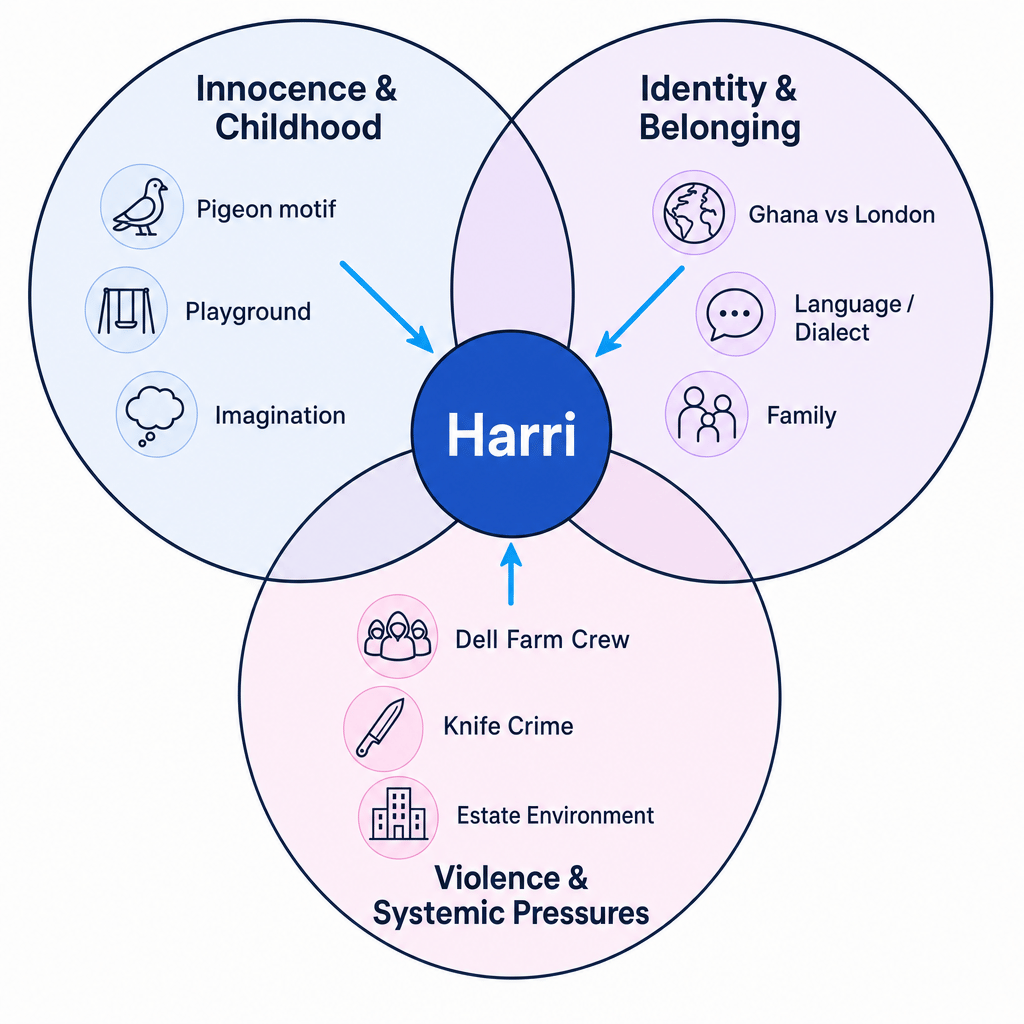
As shown in the diagram above, Harri stands at the intersection of these competing forces. His identity is shaped not only by his heritage and his childhood innocence, but also by the intense social pressures of his immediate environment.
Context Connection (AO3)
Kelman based the novel on the real-life murder of Damilola Taylor in 2000. Damilola was also a young boy who had recently moved to London from Nigeria. Understanding this context helps you explain why Kelman emphasizes the vulnerability of young immigrant children in urban environments.
Core Theme 3: Violence, Power, and Vulnerability
The setting of the novel—the Peckham estate—is dominated by the Dell Farm Crew (DFC). For these older boys, violence is a currency used to buy status and security.
The Cycle of Violence
Throughout the novel, violence is presented as an infection that spreads through the community. The older boys are trapped in a system where displaying physical dominance is the only way to avoid becoming a victim.
- Peer pressure: Harri feels the pressure to join the gang and prove himself. When he is told "If you don't fight they think you're soft", Kelman shows us the binary options available to these boys: be the predator or the prey.
- The weaponization of youth: The DFC uses younger children to carry out illegal tasks because they are less likely to draw police attention. Harri's innocence is weaponized against him by those who should be protecting him.
Missing the Systemic Critique
Do not write about the gang members as purely "evil" villains. Kelman suggests that the DFC members are also victims of a system that has failed them. Their violence is a desperate attempt to assert control in an environment where they feel powerless and neglected by society.
Step-by-Step: Analyzing a Thematic Passage
In your exam, you will need to write a structured, analytical response that traces a theme through a specific quotation or moment in the text. Here is how you can build a high-scoring analytical paragraph step by step.
Analyzing the theme of innocence in the opening chapter
Task: Analyze how Kelman presents the conflict between childhood innocence and urban violence when Harri stands over the spot where the young boy was stabbed.
Key Quotation: "You could still see the blood. It was like a map of a face. It looked like someone had dropped their juice, but it was too dark for juice."
-
State your main point (AO1): Begin with a clear statement that directly addresses the theme.
Draft: Kelman uses Harri’s naive first-person perspective to highlight how childhood innocence is confronted by the brutal reality of gang violence.
-
Introduce and embed your evidence (AO1): Blend your chosen quotation seamlessly into your sentence.
Draft: When looking at the murder scene, Harri notes that the blood looked "like someone had dropped their juice, but it was too dark for juice."
-
Analyze language and methods (AO2): Identify the literary devices used (such as simile) and explain their effect on the reader.
Draft: The simile comparing the victim's blood to "dropped... juice" emphasizes Harri's youthful innocence, as he automatically filters a horrific scene through a familiar, harmless childhood image. However, the immediate correction that "it was too dark for juice" shows the limits of this innocence; the reality of the violence forces its way into Harri's consciousness, forcing him to recognize the gravity of the crime.
-
Connect to wider context and writer's purpose (AO3): Explain why the writer made this choice. What is the bigger picture?
Draft: Through this contrast, Kelman critiques how young children living in poverty are prematurely exposed to trauma. By using a childlike register to describe a brutal stabbing, Kelman evokes sympathy from the reader, emphasizing that these children are living in an environment where death is a routine, domestic sight.
In the exam
- Focus on the "Why": Never just list the themes. Always ask yourself why Kelman chose to highlight these ideas. What message is he sending about modern British society?
- Track thematic changes: Show how a theme develops. For instance, innocence is strong at the beginning of the novel, but it is gradually chipped away as Harri is forced to make adult moral choices.
- Analyze the language of the themes: Look at the linguistic choices. How does Harri's use of Ghanaian terms contrast with the aggressive verbs and nouns of the Dell Farm Crew?
Check yourself
- How does Harri's relationship with the pigeon develop the theme of innocence versus experience?
- Why does Stephen Kelman use London street slang alongside traditional Ghanaian language, and what does this show about Harri's identity?
- In what ways does the novel suggest that the school and the police fail to protect the children on the estate?
