In the GCSE English Literature exam, you will not just be asked to retell the story of Frankenstein. Instead, the examiner wants to see how you analyze the deeper ideas Mary Shelley explores. These core ideas are the themes of the novel. By understanding these themes, you will unlock the real meaning behind Victor’s experiments and the Creature’s tragic journey.
What you'll learn
- How to analyze Shelley's warning about dangerous ambition and scientific discovery
- How to evaluate the concepts of monstrosity and societal prejudice
- How to trace the debate between nature and nurture through the Creature's development
- How to use Romantic ideas of the sublime to explain the role of nature in the text
1. Dangerous Ambition and Hubris
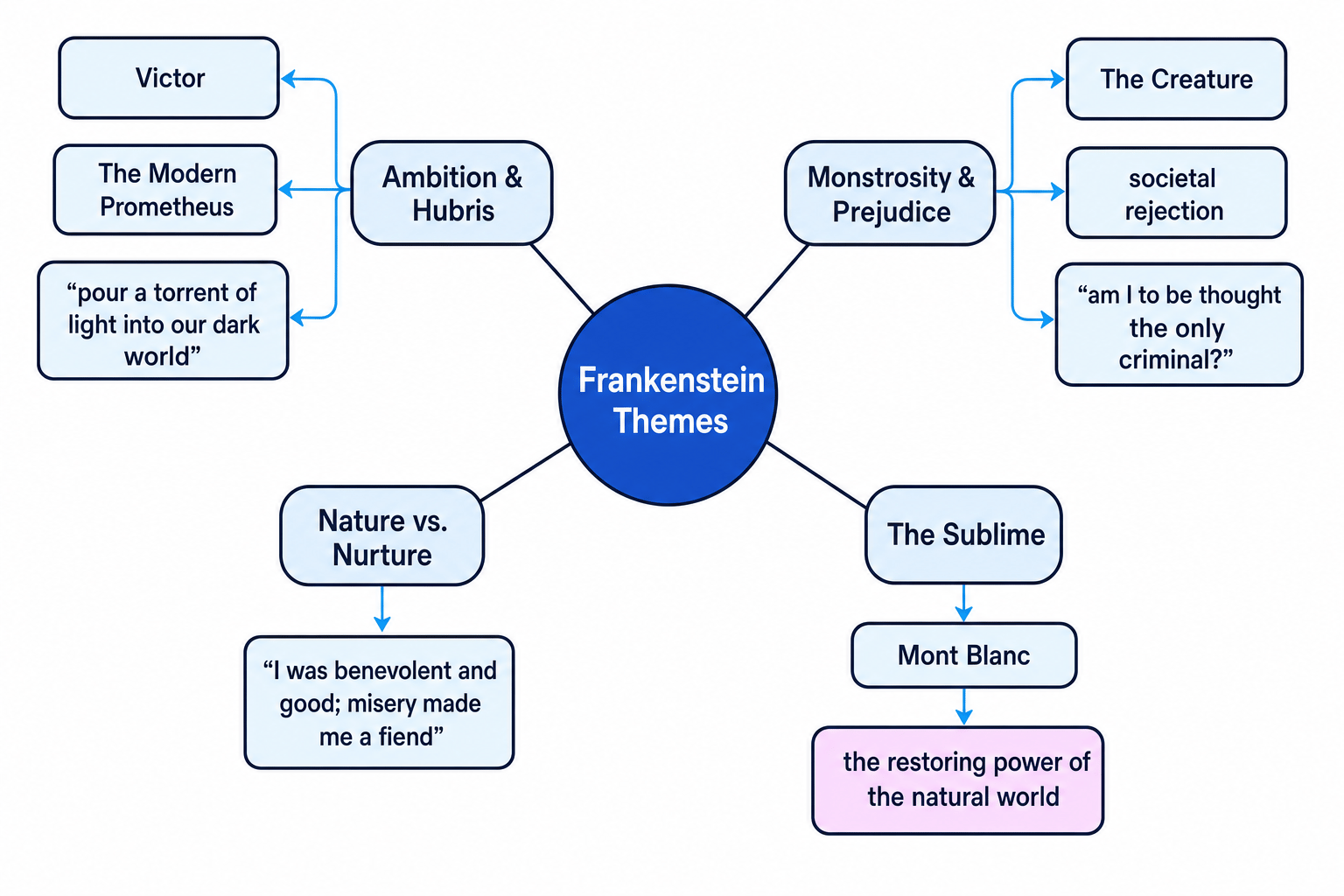
At its heart, Frankenstein is a cautionary tale about the dangers of unchecked scientific ambition. Shelley subtitle’s the novel The Modern Prometheus, which immediately alerts her readers to this theme.
Hubris
Hubris is a term from ancient Greek drama referring to dangerous overreaching pride and ambition that leads a human to attempt to bypass or challenge the laws of the gods or nature.
Victor Frankenstein’s ambition is not simply to be a successful scientist; he wants to conquer death itself. He describes his desire to "pour a torrent of light into our dark world" and hopes that "a new species would bless me as its creator."
Shelley uses Victor’s ambition to critique the scientific developments of the early 19th century (such as galvanism—the use of electricity to stimulate muscle movement). She warns that when science is driven by personal ego rather than moral responsibility, the consequences are disastrous. Victor plays God, but he refuses to take on the parental or divine responsibility that comes with creating life.
The Promethean Warning
Victor’s pursuit of knowledge mimics Prometheus, the Titan from Greek mythology who stole fire from the gods to give to humanity and was eternally punished. Victor's "fire" is the secret to life, and his punishment is the systematic destruction of everything he loves.
2. Monstrosity and Prejudice
A central question Shelley poses to the reader is: Who is the real monster?
To answer this, we must distinguish between physical monstrosity and moral monstrosity.
- The Creature is physically monstrous. He is made of mismatched body parts, stands eight feet tall, and has "watery eyes" and "shrivelled complexion." Because of this, everyone he meets reacts with immediate terror and violence.
- Victor Frankenstein is morally monstrous. He abandons his creation immediately after its birth simply because he finds it ugly: "breathless horror and disgust filled my heart." He repeatedly fails to show compassion or take responsibility.
Shelley uses this contrast to attack societal prejudice. The human characters in the novel judge solely by external appearances. The blind De Lacey is the only human who treats the Creature with kindness, showing that physical sight breeds prejudice, whereas metaphorical "vision" (insight and empathy) allows for true understanding.
3. Nature vs. Nurture
This theme explores whether our character is determined by our genetics/birth (nature) or by our upbringing and environment (nurture).
Shelley was heavily influenced by the philosopher Jean-Jacques Rousseau, who argued that humans are born naturally good ("noble savages") but are corrupted by the cruelties of society.
When the Creature is first "born," he is innocent, gentle, and deeply appreciative of the world around him. He seeks friendship and warmth. However, after experiencing constant abuse, physical attacks, and abandonment, he turns to violence.
As the Creature famously tells Victor in Chapter 10:
"I was benevolent and good; misery made me a fiend."
His decline into a "fiend" is a direct result of the lack of "nurture." Victor’s failure to act as a loving parent figures as the ultimate failure of nurture.
Confusing the Creature's nature
Do not write that the Creature was "born evil" or was "always a monster." Shelley goes to great lengths to show his initial capacity for love, empathy, and intellectual growth. His violence is a learned behavior, forced upon him by a hostile world.
4. The Sublime and the Power of Nature
As a Romantic writer, Mary Shelley believed in the immense power of the natural world. In Romantic literature, nature is not just a background setting; it is a living force that can heal, terrify, and humble humanity.
The Sublime
The Sublime is a Romantic concept referring to a feeling of awe, grandeur, and terror inspired by the vastness and power of nature (such as massive mountains, storms, or glaciers), which makes human troubles feel insignificant.
Throughout the novel, nature acts as a restorative force for Victor when he is exhausted by his work. However, when he oversteps natural boundaries, the weather reflects his moral decay. Shelley uses pathetic fallacy (where the weather mirrors human emotions) to signal danger:
- Victor creates the monster on a "dreary night of November" under a cold, flickering candle.
- The Creature and Victor have their dramatic confrontation amidst the freezing, dangerous glaciers of Chamonix (Mont Blanc).
The sublime landscapes remind both Victor and the reader that nature is ultimately supreme. No matter how much scientific knowledge Victor acquires, he cannot master or escape the natural order he violated.
Analyzing a Theme in the Text
To secure top marks in your GCSE (aiming for AO1, AO2, and AO3), you must be able to trace a theme through a specific quotation, breaking down the writer's methods and linking them to historical context.
Analyzing the theme of ambition in Chapter 4
Analyze how Shelley presents the theme of ambition in this quotation from Victor in Chapter 4:
"A new species would bless me as its creator and source; many happy and excellent natures would owe their being to me."
- Analyze the key vocabulary and imagery (AO1/AO2): Look at the nouns and verbs Victor uses to describe his goal. The noun "creator" and the verb "bless" carry heavy religious connotations. Victor is not thinking about helping humanity; he is fantasizing about being worshipped like a God. The adjective "new" highlights his desire to transcend human limits and do what has never been done before.
- Deconstruct the writer's methods and tone (AO2): Notice the hubristic and arrogant tone. The phrase "would owe their being to me" reveals his deep selfishness. He views his future creations not as independent beings with rights, but as items of debt that owe their existence directly to his ego. This foreshadows his complete inability to cope when the Creature actually demands its rights as an independent being.
- Link to context and Shelley's purpose (AO3): Relate Victor's mindset to the historical context. Shelley was writing during the Romantic era, which was highly skeptical of the Scientific Revolution's cold, calculating nature. By portraying Victor's ambition as an act of extreme egotism and religious usurpation, she warns her contemporary audience against the dangers of scientific discovery when divorced from morality, responsibility, and emotional empathy.
Integrating Context (AO3)
Never write a paragraph that is just a list of historical facts about Mary Shelley or the 19th century. Instead, weave context directly into your language analysis. Use phrasing like: "Through Victor's hubristic language, Shelley warns her 19th-century audience, who were witnessing rapid advancements in galvanism, that..."
In the exam
- Focus on the prompt: Whether the question is about a character (e.g., Victor or Walton) or an abstract concept (e.g., isolation), always frame your response around the themes that the character represents.
- Track the thematic shift: Themes in Frankenstein are dynamic, not static. Show the examiner how a theme develops. For example, explain how the theme of nature vs. nurture shifts from the Creature's initial innocence in the woods of Ingolstadt to his vengeful corruption after his rejection by the De Lacey family.
- Analyze structural links: Look for parallels. Note how Walton’s ambition in the icy Arctic circle mirrors Victor’s ambition in Geneva. This structural framing (the "epistolary" frame narrative) warns us that Walton is on the same self-destructive path unless he learns from Victor's story.
Check yourself
- Why did Mary Shelley choose "The Modern Prometheus" as the subtitle for her novel, and how does it relate to the theme of ambition?
- What is the difference between physical and moral monstrosity in the novel, and which characters represent each?
- How does the Creature's reaction to the De Lacey family support Jean-Jacques Rousseau's theory of "nature versus nurture"?
