

Stephen Kelman's Pigeon English is a vibrant, tragic, and deeply moving novel that explores the experiences of eleven-year-old Harrison "Harri" Opoku. Having recently emigrated from Ghana to a high-rise London housing estate, Harri views his new, often hostile world with a mixture of innocence, curiosity, and wonder.
In your GCSE English Literature exam, you must show a secure understanding of the text's narrative arc. You will need to explain how individual scenes relate to the whole novel and how Stephen Kelman uses structure to highlight his key themes of youth, violence, and belonging.
What you'll learn
- The chronological sequence of the main narrative and its five structural phases.
- How Kelman uses subplots to build a vivid picture of the estate's community.
- The significance of the "first-person naive narrator" to the novel's tragic impact.
- How to write analytically about structural turning points in the exam.
Understanding the Narrative Structure
Before diving into the chronological events, it is essential to understand how the story is told. Kelman structure's the novel through the eyes of an innocent child navigating an adult world of urban poverty and gang violence.
First-Person Naive Narrator
A narrative style where the story is told from the perspective of a character—frequently a child—who lacks the maturity or experience to fully comprehend the implications of the events they are describing. This technique creates dramatic irony, as the reader understands the danger surrounding the protagonist long before the protagonist does.
Harri's narrative voice is characterized by a blend of Ghanaian slang (such as "bo-sh" meaning excellent, or "aswear") and London street slang. This linguistic blend mirrors his divided identity as he tries to navigate his new life in England.
The Five-Stage Narrative Arc
The plot of Pigeon English follows a classic dramatic structure, but with a sudden, tragic subversion at its climax.
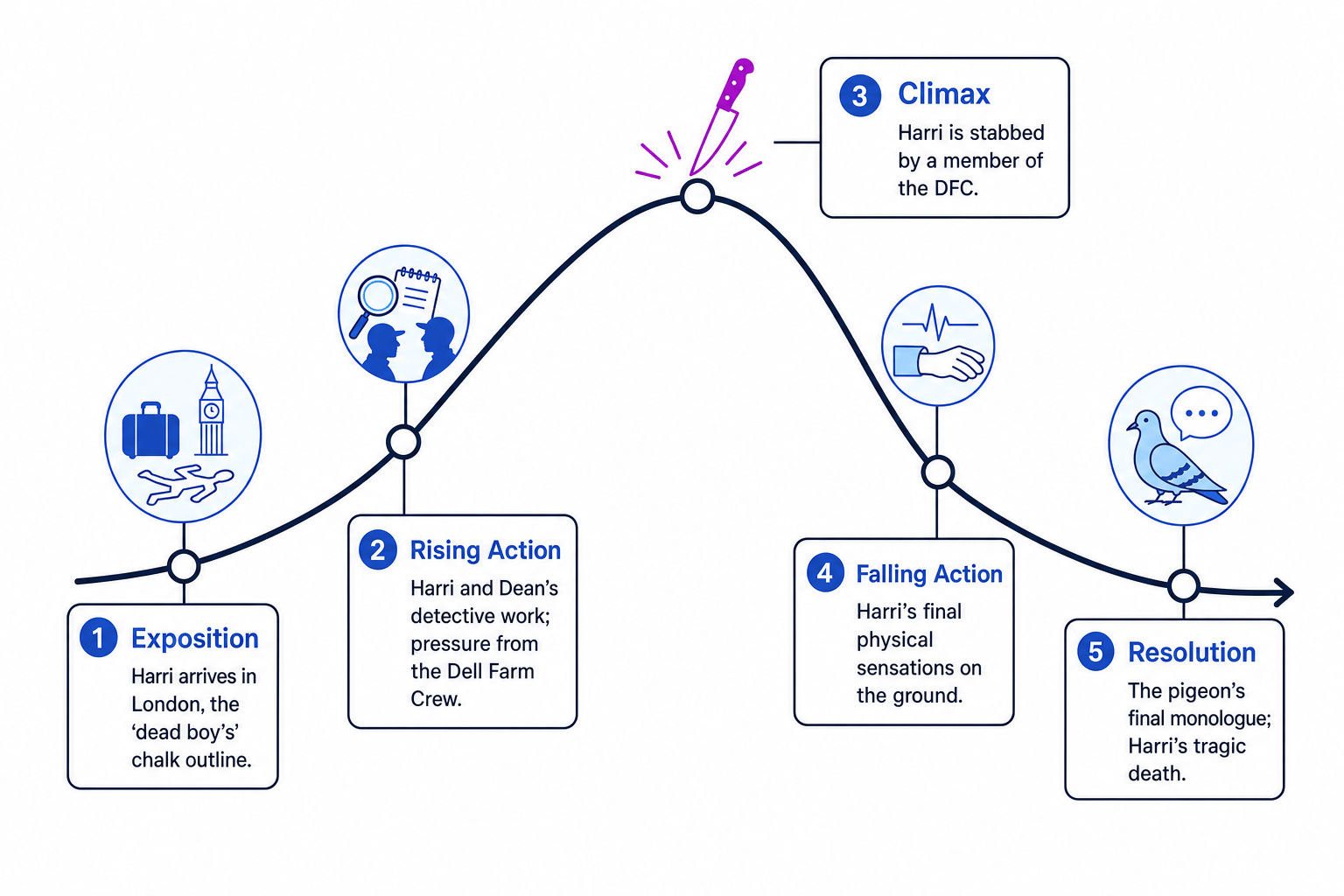
1. Exposition: Arrival and the "Dead Boy"
The novel opens immediately after a local teenager has been murdered outside a chicken shop. The physical mark of this tragedy—the "dead boy's" blood on the pavement—becomes a central landmark in Harri's world: "You could see the blood, it was like a big puddle of red ink."
Through Harri’s initial observations, we learn his family circumstances: he lives in a small flat on an inner-city estate with his mother (Mamma), his older sister (Lydia), and baby sister (Agnes). His father and grandmother remain behind in Ghana. The atmosphere of the estate is established as one of neglect and latent threat, but Harri remains focused on simple pleasures: racing his friends, observing local wildlife, and eating sweets.
2. Rising Action: Playing Detective and Peer Pressure
Harri and his best friend, Dean, decide to investigate the murder. Inspired by television detectives, they gather "evidence"—such as a discarded cigarette butt—and attempt to collect fingerprints. They suspect members of the Dell Farm Crew (DFC), the dominant gang on the estate.
As the investigation progresses, the realities of gang life begin to encroach on Harri's childhood. He is caught between his family's high aspirations and the pressure to conform to the estate's harsh social hierarchy. He witnesses the DFC's intimidation of others and is forced to participate in minor acts of delinquency. The tension steadily builds as the gang members, particularly X-Fire and Killa, realize that Harri and Dean are paying too much attention to their activities.
Structural Contrast
Kelman structures the rising action by constantly juxtaposing innocent childhood play (like Harri measuring how fast he can run) with the ominous threat of violence. This stark contrast heightens the reader's anxiety, as we recognize the danger Harri is in while he remains largely oblivious.
3. Climax: The Confrontation
The climax is the turning point where the latent danger erupts into direct violence. After various warnings, including the killing of a local girl's pet dog and threats directed at Harri’s sister, the DFC corners Harri.
The investigation is no longer a game. Harri's naive confidence is shattered when he is directly targeted by the gang. The climax occurs when Harri is stabbed in a brief, chaotic, and senseless confrontation. His shocking death is a direct result of his proximity to the truth of the initial murder, and his inability to navigate the complex, unwritten rules of estate survival.
4. Falling Action: The Physical Reality
The falling action is incredibly brief and focuses heavily on Harri’s sensory experiences as he lies dying on the pavement. The frantic, vibrant voice that has carried us through the novel begins to slow down. He notices the sky, the coldness of the concrete, and the sound of sirens in the distance.
Confusing the Climax and the Ending
Students often write that the novel ends with Harri's stabbing. Technically, the stabbing is the structural climax. The moments after the stabbing represent the falling action, and the novel's final lines form the resolution. Ensure you distinguish between these phases when writing about structure.
5. Resolution: The Pigeon's Perspective
The resolution is delivered from the perspective of the titular pigeon. Throughout the novel, the pigeon has acted as a recurring symbol—a watchful, quasi-spiritual presence that represents nature, hope, and an objective observer of human tragedy. The pigeon's final monologue offers a philosophical comfort to Harri as his spirit leaves his body, highlighting the tragedy of a young life cut short.
Key Plot Strands and Subplots
While the main plot centers on Harri's investigation of the "dead boy's" murder, Kelman weaves in several critical subplots that expand the novel's thematic depth.
Lydia and the Chaffinch Crew
Harri’s older sister, Lydia, is desperate to fit in. She associates with older, dangerous teenagers and eventually joins the Chaffinch Crew (a rival gang). This subplot highlights the gendered dangers of estate life, showing how vulnerable teenage girls are to sexual exploitation and psychological coercion in gang environments.
Auntie Sonia and Julius
Auntie Sonia (Mamma's sister) is in a relationship with Julius, a abusive and controlling man who represents the domestic violence hidden behind closed doors on the estate. Julius also acts as an illegal immigration "broker," demonstrating the financial exploitation of vulnerable migrants who lack legal status in the UK.
Mamma's Struggle
Mamma works long, grueling hours as a midwife while trying to keep her children safe. Her plotline represents the immigrant work ethic and the immense pressure placed on parents who are trying to shield their children from hostile environments without any social safety net.
Integrating Context (AO3)
When discussing the plot, link the struggles of Harri’s family to the wider social context of early 2010s Britain. The novel reflects real-world concerns about urban deprivation, the rise of knife crime, and the difficulties faced by newly arrived immigrant communities in underfunded urban areas.
Analysing a Structural Turning Point
In your exam, you will need to demonstrate how Kelman uses structure to convey meaning (AO2). Let's work through how to analyze a specific turning point in the plot.
Analyzing the transition from play to danger
Question: Explore how Kelman structures the transition from childhood play to real-world danger in the rising action of the novel.
-
Step 1: Select a structural juxtaposition. Choose a point in the text where Harri's playful innocence is directly interrupted by gang violence. A great choice is Chapter 13, where Harri and Dean are collecting evidence (playing detective) and are suddenly confronted by Killa and X-Fire.
-
Step 2: Identify the writer's methods. Identify how Kelman uses structural pace and language to mark this transition. Note the change from short, exciting, conversational sentences to heavy, threatening dialogue and physical intimidation.
-
Step 3: Analyze the effect on the reader. Explain how the sudden intrusion of the gang disrupts the comic tone of the boys' game. The reader experiences a sudden shift from amusement to fear. Use quotes to support this: Harri notes that Killa’s eyes are "yellow like a hawk" and his presence immediately makes the environment feel "cold."
-
Step 4: Link to the broader thematic message. Conclude by explaining what this structural shift tells us about the wider themes of the novel. Kelman structurally demonstrates that on the estate, childhood is an incredibly fragile state that cannot be protected from the encroaching reality of gang culture.
In the exam
- Avoid simply retelling the story. The examiner already knows the plot. Your job is to analyze why the plot is structured this way and how it affects the reader.
- Track the narrative voice. Comment on how Harri's naive narration changes over the course of the novel—moving from boundless energy and excitement to moments of fear, and finally to the quiet stillness of his death.
- Use structural terms accurately. Refer to the exposition, rising action, climax, and resolution to show you are treating the novel as a deliberate literary construct, not a real-life diary.
- Anchor your analysis to key quotes. Memorize short, versatile quotes from different parts of the narrative arc so you can trace themes from the beginning, middle, and end of the book.
Check yourself
- Why does Stephen Kelman choose to start the novel after the murder has already occurred, rather than showing the murder itself?
- What are two ways in which the subplot of Lydia and the Chaffinch Crew mirrors or contrasts with Harri's main storyline?
- How does the recurring presence of the pigeon contribute to the structure of the novel?
