What you'll learn
- How Mary Shelley uses a unique "Russian doll" narrative structure to shape our sympathies for the characters.
- The major literary genres that intersect in the novel: Gothic fiction, Romanticism, and early Science Fiction.
- How to decode the main requirements of the AQA GCSE English Literature exam for this 19th-century text.
Understanding the Structural Layout of Frankenstein
When you first open Frankenstein, you might expect a straightforward, chronological horror story. Instead, Mary Shelley constructs a complex, multi-layered narrative. To master your analysis of this novel, you must first understand how its stories are nested inside one another.
The Epistolary Frame Narrative
Shelley uses an epistolary form (a story told through letters) to frame the entire novel.
Epistolary Novel
An epistolary novel is a novel written as a series of documents, such as letters, diary entries, or newspaper clippings.
The novel's outer frame consists of letters written by the explorer Robert Walton to his sister, Margaret Saville, in England. While trapped in the Arctic ice, Walton rescues Victor Frankenstein and records Victor's harrowing tale. Inside Victor's narrative is another layer: the Creature's own account of his survival and suffering.
This technique is called a frame narrative.
Frame Narrative
A frame narrative is a literary technique where an introductory story (the "frame") sets the stage for a second narrative, or a series of shorter stories, contained within it.
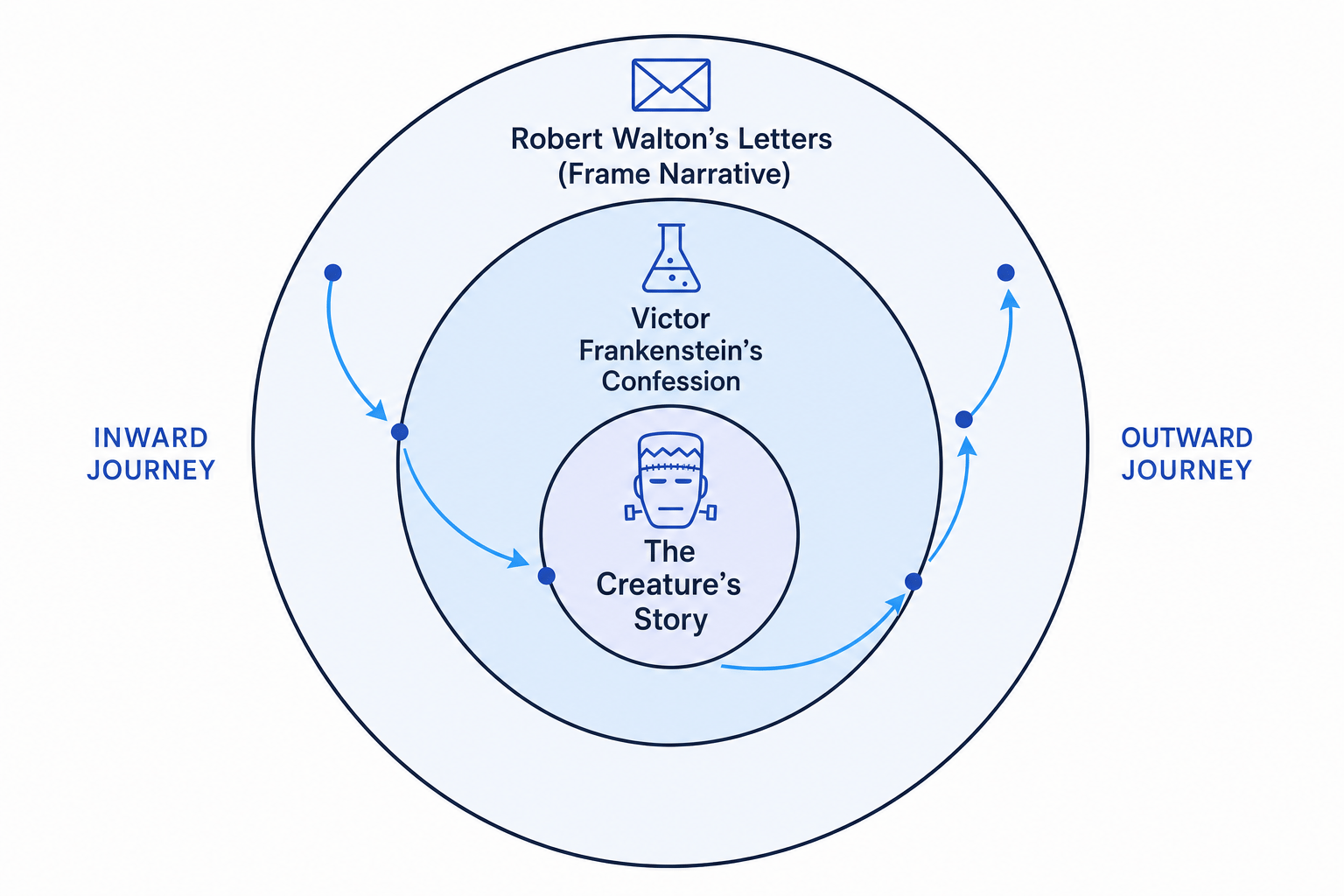
This structure is often compared to Russian nesting dolls (matryoshka dolls). The narrative travels inward to the Creature at the center, then shifts back outward to Victor, and finally returns to Walton's letters at the very end of the novel.
Why This Structure Matters (The Unreliable Narrator)
Shelley does not use this structure just to be clever; it serves a crucial thematic purpose. Because every story is told through someone else's perspective, we must consider the reliability of our narrators.
The Layering of Truth
By nesting the Creature's voice at the very center of the novel, Shelley forces us to question who the real "monster" is. However, because the Creature's story is filtered through Victor, and Victor's story is filtered through Walton's letters, the reader is constantly reminded of the subjective, biased nature of human storytelling.
- Robert Walton is an ambitious explorer who idolizes Victor. His letters frame our initial perception of Victor as a noble, tragic genius.
- Victor Frankenstein is consumed by guilt and anger. He describes his creation as a "miserable monster" and a "fiend."
- The Creature speaks with surprising eloquence, revealing his pain, isolation, and desire for love.
Because we hear the stories in this specific order, our sympathies are constantly challenged and reshaped.
The Intersection of Literary Genres
To write high-scoring essays (addressing both language analysis and historical context), you need to understand the three distinct literary movements that converge in Frankenstein.
1. Gothic Fiction
The Gothic genre was incredibly popular in the late 18th and early 19th centuries. Key conventions include:
- Atmospheric settings: Ruined castles, desolate landscapes (like the Swiss Alps or the frozen Arctic), and dark, stormy nights.
- The Supernatural: Elements that defy natural laws, or a sense of dread and terror.
- High emotion: Characters experiencing extreme psychological distress, madness, or passion.
In Frankenstein, Shelley adapts these conventions. The "dreary night of November" when the Creature is brought to life is a classic Gothic opening, filled with tension and pathetic fallacy (where the weather mirrors the mood).
2. Romanticism
Not to be confused with modern romance or love stories, Romanticism was an artistic and philosophical movement that reacted against the scientific rationalism of the Enlightenment. Romantic writers valued:
- The power of nature: Nature as a spiritual force that cannot be tamed by humanity.
- The Sublime: A feeling of awe mixed with terror when witnessing the vastness and power of the natural world (such as glaciers or thunderstorms).
- Emotion over reason: Championing the individual's inner emotional world and imagination over cold scientific calculations.
Victor violates Romantic values by trying to master nature through science, rather than appreciating its sublime beauty.
3. Early Science Fiction
Frankenstein is widely considered one of the very first science fiction novels. Unlike traditional Gothic tales that rely on magic or demons, Victor's creation is rooted in (speculative) scientific methods of the era, such as galvanism (using electricity to stimulate muscle movement) and chemistry. Shelley warns of the dangers of unchecked scientific exploration.
Formulating an Essay Argument: Structural Analysis
In the GCSE exam, you will be asked to write an essay on a character or a theme in Frankenstein. To achieve top marks, you must link language, structure, and context together.
Here is a step-by-step example of how to build an analytical paragraph that links the novel's structure to its main themes.
Linking structure to theme in an analytical paragraph
- Identify the structural feature and its immediate effect: Choose a key moment where the shifting narrative voices overlap, such as the transition from Walton's letters to Victor's story. Notice how Walton's ambition mimics Victor's, creating a parallel structure.
- Select precise evidence to support the link: Use a memorable quote from Walton that demonstrates this shared ambition. In Letter II, Walton writes that he would gladly sacrifice "most precious" human lives to achieve his goal: "one man's life or death were but a small price to pay for the acquirement of the knowledge which I sought."
- Identify the writer's method and link to context: Point out how Shelley uses character foils (characters who contrast or parallel each other to highlight specific qualities) to warn against the dangers of the scientific revolution. Walton's hubris (excessive pride) mirrors Victor's fatal flaw before Victor even begins speaking.
- Explain the overall effect on the reader: Conclude by explaining how this structural parallel acts as a moral warning. By framing Victor’s tragedy with Walton’s letters, Shelley emphasizes that Victor's obsessive pursuit of knowledge is not an isolated incident, but a systemic danger of human ambition.
Remember the real title!
The full title of the novel is Frankenstein; or, The Modern Prometheus. Prometheus is a figure from Greek mythology who stole fire from the gods to give to humanity, and was eternally punished for it. Victor is the "Modern Prometheus" because he steals the secret of life from nature, resulting in his own destruction. Referring to this subtitle in your exam is an excellent way to show a deep understanding of Shelley's intentions.
Confusing Frankenstein with the Creature
It is the single most common mistake in English literature essays: calling the Creature "Frankenstein." Frankenstein is the creator (Victor); his creation has no name and is referred to in the text as "the Creature," "the monster," "the fiend," or "the demon." Getting this wrong instantly damages your essay's credibility. Use his lack of a name to write analytically: he has no name because Victor abandoned his parental duty from the moment of creation.
In the exam
- Look at the whole novel: Even though the exam paper provides a short extract, you must discuss the novel as a whole. Use the extract as a springboard to talk about wider themes and structural patterns across the text.
- Focus on Shelley's intent (AO3): Remember that the characters are constructs used to convey ideas. Don't write about Victor or the Creature as if they are real people; instead, write about how and why Mary Shelley constructed them this way to warn her 19th-century audience.
- Embed short quotations: Avoid long, block quotes. Instead, weave single words or short phrases naturally into your own sentences (e.g., Victor's ambition to "pour a torrent of light into our dark world"). This keeps your writing sharp and analytical.
Check yourself
- Can you list the three distinct narrative voices that make up the "Russian doll" epistolary structure of the novel, starting from the outermost frame?
- What is the difference between Gothic conventions and Romantic ideals, and how does Victor Frankenstein span both?
- Why did Mary Shelley subtitle her novel The Modern Prometheus, and how does this myth relate to Victor's actions?
