

Welcome to your study guide for Stephen Kelman’s 2011 novel Pigeon English. This guide is designed to help you master the key concepts, character dynamics, and thematic structures needed to write a top-tier essay for your AQA GCSE English Literature Paper 2 exam.
What you'll learn
- The central plot and real-world context that inspired the novel.
- How Stephen Kelman uses a unique, childlike narrative voice to explore serious themes.
- How to analyse the collision between childhood innocence and harsh urban reality.
Introducing the Novel: Setting and Inspiration
Pigeon English is set on the fictional Dell Farm Estate, a gritty, run-down inner-city housing estate in London. The story is narrated by Harrison "Harri" Opoku, an eleven-year-old boy who has recently immigrated to England from Ghana with his mother and older sister, Lydia.
The novel is deeply rooted in contemporary British social history. Kelman was inspired to write the book following the tragic, real-life murder of Damilola Taylor in 2000. Damilola was a ten-year-old Nigerian boy who was killed on a London housing estate. By using this real-world event as a springboard, Kelman crafts a story that is both a gripping mystery and a devastating social commentary.
The Dell Farm Estate
The setting of the novel acts as a character in its own right. The concrete tower blocks, high crime rates, and gang presence of the Dell Farm Estate represent the systemic neglect of working-class immigrant communities in 21st-century Britain.
The Core Concept: The Dual Narrative Perspective
The most important literary technique you must understand in Pigeon English is the narrative perspective. Kelman writes the novel in the first-person, entirely from Harri's point of view. This creates a powerful contrast between what Harri sees and what the reader understands.
Naive Narrator
A naive narrator is a first-person narrator who lacks the experience, maturity, or cognitive ability to fully understand the events they are describing. Because of their youth or innocence, the reader can see the danger or tragedy in a situation before the character does.
Harri's narrative voice is characterised by a blend of three linguistic influences:
- Ghanaian English and Patois: Words from his homeland, such as "chale" (friend) and "obruni" (white person).
- London Street Slang: Vocabulary picked up from older kids on the estate, like "safe", "marv", and "vexed".
- Childlike Neologisms: Creative words Harri invents himself to make sense of his world, such as "the suspect" or describing things as "proper" or "mental".
This linguistic blend creates a warm, vibrant, and energetic tone. However, it also creates dramatic irony—where we, the audience, recognize the immediate threat of gang violence and poverty while Harri views his environment with wonder and curiosity.
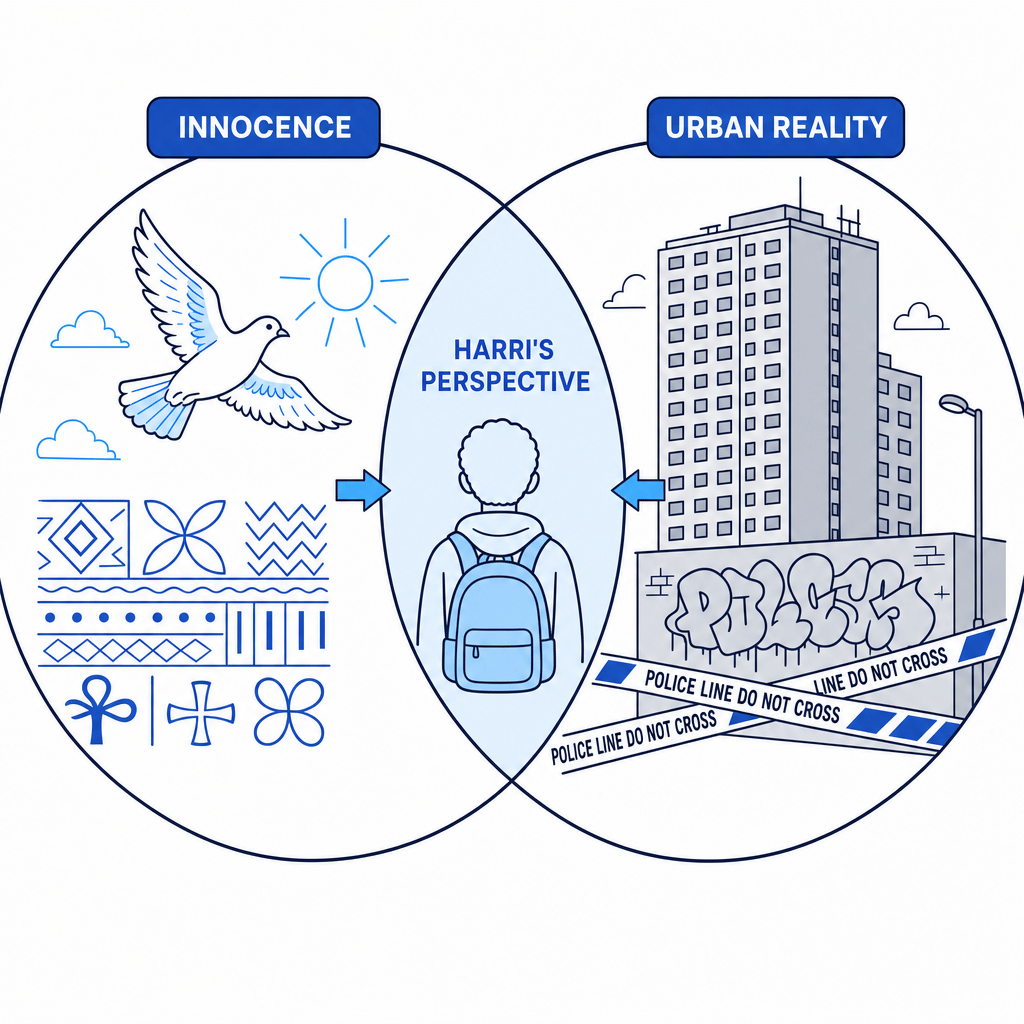
Identifying the Tone
Many students write that Pigeon English is a purely "sad" or "depressing" book because it deals with murder and gang violence. Do not miss the joy! Harri’s voice is full of humour, excitement, and love. The tragedy of the novel only works because his childhood innocence is so bright and endearing.
Worked Example: Analysing Harri's Voice
In your GCSE exam, you will need to explain how Kelman uses language to show the clash between Harri's innocence and his dangerous surroundings (AO2). Let's work through how to analyse a short passage from the very beginning of the novel, where Harri looks at the physical evidence of the young boy's murder.
"You could see the blood. It was a proper stain... It looked like a map of somewhere."
Analysing the collision of innocence and violence
Analyze how Kelman uses imagery in this quote to convey Harri's naive perspective.
- Identify the contrasting elements: Identify the physical reality (the "blood" of a murder victim) and Harri's imaginative, childlike interpretation of it ("a map of somewhere").
- Analyse the linguistic method: Examine the noun "map". A map is a tool of discovery, adventure, and childhood games. By comparing a brutal bloodstain to a "map" using a simile, Kelman demonstrates how Harri filters horrific adult violence through a lens of childhood play and curiosity.
- Evaluate the effect on the reader: Connect this language choice to the reader's emotional response. The contrast makes the reader feel a deep sense of pathos (pity), as we realize Harri is too innocent to comprehend the tragic finality of the boy's death.
- Link to context and theme (AO3): Explain how this reflects the normalization of violence on the estate. To Harri, blood on the pavement is not a terrifying anomaly; it is simply another feature of his daily playground.
Structure and Symbolism: The Pigeon
Structurally, the novel is episodic. It does not follow a traditional, neat detective plot, even though Harri and his friend Dean are trying to solve the murder. Instead, we see daily snapshots of school life, family relationships, and gang initiations.
Woven into this structure is the magical realist element of the Pigeon. Occasionally, a literal pigeon speaks directly to the reader in italicised passages.
What does the Pigeon represent?
The pigeon is a multi-layered symbol in the novel:
- A Guardian Angel: It watches over Harri, representing a spiritual connection to his grandmother in Ghana.
- An Objective Observer: As a bird, it can fly above the concrete walls of the estate, viewing human suffering with a detachment and wisdom that the human characters lack.
- Nature in the Concrete Jungle: It represents the persistent presence of natural beauty and freedom in an environment dominated by gray concrete and social confinement.
Quoting the Pigeon
If you want to achieve a Grade 8 or 9, try to quote the Pigeon's italicised voice in your essays. For example, when the Pigeon says, "I wanted to tell him... how beautiful he was," it highlights the tragedy of a child whose life is cut short by a society that fails to protect him.
In the exam
- Focus on the prompt: Whether the question is about Harri, Lydia, the Dell Farm Crew, or a theme like violence, always keep the clash between innocence and experience at the heart of your thesis.
- Embed short, multi-word quotes: Because the exam is closed-book, memorize short, versatile phrases. Words like "proper" or "chale" are easy to integrate into your analysis of Harri's voice.
- Connect to AO3 (Context) naturally: Do not just "dump" historical facts about Damilola Taylor. Instead, argue that Kelman uses Harri’s story to critique the societal structures that allow young, working-class black boys to fall victim to gang culture in modern Britain.
Check yourself
- Why does Stephen Kelman use a first-person naive narrator instead of an omniscient third-person narrator?
- What is the significance of the novel's title, Pigeon English? Consider both the language (Pidgin) and the bird.
- How does the setting of the Dell Farm Estate influence the choices available to characters like Lydia and Jordan?
