Mastering the essay-writing process for Charlotte Brontë’s Jane Eyre is about more than just memorizing plot points or listing literary devices. To achieve top marks in your GCSE English Literature exam, you must construct a cohesive, persuasive argument that treats the novel as a deliberate piece of art.
This guide will show you how to structure high-scoring essays that seamlessly weave together your personal response, precise language analysis, and Victorian social context.
What you'll learn
- How to decode an exam prompt and build a cohesive, thesis-driven argument
- The "Analytical Loop" method for structuring paragraphs that meet all GCSE Assessment Objectives
- How to embed and analyze precise, memorable "micro-quotations"
- The art of linking Victorian social realities directly to Brontë's structural and linguistic choices
Understanding the Pillars of a Grade 9 Essay
To write a model essay, you must first understand what the examiners are looking for. Your essay is graded against three main Assessment Objectives (AOs). Instead of treating these as separate checklists, a top-tier essay blends them fluidly in every single paragraph.
The Three Assessment Objectives (Paper 1)
- AO1 (Critical Response & Textual References): Presenting a clear, focused argument (thesis) that directly answers the question, supported by well-chosen, integrated quotations.
- AO2 (Analysis of Language, Form, and Structure): Examining how Brontë uses language, structural shifts, or novel forms to convey her ideas, using precise terminology.
- AO3 (Contextual Relationships): Explaining how the novel reflects, challenges, or comments on the social, historical, and cultural contexts of Victorian Britain.
Many students struggle because they treat context (AO3) or language analysis (AO2) as historical or grammatical "add-ons" that do not connect to their main point. The secret to a model essay is synthesis: using Brontë's methods and historical context as the direct evidence to prove your central argument.
Paragraph Architecture: The Analytical Loop
A model essay does not just move chronologically through the novel. Instead, it is organized around conceptual ideas. Each paragraph should act as a mini-argument that supports your main thesis statement.
To achieve this, we use the Analytical Loop. Rather than a rigid linear structure (like the traditional PEEL), the loop encourages you to weave back and forth between your thesis, the writer's methods, and the historical context.
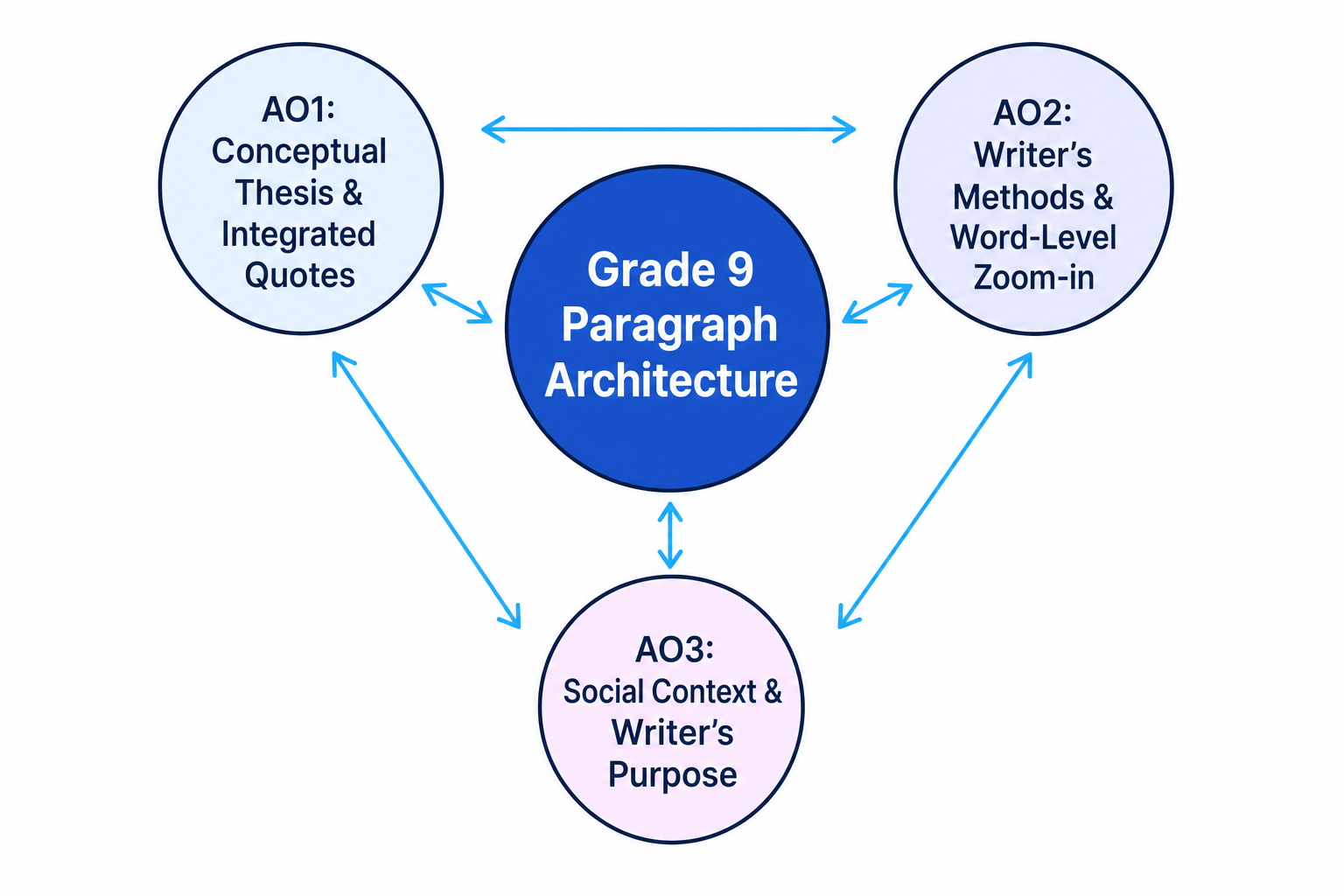
1. The Conceptual Topic Sentence (AO1)
Your paragraph must start with a claim about meaning, not plot. Avoid starting with: "In Chapter 2, Jane is locked in the red-room." Instead, start with an analytical assertion: "Brontë uses the physical confinement of the red-room to symbolize the systematic oppression and emotional isolation Jane experiences as a dependent, classless female in Victorian society."
2. Integrated Micro-Quotations (AO1)
Do not drop long, clunky block quotes into your writing. Instead, use "micro-quotes" (one to three words) and embed them directly into your own sentences. This keeps your writing fluid and academic.
Embedding Micro-Quotes
Instead of writing: Jane shows she is angry when she says, "I resisted all the way."
Write: Jane's refusal to submit to her unjust punishment is clear when she recalls how she "resisted all the way" during her banishment to the red-room.
3. Method-Led Analysis (AO2)
Identify the specific literary or structural method Brontë uses, zoom in on a powerful word, and analyze its connotations. Why did Brontë choose that specific word? What feelings or ideas does it evoke in the reader?
4. Contextual Link (AO3)
Explain why Brontë wanted to convey this idea to her Victorian audience. How does it connect to Victorian views on class, religion, gender roles, or the treatment of orphans?
Put It Into Practice: A Worked Example
Let's walk through how to construct a high-scoring analytical paragraph step by step.
We will use the following typical GCSE prompt:
Explore how Brontë presents Jane’s rebellion against authority in the early stages of the novel.
Analyzing Jane's resistance in the Red-Room
-
Draft a conceptual topic sentence (AO1): Begin by establishing a clear claim that links Jane's rebellion to a broader thematic meaning, rather than just describing the plot event.
Draft: Brontë utilizes the Gothic setting of the red-room to dramatize Jane’s early psychological rebellion against patriarchal tyranny and social marginalization.
-
Embed a precise micro-quotation seamlessly (AO1): Introduce your evidence naturally within a sentence that furthers your argument, avoiding phrases like "this is shown when".
Draft: Relegated to the margins of the Reed family, Jane describes herself as a "discord" and a "heterogeneous thing," highlighting how her passion defies the cold expectations of her aunt.
-
Analyze language and identify the writer's methods (AO2): Select a specific word or technique to analyze. Zoom in on its connotations and explain its dramatic impact.
Draft: The noun "discord" functions as an auditory metaphor, suggesting that Jane’s presence disrupts the superficial, hypocritical harmony of Gateshead Hall. Furthermore, the dehumanizing, abstract noun "thing" reinforces her complete emotional alienation, presenting her rebellion not as mere childhood defiance, but as an existential struggle to assert her humanity.
-
Integrate social context to explain the writer's purpose (AO3 & AO1 Link): Connect the linguistic analysis to Victorian realities. Explain what Brontë is criticizing or exposing about her society.
Draft: Through this intense struggle, Brontë criticizes the rigid Victorian class hierarchy that demanded absolute docility from dependent, orphaned children. By portraying Jane’s rebellion as a natural, righteous response to psychological cruelty, Brontë challenges her contemporary readers to question the moral authority of those who exploit class and gender vulnerabilities.
Spotting the Pitfalls
Even students who know the novel inside out can lose marks by falling into common exam traps.
The 'Feature-Spotting' Trap
Feature-spotting is identifying a literary device (e.g., "Brontë uses a metaphor here") without explaining its effect or how it supports your main argument. Identifying a method gets you very few marks; analyzing why the writer chose that method is what earns a Grade 9. Always ask yourself: How does this specific device help Brontë convey her main message about class, gender, or morality?
The Context Dump
Never write a paragraph of pure history. Writing a detailed biography of Charlotte Brontë or a long essay on the history of Victorian governesses without linking it directly to the text will limit your mark. Context must only be used to explain the themes and purposes of the novel's structural and linguistic choices.
The Golden Rule of Exam Prep
In a closed-book exam, your best friends are flexible, short, three-to-four-word quotations. Memorable phrases like "cold, solitary micro-cosm", "half-frozen nook", or "relic of ancient days" can be applied to essays on isolation, class, setting, or Jane's internal growth.
In the exam
- Spend 5 minutes planning: Do not start writing immediately. Read the extract, identify the core theme of the prompt, choose 3-4 key conceptual points, and scribble down your thesis statement first.
- Structure chronologically or conceptually: A strong essay structure often tracks Jane's development across her physical journey: Gateshead/Lowood (confinement/injustice), Thornfield (passion/temptation), Moor House (independence/spirituality), and Ferndean (resolution/equality).
- Use the extract as a springboard: The exam question asks you to look at the printed extract and the rest of the novel. Start by analyzing 1-2 rich methods in the extract, then leap out to other parts of the novel that mirror, contrast, or develop those exact same ideas.
- Refer to 'the reader' or 'the Victorian audience': This keeps your focus firmly on AO2 and AO3, reminding the examiner that you are analyzing a deliberate piece of literature designed to provoke a reaction.
Check yourself
- Can you draft a thesis statement that explains how the physical settings of Jane Eyre reflect Jane's internal psychological state?
- Do you have 3 distinct "micro-quotes" memorized for the characters of Helen Burns, Rochester, and St. John Rivers?
- How does the concept of the "Victorian Angel in the House" contrast with Jane's behavior, and how would you link this to AO3 in an essay on gender roles?
