

When writing about Stephen Kelman’s Pigeon English for your GCSE English Literature exam, you are not just retelling Harri Opoku's story. You are analyzing how Kelman uses form, language, and structure to critique modern society.
To score highly, your essays must be thesis-driven, analytically rigorous, and historically informed. These notes will guide you step-by-step through constructing a top-tier essay response.
What you'll learn
- How to transform a simple plot point into a sophisticated, thesis-driven argument.
- The "Paragraph Chain" method for integrating language analysis and context seamlessly.
- Strategies for analyzing Kelman's unique narrative choices, such as his use of colloquial dialect and symbolic imagery.
The Elements of a High-Scoring Essay
To succeed in the modern prose section, your essay must address three core pillars of literary analysis: argumentation, analysis, and context.
1. Conceptualized Response (AO1)
An outstanding essay begins with a clear, thesis-led argument. A thesis is not just an observation; it is an interpretation of the text's deeper moral or social message.
Conceptualized Response
A conceptualized response treats the novel as a conscious construct. Instead of writing about Harri as a real person, you discuss him as a tool used by Kelman to expose the vulnerabilities of youth in inner-city estates.
2. Method-Led Analysis (AO2)
Instead of "device spotting" (simply naming a metaphor or simile), high-scoring essays analyze the effect of these choices. You need to examine how Kelman's language and structural decisions shape the reader's emotional journey.
Avoid the 'Shopping List' Approach
Never list literary terms without explaining their impact. Saying "Kelman uses a metaphor to show violence" gets very few marks. Instead, explain how the specific imagery of the metaphor conveys a sense of inescapable danger or loss of innocence.
3. Contextual Integration (AO3)
In Pigeon English, context is not a history lesson tacked onto the end of a paragraph. It must be woven into your analysis of the characters' lives.
Kelman wrote the novel in the wake of the tragic, real-life murder of 10-year-old Damilola Taylor in London in 2000. The novel explores themes of urban deprivation, immigration, gang culture, and the systematic failure of institutions to protect vulnerable children.
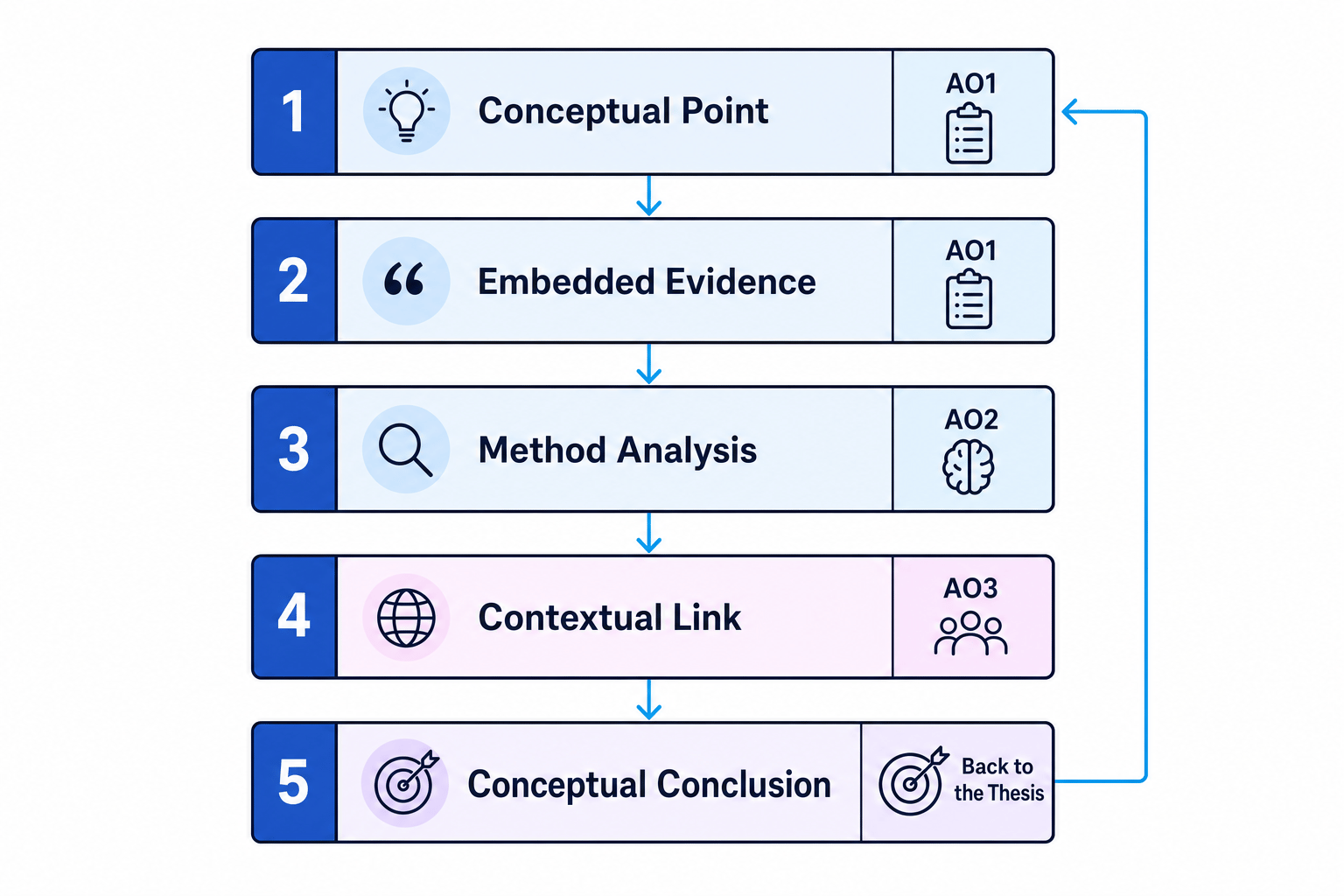
Visualizing the Essay Paragraph Structure
Before drafting your essay, it is vital to understand how these assessment objectives flow together in a paragraph. Rather than treating them as separate boxes to tick, look at them as a continuous, reinforcing chain.
Step-by-Step Writing Guide
To see this in action, let's look at how to build a high-scoring paragraph from scratch. We will respond to the following prompt:
How does Kelman present the destructive influence of gang culture in Pigeon English?
Constructing a theme-focused analytical paragraph
- Formulate a conceptual point (AO1): Write a thesis-driven opening sentence that focuses on Kelman's overarching message about gangs.
- Drafting: Kelman presents gang culture not merely as an external threat, but as a corrosive force that dehumanizes the youth of the estate, stripping them of their innocence and reducing individual lives to mere territorial tokens.
- Embed precise evidence (AO1): Introduce a short, highly focused quote from the text, weaving it directly into your own sentence structure.
- Drafting: This dehumanization is highlighted immediately after the opening tragedy, when Harri observes that the murdered boy is "not even a person anymore, he’s just a sign," referring to the bloodstain on the pavement.
- Analyze Kelman's linguistic and structural methods (AO2): Zoom in on key words or techniques. Identify the word class or literary device and explain its psychological or thematic effect.
- Drafting: The stark, monosyllabic noun "sign" illustrates how rapidly the violent environment strips a child of their humanity and identity. By reducing a human life to a physical marker of gang territory, Kelman highlights how the community has become desensitized to tragedy. The contrast between Harri's naive voice and this bleak realization underscores the tragic loss of childhood innocence.
- Integrate relevant social and literary context (AO3): Explain how this analysis reflects the real-world issues Kelman is addressing.
- Drafting: This mirrors the bleak reality of early 2000s London estates, where systemic deprivation and a lack of institutional support left young boys highly vulnerable to gang exploitation and cyclical violence. Kelman's depiction directly echoes the public shock surrounding the real-life murder of Damilola Taylor, urging readers to confront the societal neglect of marginalized children.
- Synthesize with a final conceptual link (AO1): Conclude your paragraph by linking the analysis back to your central thesis and the essay prompt.
- Drafting: Ultimately, Kelman demonstrates that the true destruction of gang culture lies in this rapid erasure of individuality, leaving children to view their peers as symbols of threat or territory rather than human beings.
The 'Grafted-On' Context Mistake
Many students write an excellent analysis of language and then suddenly drop in a sentence like: "This was written in 2011 after Damilola Taylor died." This is known as "grafting." To avoid this, always link your context directly to the writer's intention: "Kelman utilizes this stark imagery to shock a contemporary readership who, in the wake of real-life tragedies like the murder of Damilola Taylor, had become desensitized to urban youth violence."
Adapting to Different Themes
While gang culture is a major theme, you must be ready to adapt this exact paragraph structure to any aspect of the novel. Use the table below to see how to pair core themes with precise evidence and methods:
| Theme | Key Evidence | Key Method to Analyze | Contextual Link |
|---|---|---|---|
| Innocence vs. Experience | "I wanted to touch it but it was too fast." (Harri trying to catch a bird) | Symbolism: The bird represents fragile, fleeting innocence and freedom that Harri desperately tries to hold onto. | The challenges faced by young immigrants navigating hostile, unfamiliar environments. |
| Identity and Belonging | "You can tell who the Dell Farm Crew are because they all wear a blue furry clip on their hoods." | Visual Symbolism: The "blue furry clip" represents the superficial, almost childish symbols used to mask deep insecurity and fear. | The psychological need for safety and belonging in a society where traditional protective structures (like police or families) are perceived as failing. |
| Supernatural / Magic Realism | The Pigeon's first-person monologues: "I am the feather..." | Narrative Voice: Shift in perspective to an omniscient, poetic narrator. | The use of magic realism to offer a spiritual escape from the grim realities of the concrete estate, representing hope and a wider moral perspective. |
The Power of the Pigeon
When writing about the Pigeon itself, remember that it represents a higher moral order or spiritual protection. It watches over Harri when the human world fails him. Always analyze how the Pigeon's poetic, elevated language contrasts with the harsh slang of the estate.
In the exam
- Spend 5 minutes planning: Do not start writing immediately. Write down your thesis statement and choose the 3 core quotes you will build your essay paragraphs around.
- Track the character's arc: If you get a character question (e.g., on Harri, Lydia, or Jordan), structure your essay chronologically to show how they change. Your paragraphs should represent the Beginning, Middle, and End of their journey.
- Embed your quotes: Keep quotes under 5 words where possible. Integrating them into your sentences makes your writing flow naturally and demonstrates total control of the text.
- Refer to Kelman's choices: Continually use phrases like "Kelman constructs...", "Kelman critiques...", or "Kelman utilizes..." to remind the examiner that you are analyzing a work of literature, not discussing real events.
Check yourself
- Can you explain the difference between a plot-focused topic sentence and a conceptual, thesis-led topic sentence?
- Which real-life tragedy inspired Stephen Kelman to write Pigeon English, and how does this contextual point strengthen your analysis of the novel's ending?
- Identify two key symbolic meanings of the pigeon in the novel and explain how they connect to the theme of innocence.
