Pride and Prejudice, published in 1813, is Jane Austen's most famous masterpiece. On its surface, it is a sparkling romantic comedy about the turbulent relationship between Elizabeth Bennet, the daughter of a country gentleman, and Fitzwilliam Darcy, a rich aristocratic landowner. However, beneath its witty dialogue and romantic tension lies a sharp, enduring critique of the British class system, gender inequality, and the financial realities of the Regency era.
To excel in your GCSE exam, you must look past the "fairy-tale" romance and understand how Austen uses structural contrasts, sharp characterization, and irony to expose the mercenary nature of her society.
What you'll learn
- The structural shape of the novel, tracking how characters move from initial misconceptions to mutual self-discovery.
- The social and legal constraints of the Regency era, including gender expectations, social class, and the threat of financial ruin.
- How Jane Austen utilizes distinctive literary methods, such as ironical narration and free indirect discourse, to critique her contemporary world.
1. Setting the Scene: Regency Context and the Bennet Predicament
Before diving into the characters, you must understand the rules of the world they inhabit. Pride and Prejudice is set in rural England during the Regency era (roughly 1811–1820). This was a highly stratified, patriarchal society where a person's life was dictated by their birth, land, and wealth.
Patriarchy
A social system in which men hold primary power and dominate roles in political leadership, moral authority, social privilege, and control of property.
At the heart of the novel is the Bennet family of Longbourn. They belong to the landed gentry—they are respectable landowners, but they are not incredibly wealthy. Mr. and Mrs. Bennet have five daughters and no sons. This poses a catastrophic legal problem: the Bennet estate is under a legal restriction known as an entailment.
Entailment
A legal contract that restricts the inheritance of an estate to male-line descendants. Because Mr. Bennet has no sons, his property must pass to his closest male relative—his pompous cousin, Mr. Collins—upon his death.
Because of the entailment, the Bennet sisters will inherit almost nothing. If their father dies before they are married, they risk being cast out of their home and forced into poverty or humiliating employment (such as becoming a governess).
Therefore, marriage in this society is not simply a matter of love; it is a vital, high-stakes financial survival strategy. This reality drives the actions of almost every character in the novel, especially Mrs. Bennet, whose frantic matchmaking is born out of genuine desperation.
2. The Structural Journey: Pride, Prejudice, and Self-Knowledge
The novel’s original title was First Impressions, which perfectly captures its narrative engine. The plot relies on a dual structure where the two main characters must undergo parallel journeys of psychological growth to overcome their personal flaws.
The Parallel Arcs of Growth
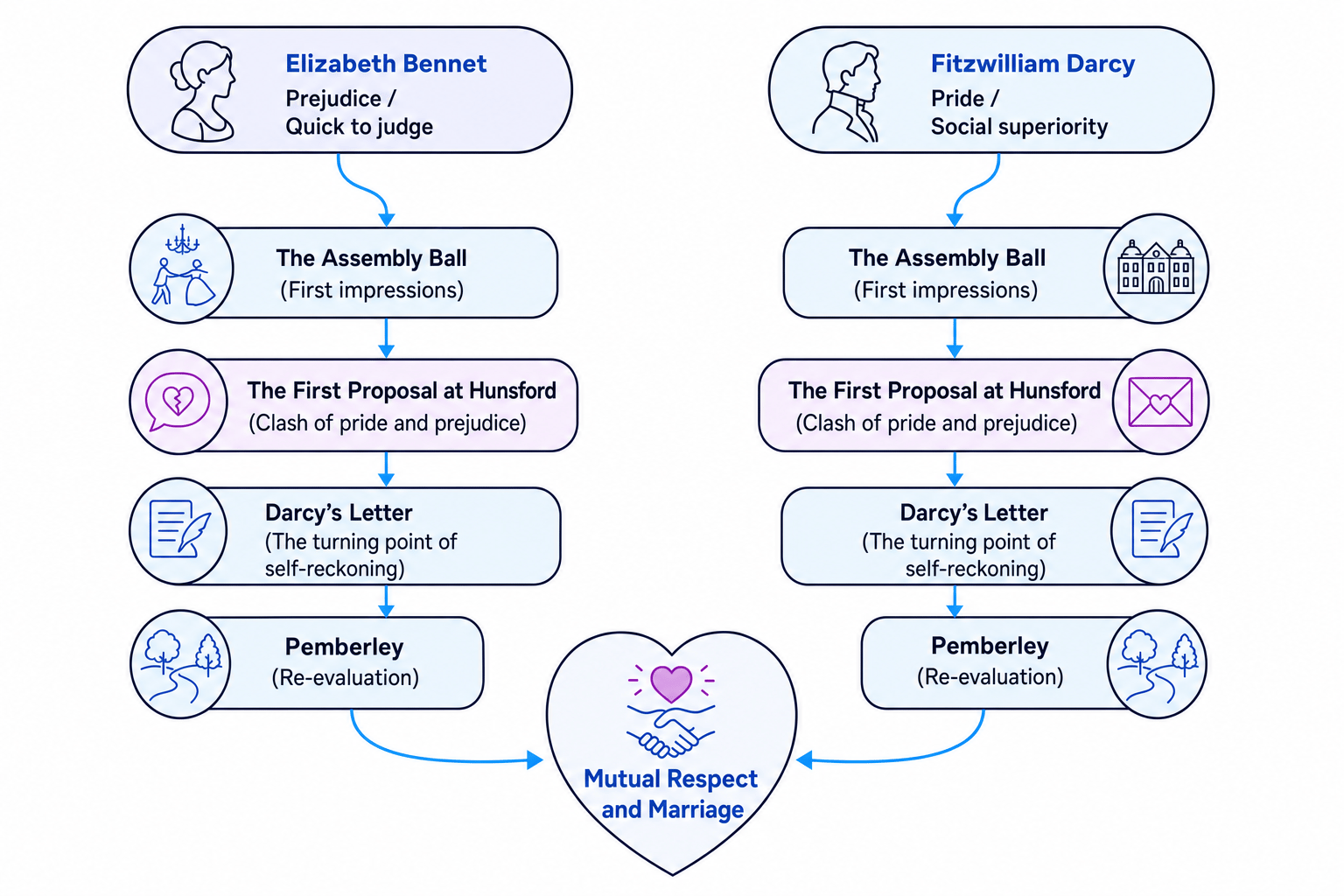
- Fitzwilliam Darcy represents Pride. Secure in his immense wealth (£10,000 a year) and high social standing, he looks down on provincial society and believes himself superior to the Bennets. He must learn humility and realize that nobility of character is more important than noble birth.
- Elizabeth Bennet represents Prejudice. Proud of her own quick wit and observation skills, she makes snap judgments about others (such as trusting the charming Wickham and instantly despising Darcy). She must learn to question her own perceptions and recognize when her vanity has blinded her to the truth.
The diagram below maps how their personal growth mirrors and corrects each other's flaws across the novel's key milestones:
The Turning Point of the Novel
The structural midpoint of the novel is Darcy's letter to Elizabeth (Chapter 35), delivered the day after she rejects his first, arrogant marriage proposal. The letter acts as a mirror, forcing Elizabeth to realize her own capacity for prejudice ("Till this moment, I never knew myself") and forcing Darcy to reflect on his own insufferable pride.
3. Austen’s Literary Methods: Irony and Narrative Voice
To gain top marks in AO2 (Analysis of Language, Structure, and Form), you must be able to discuss how Austen tells her story. She does not write simple, straightforward prose; instead, she uses a highly sophisticated narrative technique.
Comedy of Manners and Satire
Pride and Prejudice belongs to the genre of the comedy of manners. Austen uses satire (humor, irony, or exaggeration used to expose and criticize people's stupidity or vices) to mock the absurdities of her neighbors.
Comedy of Manners
A literary genre that satirizes the manners, behavior, and affectations of a specific social class, often focusing on the gap between polite appearances and selfish realities.
Free Indirect Discourse
One of Austen’s most innovative techniques is free indirect discourse.
Free Indirect Discourse
A style of third-person narration that slips into the voice, vocabulary, and internal thoughts of a character without using formal dialogue indicators (like "she thought" or "he felt").
Instead of saying, "Elizabeth felt angry because her mother was being embarrassing," Austen's narrator will adopt Elizabeth's internal tone directly within the third-person narrative. This allows the reader to share Elizabeth's intimacy and perspective while still maintaining enough distance to see her flaws.
Worked Example: Analyzing the novel's opening sentence
The opening line of Pride and Prejudice is one of the most famous in English literature. Let's walk through how to analyze this sentence to show deep understanding of language, irony, and context.
"It is a truth universally acknowledged, that a single man in possession of a good fortune, must be in want of a wife."
Analyzing the opening sentence
-
Identify the literal statement and its ironic subtext. Look at the claim: "It is a truth universally acknowledged..." The literal statement claims that wealthy single men are actively seeking wives. In reality, the reverse is true: it is the families of portionless young women who are desperately seeking wealthy husbands. The sentence says one thing but means the exact opposite, establishing the novel's ironic tone.
-
Deconstruct the key linguistic choices. Examine the phrase "universally acknowledged." This hyperbole mocks the insular, gossip-driven values of provincial society, where local gossip is treated as absolute law. The modal verb "must" implies a natural, inescapable law, exposing how society normalizes the commodification of marriage and treats wealthy bachelors as public property.
-
Connect the voice to the perspective (Free Indirect Discourse). Recognize that this sentence does not represent Jane Austen's personal view, nor does it represent a neutral narrator. Instead, Austen adopts the collective voice of the neighborhood gossips (led by figures like Mrs. Bennet). By masquerading as this collective voice, she exposes its mercenary, hunting nature from the very first line.
-
Link the linguistic analysis to the historical context. Relate this social pressure to the laws of entailment and the lack of career options for middle-class Regency women. Because women could not work or easily inherit property, capturing a "single man in possession of a good fortune" was not a romantic whim but a vital survival strategy.
-
Synthesize the points into a structured analytical paragraph. Combine these insights into a cohesive point. Show how the irony of the opening sentence establishes the novel's central conflict between individual autonomy and societal expectations:
Austen opens the novel with the famous ironic maxim, "It is a truth universally acknowledged, that a single man in possession of a good fortune, must be in want of a wife." By using the hyperbole "universally acknowledged," Austen satirizes the insular perspective of the provincial gentry, who view a wealthy man not as an individual, but as a financial target for their daughters. The modal verb "must" humorously frames this desperate hunt as an natural inevitability. Through this ironic voice, which mimics the collective anxieties of characters like Mrs. Bennet, Austen immediately establishes the grim underlying context of the novel: in a patriarchal society dominated by male entailment, marriage is treated as an economic transaction essential for female survival.
4. Key Themes of the Novel
As you read and review the novel, keep these central thematic dualities in mind:
- Love and Marriage vs. Financial Security: The contrast between Charlotte Lucas's pragmatism (marrying the absurd Mr. Collins to avoid being a burden to her family) and Elizabeth’s desire for intellectual and emotional equality.
- Class and Snobbery: The conflict between the aristocratic elitism of Lady Catherine de Bourgh and Darcy's snobbish pride, versus the moral integrity and independent spirit of Elizabeth Bennet, who famously declares herself "a gentleman’s daughter."
- Reputation and Propriety: The rigid social rules that govern female behavior. The contrast between the elder sister Jane's quiet modesty and the reckless, impulsive behavior of Lydia Bennet, whose elopement with Wickham threatens to ruin the reputation of the entire family.
The Spectrum of Marriage
Austen does not present marriage in a simplistic, fairy-tale way. Instead, she presents a spectrum of unions: from the disastrously shallow (Lydia and Wickham), to the purely mercenary (Charlotte and Mr. Collins), to the ideal partnership of equals (Elizabeth and Darcy) which balances financial stability with mutual respect.
Dismissing Mrs. Bennet as purely comedic
Many students write off Mrs. Bennet as a foolish, noisy caricature. While she is certainly a comic figure, you must recognize that her anxiety is grounded in a grim legal reality. With five unmarried daughters and an estate destined for Mr. Collins, her frantic efforts to secure wealthy husbands are the only thing standing between her family and destitution.
Avoid 'Device Spotting'
Instead of simply labeling a sentence as "ironic," always explain how the irony functions and why Austen uses it. Ask yourself: who is the target of the irony, and what social expectation is she exposing?
In the exam
- Focus on character growth: Do not treat Elizabeth or Darcy as static characters. Your essay must track their development from flawed, self-satisfied individuals to self-aware partners.
- Analyze narrative voice: Whenever you quote the text, ask yourself if the narrator is speaking sincerely or ironically adopting a character's viewpoint.
- Weave context into your analysis: Never write a separate "context paragraph" at the end. Instead, link historical realities (like inheritance laws or class hierarchies) directly to the characters' choices and dialogue.
Check yourself
- Why is the concept of "first impressions" (the novel's original title) so central to the structural journey of Elizabeth and Darcy?
- How does the law of entailment drive the actions of Mrs. Bennet, Mr. Collins, and Charlotte Lucas?
- Can you find an example of free indirect discourse in the novel and explain how it shapes our sympathy for Elizabeth?
