What you'll learn
- How a strong Frankenstein essay is built for the AQA 19th-century novel question.
- How to move from quotation to method, effect and meaning — not just “feature spotting”.
- How to use context without bolting it on awkwardly.
- What a model paragraph and compact model essay look like in practice.
What a “model essay” is actually modelling
A model essay is not something to memorise word-for-word. It is a demonstration of how thinking is organised: how each paragraph makes a point, uses evidence, analyses Shelley’s methods, and links back to the question.
In the exam, you will answer one question on Frankenstein. AQA gives you an extract and asks you to write about that extract and the novel as a whole. The best answers keep moving between the small details of language and the bigger ideas of the whole text.
Thesis
A thesis is your overall argument: the main interpretation you want your essay to prove. In Frankenstein, a strong thesis usually says something about how Shelley presents an idea and why that presentation matters.
The diagram below shows the basic movement of a strong extract-to-whole-text essay.
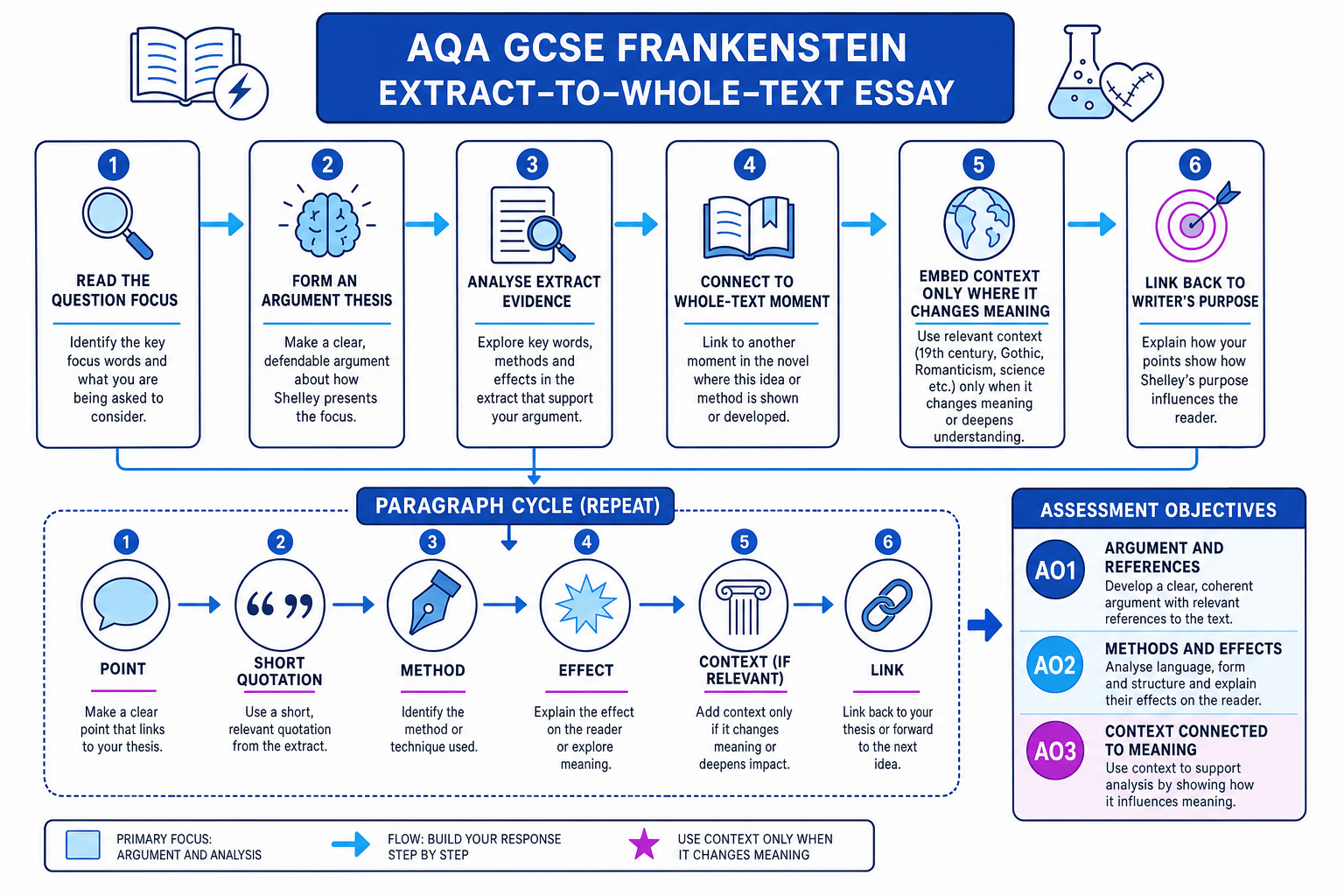
The core shape of a strong essay
A good Frankenstein essay usually has four parts:
- A clear introduction that gives your thesis.
- Two or three analytical paragraphs on the extract.
- One or two links to the wider novel, using short remembered quotations.
- A brief conclusion that sharpens your argument rather than repeating it.
You do not need a huge number of quotations. Because the exam is closed book, it is better to use short, accurate quotations that you can analyse closely.
Quality beats quantity
A high-level answer usually does more with fewer quotations. One phrase such as “the beauty of the dream vanished” can be analysed for language, structure, theme and context if you think carefully.
Building an introduction
Your introduction should not retell the plot. It should answer the question directly and set up an argument.
A weaker opening might say:
Shelley presents the creature as an outsider in many ways. This is shown through his appearance and how people treat him.
That is true, but it is quite general. A stronger opening offers a sharper interpretation:
Shelley presents the creature as an outsider not because he is naturally evil, but because society and Victor reject him. Through the creature’s isolation, Shelley questions whether monstrosity is created by birth, appearance or human cruelty.
This is better because it creates an argument you can develop.
Improving a thesis
- Start with the question focus: if the question asks about the creature as an outsider, your answer must keep returning to exclusion, loneliness and rejection.
- Add Shelley’s possible message: the creature is not simply born monstrous; he is made miserable by abandonment and prejudice.
- Make it debatable: instead of saying “he is an outsider”, argue that Shelley uses his outsider status to criticise Victor’s irresponsibility and society’s judgement of appearances.
Paragraphs: point, evidence, method, effect, link
A model paragraph does not just include a quotation. It explains how Shelley’s writing creates meaning.
Method
A method is a deliberate choice made by the writer. In prose, this can include language choices, imagery, symbolism, narrative voice, structure, contrast, foreshadowing, setting, motif or form.
For example, in Chapter 5 Victor describes the creature’s birth:
“the beauty of the dream vanished”
This is a very short quotation, but it is powerful. Shelley contrasts “beauty” with “vanished” to show how Victor’s ambition collapses the moment his experiment succeeds.
Turning a quotation into analysis
- Identify the contrast: “beauty” suggests Victor’s idealised fantasy of scientific glory, while “vanished” suggests sudden loss and disillusionment.
- Connect the method to meaning: Shelley uses this contrast to show that Victor’s dream was unstable and selfish, not noble.
- Link to the wider novel: Victor repeatedly refuses responsibility after this moment, so the creature’s later suffering can be traced back to Victor’s immediate rejection.
Using context naturally
Context means the historical, social or literary background that helps us understand the novel. For Frankenstein, useful contexts include Romanticism, Gothic literature, scientific discovery, religion and the myth of Prometheus.
But context should never feel like a random history fact. It should explain meaning.
Bolted-on context
Avoid writing a sentence like, “Mary Shelley was a Romantic writer,” and then moving on. Instead, connect context to the argument: Shelley’s Romantic distrust of unchecked ambition shapes her warning against Victor’s attempt to dominate nature.
A good contextual sentence might be:
As a Romantic writer, Shelley challenges the Enlightenment belief that scientific progress is always beneficial, presenting Victor’s “ardour” for knowledge as dangerous when it is separated from moral responsibility.
Notice that the context supports the interpretation. It does not interrupt it.
Compact model essay
Here is a compact model response to the question:
How does Shelley present the creature as an outsider in Frankenstein?
Shelley presents the creature as an outsider not because he is naturally evil, but because he is rejected by his creator and by human society. Through the creature’s isolation, Shelley questions whether “monsters” are born or made, and criticises Victor’s failure to take responsibility for the life he creates.
From the moment of his animation, the creature is treated as unnatural and excluded from human sympathy. Victor calls him “the wretch — the miserable monster whom I had created”, immediately defining him through disgust rather than care. The noun “wretch” suggests suffering, but Victor uses it contemptuously, showing his inability to recognise the creature’s vulnerability. Shelley also makes Victor admit that he “had created” him, which reminds the reader that the creature’s isolation begins with his maker’s rejection. This is important structurally because the birth scene reverses the expected image of parenthood: instead of nurture, there is abandonment. Shelley therefore presents the creature’s outsider status as the result of Victor’s moral failure.
Shelley also uses the creature’s own voice to complicate the reader’s response. When he confronts Victor, he says, “I ought to be thy Adam; but I am rather the fallen angel.” The biblical allusion to “Adam” presents the creature as a first man figure who expects guidance and love from his creator. However, the contrast with “fallen angel” shows that he feels cast out and corrupted. This allusion makes Victor appear like a negligent god, while the creature becomes both victim and threat. Shelley’s use of the creature’s eloquent first-person narrative encourages the reader to sympathise with him, challenging the prejudice created by his frightening appearance.
The creature’s outsider status is also shaped by society’s obsession with appearances. Although he learns language, emotion and morality by watching the De Lacey family, he is still violently rejected when he tries to enter human community. His claim that “I was benevolent and good; misery made me a fiend” directly presents evil as a consequence of suffering. The balanced structure of the sentence contrasts his original goodness with what he becomes, suggesting that isolation transforms him. Shelley therefore criticises a society that judges by surface rather than inner character.
By the end of the novel, the creature has become more dangerous, but Shelley never lets the reader forget his loneliness. His statement “I am malicious because I am miserable” links violence to emotional deprivation. The alliteration of “malicious” and “miserable” connects his cruelty with his suffering, implying that his monstrosity has been produced by rejection. In this way, Shelley presents the creature as an outsider in order to question the boundaries between human and monster. The real horror of the novel is not only the creature’s violence, but the human cruelty that helps create it.
What makes this a strong model?
The essay works because it has a clear argument from start to finish: the creature is made into an outsider by rejection. Each paragraph returns to that idea.
It also balances the assessment skills. It gives an informed personal response, supports ideas with short quotations, analyses Shelley’s language and structure, and uses context through biblical allusion and ideas about creation without turning the essay into a history lesson.
A useful paragraph test
After writing a paragraph, ask: Have I explained what Shelley is making the reader think or feel? If the answer is no, you probably need more analysis, not another quotation.
Adapting model essays in the exam
You should not force a memorised essay onto the question. Instead, adapt the model structure.
If the question is about ambition, you might use Victor’s “ardour” and “the beauty of the dream vanished”.
If the question is about responsibility, you might focus on Victor’s phrase “whom I had created” and the creature’s “Remember that I am thy creature”.
If the question is about sympathy, you might use “I ought to be thy Adam” and “misery made me a fiend”.
The skill is not learning one perfect essay. The skill is learning how to build a flexible argument from secure knowledge.
In the exam
- Start with a thesis that answers the exact question and names Shelley’s bigger idea.
- Use short quotations, then zoom in on individual words or methods before linking to the whole novel.
- Add context only when it deepens your interpretation of Shelley’s message.
Check yourself
- Can you write a one-sentence thesis for a question on the creature as an outsider?
- Can you analyse “I ought to be thy Adam” without just retelling the Bible story?
- Can you explain the difference between adding context and bolting on context?
