

In your AQA GCSE English Literature exam, you are assessed on your ability to remember, select, and closely analyse quotes from Pigeon English (AO1 and AO2). Because this is a closed-book exam, you don't need to memorise entire paragraphs. Instead, you need high-yield, short quotes—sometimes called "micro-quotes"—that are packed with literary methods and deep thematic meaning.
What you'll learn
- How to select and memorise highly versatile quotes for Pigeon English.
- How to closely analyse the linguistic blend of Ghanaian dialect and Multicultural London English (MLE).
- How to connect Harri’s unique voice to the novel’s main themes: innocence, violence, and identity.
The Power of "Micro-Quotes"
When studying a modern novel, many students make the mistake of trying to memorise long, complex sentences. In the exam room, under pressure, these long quotes are easily forgotten or misquoted.
Micro-Quote
A micro-quote is a highly concentrated phrase of just two to five words that contains a specific language method (such as a metaphor, sensory adjective, or slang term) and can be easily integrated directly into your essay sentences.
Using micro-quotes keeps your writing fluid and allows you to build a highly analytical, method-focused response.
Less is More
A single, well-analysed word or short phrase is worth far more to an examiner than a massive chunk of text dropped into your essay without close analysis. Aim for precision, not length.
Key Quotes Map
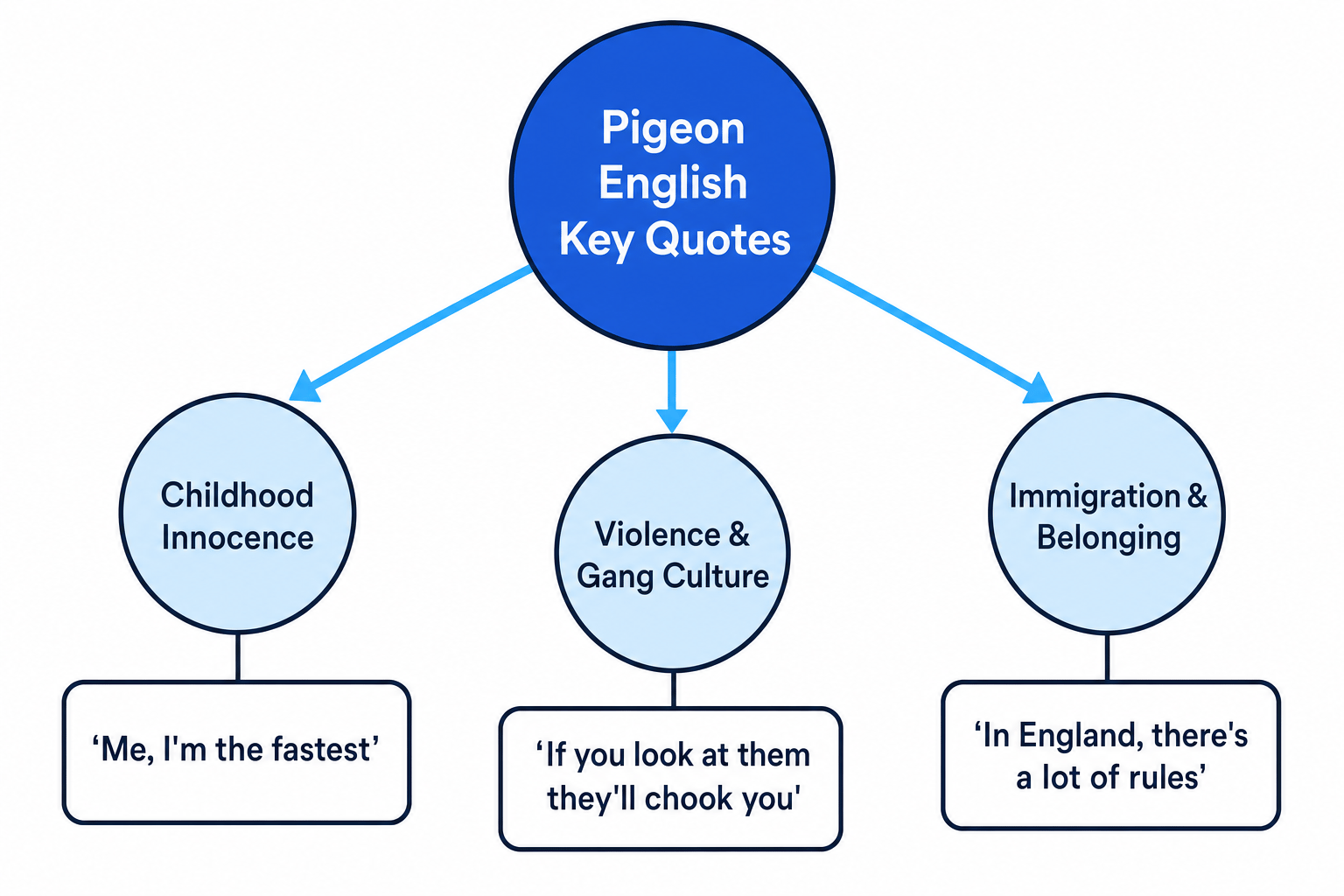
To help you visualise how the novel's core themes are supported by specific evidence, review the thematic map below. It connects central characters and ideas directly to memorable, high-impact quotes.
Theme 1: Childhood Innocence and Vulnerability
One of the most powerful aspects of Pigeon English is Harri’s narrative voice. He is an innocent eleven-year-old child trying to navigate an environment filled with adult dangers.
"Me, I'm the fastest."
- Context: Harri repeats this throughout the novel. Running is his superpower, his joy, and his way of asserting his identity.
- Analysis:
- Linguistic Structure: The non-standard syntax ("Me, I'm...") establishes Harri’s youthful, informal voice and reflects the influence of his Ghanaian native tongue.
- Method: This phrase acts as a tragic motif.
- Reader Effect & Theme: It highlights Harri's childlike belief that physical speed can protect him from harm. The dramatic irony is devastating: in the end, Harri’s speed cannot save him from the knife of the Dell Farm Crew. His innocence blinds him to the true gravity of the threat.
"If you stand on a line it means you’re going to die."
- Context: Harri describes the games he plays on the council estate streets.
- Analysis:
- Method: Hyperbole and foreshadowing.
- Reader Effect & Theme: This quote illustrates how children gamify their dangerous surroundings to cope with them. Superstitions and playground rules are juxtaposed with real, lethal threats. It subtly foreshadows Harri’s eventual fate: he steps over the invisible "lines" drawn by the local gang and pays the ultimate price.
Spotting Dramatic Irony
Always look for moments where Harri is laughing or playing, but you (the reader) feel a sense of dread. That contrast is dramatic irony, and it is Stephen Kelman's primary tool for building tension.
Theme 2: Violence and Gang Culture
The novel is set on a fictional London council estate, heavily influenced by the real-world social context of the early 2000s (including the tragic death of Damilola Taylor in 2000).
"If you look at them they’ll chook you."
- Context: Harri explaining the unwritten rules of the estate and the threat posed by the Dell Farm Crew (DFC).
- Analysis:
- Method: Colloquial slang and direct pronoun usage ("them", "you").
- Linguistic Terminology: Multicultural London English (MLE). The verb "chook" is MLE slang for "stab" or "pierce".
- Reader Effect & Theme: This quote highlights the casual normalization of extreme violence in Harri’s daily life. A simple glance can result in physical assault. The word "chook" sounds almost playful or cartoonish, showing how thoroughly Harri has desensitised himself to the constant threat of violence to survive mentally.
Missing the Sociolinguistic Context
Do not just call Harri’s language "bad English" or "poor grammar." This is Multicultural London English (MLE), a rich sociolect that reflects the diverse immigrant communities of modern London. Refer to it as a deliberate stylistic choice by Kelman to represent cultural hybridity.
Theme 3: Immigration and Belonging
Harri and his family have recently arrived from Ghana, hoping for safety and prosperity. Instead, they find a concrete landscape governed by foreign social codes.
"In England, there’s a lot of rules."
- Context: Harri observes the rigid, sometimes baffling social expectations of his new home.
- Analysis:
- Method: Simple sentence structure, contrast.
- Reader Effect & Theme: In Ghana, Harri’s life was defined by open spaces, community, and freedom. In England, he is confined by physical fences, security grates, and strict social barriers. The "rules" refer not just to the law, but to the hostile social climate of the estate where even walking down the wrong street can be dangerous.
Theme 4: The Pigeon (Magical Realism)
Kelman uses a personified pigeon as a recurring character to offer an objective, spiritual perspective on human behavior.
"I was just checking you were okay."
- Context: The pigeon speaks directly to Harri, acting as a protector or spiritual guide.
- Analysis:
- Method: Personification and magical realism (where supernatural or fantastical elements are treated as normal parts of a realistic setting).
- Reader Effect & Theme: The pigeon represents a higher moral perspective. Unlike the humans on the estate, the pigeon offers unconditional care and watchful protection. It serves as a symbol of the natural world, watching over Harri’s innocence in a concrete jungle where human structures have failed to protect him.
How to Analyse a Quote in Your Essay
Let’s look at how to put these concepts into practice. When writing about a quote, always follow a clear analytical journey:
- Identify the method used by the writer.
- Zoom in on a specific word or phrase.
- Explain the effect on the reader.
- Link your analysis to the historical/social context (AO3).
Analysing Harri's Voice
Let's work through an analysis of the quote: "Me, I'm the fastest."
- State your point and introduce the quote: Kelman uses Harri’s naive self-confidence to create a poignant sense of tragic foreshadowing. This is evident when Harri repeatedly boasts, "Me, I'm the fastest."
- Identify the method and zoom in on language: The use of the non-standard pronoun construction "Me, I'm..." highlights his distinctive linguistic identity, blending his Ghanaian heritage with London slang. Furthermore, the adjective "fastest" acts as a recurring structural motif throughout the novel.
- Analyse the effect on the reader: This boastful claim reflects Harri's childlike, innocent belief that his physical agility makes him invincible. It creates dramatic irony because the reader understands that his speed is no match for the systemic, weaponised violence of the Dell Farm Crew.
- Link to context and theme: Through this, Kelman exposes the extreme vulnerability of immigrant children in deprived urban environments. He shows how their natural, playful innocence is ultimately crushed by the harsh realities of the concrete estate.
In the exam
- Embed your quotes: Never write: "A quote that shows this is 'Me, I'm the fastest'." Instead, weave it into your own sentence: Harri's persistent belief that he is "the fastest" creates a poignant sense of dramatic irony.
- Name the method: Don't just explain what the quote means. Name the writer's technique (e.g. motif, MLE colloquialism, foreshadowing, contrast) to secure high marks for AO2.
- Link to AO3 context: Always explain why Kelman wrote this. Is he commenting on the vulnerability of young immigrants? Is he criticising the lack of social support on inner-city estates? Keep the author's purpose in mind.
Check yourself
- Can you explain what the term "chook" reveals about Harri's environment and the dialect he is adopting?
- Why is the recurring motif "Me, I'm the fastest" considered an example of tragic dramatic irony?
- How does the phrase "In England, there's a lot of rules" highlight the contrast between Harri's life in Ghana and his new life in London?
