Preparing for a closed-book exam can feel daunting, but you do not need to memorise entire pages of text to score highly. Instead, the secret is mastering a small, highly versatile selection of short quotations that you can analyse deeply and apply to multiple characters and themes.
What you'll learn
- How to select and memorise highly versatile "micro-quotations" for the exam
- The deep literary, thematic, and contextual significance of key quotes in Frankenstein
- How to explode a quotation to extract maximum marks for language and structural analysis
The Art of the Micro-Quotation
In your GCSE English Literature Paper 1 exam, you are assessed on your ability to construct a well-supported argument and analyse the writer's craft. Because the exam is closed-book, you must quote from memory.
Micro-Quotation
A micro-quotation is a highly condensed phrase of two to five words that contains rich figurative language, a powerful structural technique, or a deep contextual link.
Using micro-quotations is much more effective than memorising long sentences. They are easier to remember, can be integrated seamlessly into your own sentences, and allow you to focus your analysis on specific, high-impact words.
Integrate, don't decorate
Do not simply drop a quotation into your paragraph without explaining it. Always weave it into your sentence and immediately identify a method (such as a metaphor, allusion, or juxtaposition) to explain why Mary Shelley chose those exact words and how they affect the reader.
1. Victor's Ambition and Hubris
Victor Frankenstein's downfall is driven by his desire to transcend human limits. This is a classic example of hubris—a term originating in Greek tragedy that refers to dangerous, overweening pride and ambition that ultimate leads to ruin.
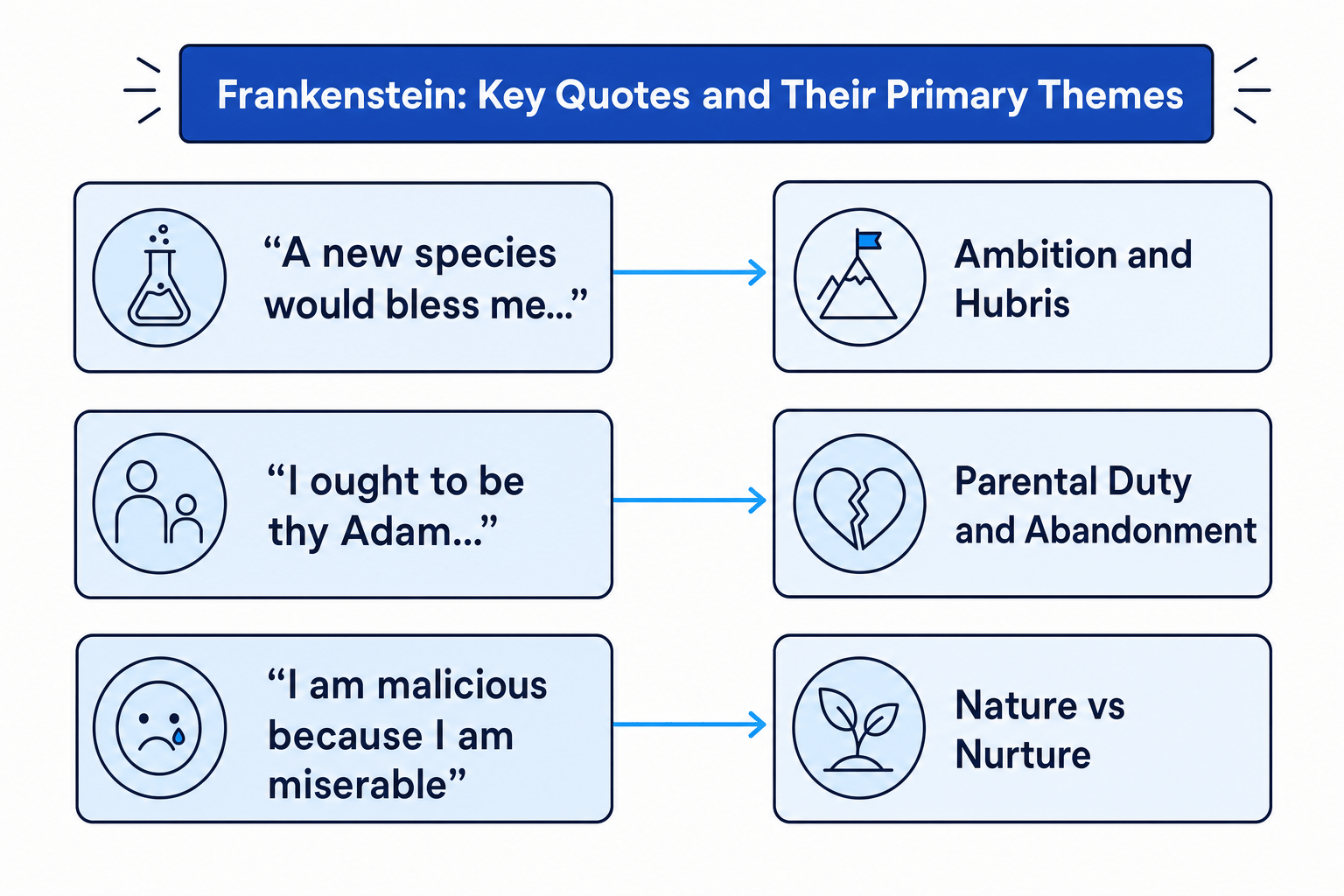
"A new species would bless me as its creator and source; many happy and excellent natures would owe their being to me." — Victor Frankenstein (Chapter 4)
The Analysis
- Context and Theme: Victor is speaking as he gathers materials for his creation. This quote highlights his extreme hubris. He is not motivated by scientific progress or altruism, but by a desire for personal glory and divine status.
- Language Analysis: The verb "bless" has religious connotations, showing that Victor desires the worship typically reserved for God. The noun phrase "creator and source" elevates him to a god-like status.
- Structural Irony: The adjective "happy" and "excellent" create a stark contrast with the miserable, violent reality of the creature's actual existence. Shelley uses this dramatic irony to warn the reader of the dangers of scientific experimentation unchecked by moral responsibility.
Confusing the Creator and the Monster
It is a classic mistake to call the monster "Frankenstein". Victor is Frankenstein; his creation is "the monster", "the creature", or "the daemon". Referring to the creature as "Frankenstein" in the exam will instantly undermine your essay's credibility.
2. The Turning Point of Creation
The transition from Victor's obsessive ambition to his immediate regret is one of the most important structural shifts in the novel.
"The beauty of the dream vanished, and breathless horror and disgust filled my heart." — Victor Frankenstein (Chapter 5)
The Analysis
- Context and Theme: This shift occurs immediately after the creature opens its "dull yellow eye". This is the turning point where Victor's idealistic romance with science crashes into Gothic reality.
- Language Analysis: The juxtaposition of "beauty" and "dream" against "horror" and "disgust" emphasizes Victor's psychological instability. The adjective "breathless" implies that Victor is literally suffocated by the consequences of his actions, foreshadowing his physical and mental decline.
- Romanticism vs. Gothic: This quote represents a key clash between two literary movements. The "dream" represents the idealistic, Romantic pursuit of nature's secrets, while the "disgust" represents the horrific, Gothic consequences of crossing natural boundaries.
3. The Monster's Cry for Justice
The creature's first-person narrative in the middle of the novel shifts the reader's empathy. He is not a mindless brute, but an eloquent, suffering being.
"I am malicious because I am miserable. Am I not shunned and hated by all mankind?" — The Monster (Chapter 17)
The Analysis
- Context and Theme: The creature is speaking to Victor on the Mer de Glace, demanding that Victor create a female companion for him. This quote directly addresses the theme of nature versus nurture.
- Language and Structure: Shelley uses causality here: "malicious because I am miserable". The alliteration of the "m" sound ("malicious", "miserable", "mankind") links his inner emotional state directly to his outer actions and his treatment by society.
- The Rhetorical Question: The creature's use of a rhetorical question ("Am I not...") demonstrates his highly developed intellect and capacity for rational thought, which contrasts sharply with the "monster" Victor perceives him to be.
The Eloquent Monster
Remember that the creature does not speak in grunts! He learns language by observing the De Lacey family and reading classic literature like John Milton's Paradise Lost. His speech is highly formal, poetic, and persuasive. Commenting on the sophistication of his language is a fantastic way to score marks for structural analysis.
Worked Example: Deconstructing a Complex Literary Allusion
In your exam, the highest marks are awarded to students who can link a quotation's language to its wider literary context. Let's look at one of the most famous and versatile quotes in the entire novel.
"I ought to be thy Adam; but I am rather the fallen angel, whom thou drivest from joy for no misdeed." — The Monster (Chapter 10)
Unpacking the Monster's Biblical Allusion
Here is how you can systematically unpack this quotation in a high-scoring analytical paragraph:
- Identify the core literary method and its source. The creature uses a direct biblical allusion, referencing the creation story in Genesis and John Milton's epic poem Paradise Lost. By comparing himself to both Adam (the first human, created in love) and the "fallen angel" (Satan, who rebelled against God and was cast into Hell), the creature demonstrates his deep education and self-awareness.
- Analyse the structural juxtaposition and pronouns. The juxtaposition of the idealised "Adam" with the cursed "fallen angel" highlights the tragedy of the creature's existence. He was made to be loved, but is treated like a demon. The archaic pronouns "thy" and "thou" show that the creature is addressing Victor directly, demanding that his creator acknowledge his paternal responsibility.
- Link the analysis to context and the writer's purpose. Shelley uses this allusion to critique Victor's failure as a "parent" and a creator. Unlike the God of Genesis, who cares for Adam, Victor abandons his creation immediately. By comparing himself to Satan, the creature warns Victor that neglect and isolation breed rebellion and violence. This reflects Romantic ideas about how society corrupts the innocent.
4. The Double and the Pursuit of Revenge
By the end of the novel, Victor and the creature have become mirror images of each other, locked in a destructive cycle of mutual isolation and revenge.
"I shall be with you on your wedding-night!" — The Monster (Chapter 20)
The Analysis
- Context and Theme: The creature delivers this threat after Victor destroys the half-finished female companion. It sets up the novel's final tragic climax: the murder of Elizabeth Lavenza.
- Dramatic Irony and Foreshadowing: Victor mistakenly assumes the creature intends to kill him on his wedding night. This hubristic self-absorption prevents Victor from protecting Elizabeth, leading to her death.
- The "Doppelgänger" Motif: In Gothic literature, a doppelgänger is a double or alter-ego. By threatening Victor's wedding night, the creature ensures that Victor will experience the exact same isolation that he does—deprived of a mate, cursed to wander the earth alone.
Do not overlook Robert Walton
Many students forget Robert Walton, the Arctic explorer who frames the story. Walton's ambition mirrors Victor's. Quotes from Walton's letters, such as "I would sacrifice my fortune, my existence, my every hope, to the furtherance of my enterprise," are brilliant for showing how Shelley structures the novel as a "cautionary tale" within a frame narrative.
In the exam
When writing about quotations under exam conditions, keep these strategies in mind:
- Embed your quotations naturally: Avoid writing "This is shown in the quote...". Instead, integrate the quote directly into your sentence structure, e.g., Victor's descent into madness is signaled when he confesses that "breathless horror and disgust" have taken over his heart.
- Zoom in on key words: After introducing a quotation, pick out one or two specific words to analyse in detail. Discuss their connotations, word class, and psychological impact.
- Tie every quote to the writer's big ideas: Never analyse a quote in a vacuum. Always ask yourself: Why did Mary Shelley write this? What warning was she giving to her 19th-century audience about science, social prejudice, or parenting?
Check yourself
Before your exam, make sure you can answer these questions about your key quotes:
- Which quotation best demonstrates the concept of hubris in Victor's character, and which specific words prove it?
- How does the creature use biblical allusions to challenge Victor's authority as his creator?
- What is the structural significance of the contrast between Victor's "dream" and his "disgust" in Chapter 5?
