To excel in your GCSE English Literature exam, you must understand how Mary Shelley uses specific chapters to drive the plot, develop her themes, and reveal character psychology. Because the AQA exam is closed-book, focusing your revision on a few pivotal chapters allows you to memorize high-impact, versatile quotations that can be applied to almost any essay prompt.
In these notes, we will break down the structure of the novel, analyze three of the most important chapters in detail, and look at how to connect a single scene to the wider text.
The Power of Key Chapters
AQA examiners do not expect you to know every page of the novel equally well. Instead, they look for deep, precise analysis of crucial turning points, showing how language and structural choices in a single scene mirror the main themes of the entire text.
What you'll learn
- How the novel's nested narrative structure shapes our perspective of the story.
- In-depth thematic and structural breakdowns of Chapter 4, Chapter 5, and Chapter 10.
- A robust, step-by-step method to link a specific chapter extract to the rest of the novel.
The Structure of the Novel: The Frame Narrative
Before analyzing individual chapters, we must look at how the novel is put together. Shelley does not tell the story chronologically from a single point of view. Instead, she uses a frame narrative.
Frame Narrative
A frame narrative is a literary technique where an introductory story (the "frame") sets the stage for a second, internal narrative. In Frankenstein, the story is told through three nested "layers" of narrators.
This structure is also epistolary (written in the form of letters) at its outermost layer, as Robert Walton writes to his sister, Margaret Saville.
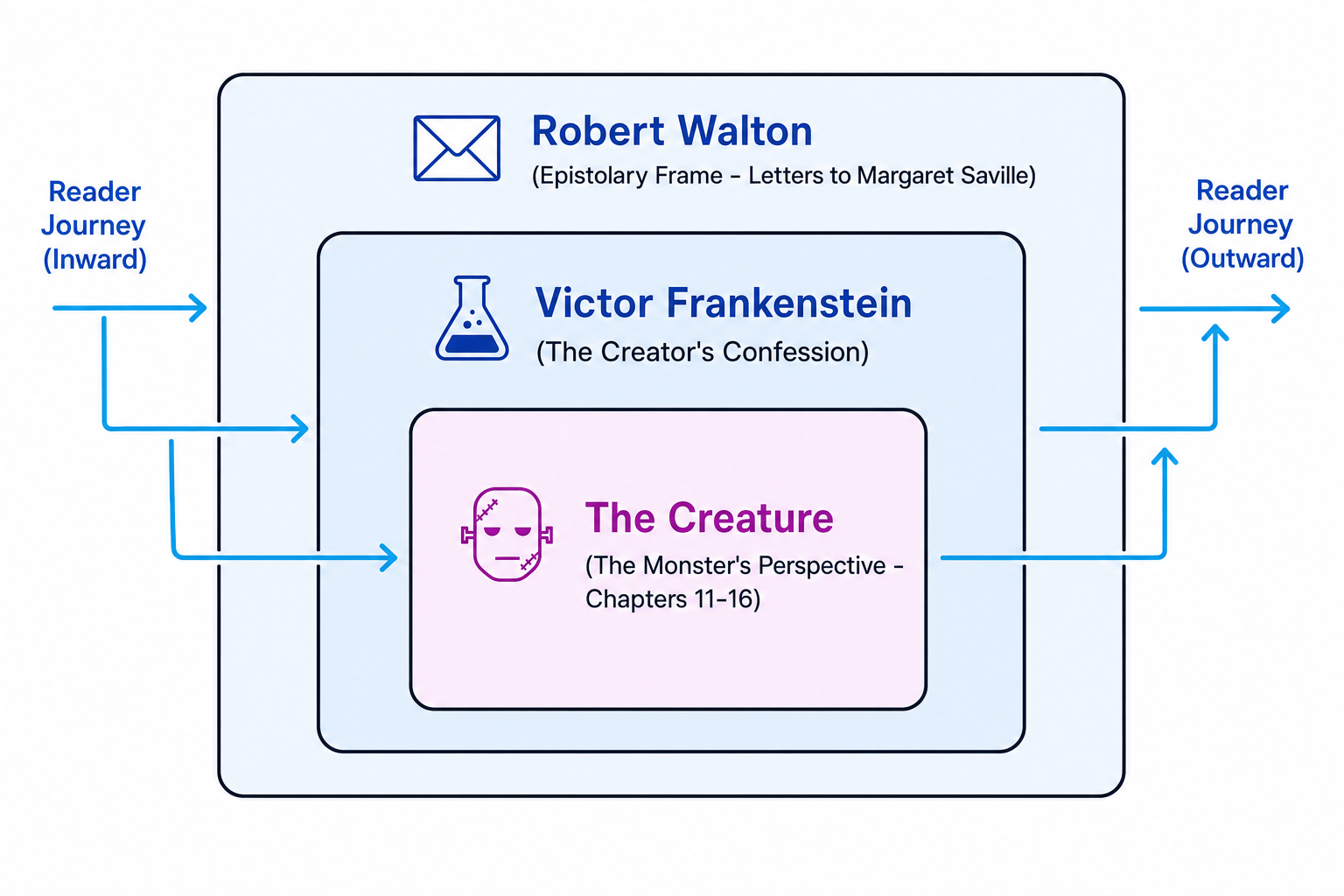
This structure is highly deliberate:
- It creates distance and doubt: We are hearing the Creature's story filtered through Victor, filtered through Walton. This forces us to question the reliability of our narrators.
- It highlights parallels: Walton, Victor, and the Creature are all isolated figures searching for companionship and intellectual glory.
Chapter 4: The Pursuit of Knowledge (The Build-Up)
In Chapter 4, Victor describes his time at the University of Ingolstadt. He becomes obsessed with the secrets of life and death, spending his nights in charnel houses and vaults.
Key Plot and Structural Developments
- Victor isolates himself completely from his family and the natural world.
- He transitions from a student of science to someone trying to usurp the role of God and Nature.
- The chapter acts as the exposition of Victor’s hubris, building tension before the creation.
Key Language Analysis
Victor admits, "I pursued nature to her hiding-places."
- Method: Personification of "nature" as female and the verb "pursued."
- Effect: This reveals Victor’s aggressive, invasive attitude toward the natural world. Instead of appreciating nature's beauty (a key Romantic value), he wants to dominate and dissect it.
- Context: Shelley is critiquing the aggressive scientific developments of the early 19th century (the Industrial Revolution and Galvanism), suggesting that rational science without moral boundaries is destructive.
The Romantic Sublime
The Romantics believed in the power of the sublime—the idea that nature is so vast, beautiful, and terrifying that it humbles humanity. In Chapter 4, Victor rejects the sublime by locking himself in his "workshop of filthy creation," cutting himself off from the natural world to focus on his own ego.
Chapter 5: The Birth of the Monster (The Climax of Gothic Horror)
Chapter 5 is arguably the most famous chapter in the novel. It represents the physical realization of Victor's ambition and his immediate fall into despair.
Key Plot and Structural Developments
- Victor successfully brings his creation to life on a "dreary night of November."
- The moment the Creature opens its eyes, Victor's dream of glory is shattered, replaced by instant revulsion.
- Victor flees his laboratory and falls into a fitful sleep, where he experiences a disturbing, prophetic dream.
Key Language Analysis
Shelley begins the chapter with a classic Gothic setting: "It was on a dreary night of November, that I beheld the accomplishment of my toils."
- Method: Pathetic fallacy ("dreary night of November") and Gothic imagery ("half-extinguished light").
- Effect: The gloomy, dying environment reflects the moral decay of Victor's project. The "half-extinguished" candle serves as a metaphor for Victor’s failing humanity and the dimming of the rational light of the Enlightenment.
When the Creature wakes, Victor's reaction is visceral: "the beauty of the dream vanished, and breathless horror and disgust filled my heart."
- Method: Juxtaposition of "beauty" and "dream" with "horror" and "disgust."
- Effect: This marks the sudden transition from obsessed creator to negligent parent. The noun "disgust" shows that Victor is repulsed purely by the Creature's aesthetics, highlighting his shallow, superficial morality.
Victor's Nightmare
While asleep, Victor dreams of kissing Elizabeth, who then transforms into the corpse of his dead mother, Caroline Beaufort, with grave-worms crawling through her shroud.
- Method: Foreshadowing and psychological symbolism.
- Effect: This dream reveals Victor’s deep-seated guilt and anxiety about death. By attempting to create life without a woman, he has bypassed natural reproduction, symbolically bringing death upon those he loves.
Confusing the Creature's Original State
Do not write that the Creature is born evil in Chapter 5. In this chapter, the Creature reaches out a hand and smiles at Victor, uttering "inarticulate sounds." Shelley portrays the Creature as an innocent newborn seeking parental love; it is Victor’s abandonment that sets the tragedy in motion.
Chapter 10: The Summit of Montanvert (The Confrontation)
In Chapter 10, Victor seeks solace in the sublime mountains of Chamonix, only to be confronted by his creation on the Mer de Glace (Sea of Ice).
Key Plot and Structural Developments
- This chapter marks a massive structural shift: it is the bridge that leads into the Creature's own narrative.
- The vast, icy landscape of the Alps provides a dramatic backdrop for the confrontation.
- The Creature speaks for the first time, shocking Victor (and the reader) with his sophisticated, eloquent language.
Key Language Analysis
The Creature confronts Victor with a profound biblical allusion: "Remember, that I am thy creature; I ought to be thy Adam, but I am rather the fallen angel, whom thou drivest from joy for no misdeed."
- Method: Biblical allusion (to the Book of Genesis and John Milton's epic poem Paradise Lost).
- Effect: By comparing himself to "Adam," the Creature reminds Victor of his absolute duty as a creator/parent. By comparing himself to the "fallen angel" (Satan), he warns Victor that neglect and exclusion breed jealousy, anger, and evil.
- Context: This reflects the philosopher Jean-Jacques Rousseau’s theory that humans are born naturally good ("noble savages") but are corrupted by society's prejudices and institutions.
The Sublime
The sublime is a literary and artistic concept referring to a grandeur of landscape that strikes awe, majesty, and terror into the human soul. Shelley uses the icy, grand peaks of Montanvert to contrast the petty, destructive desires of human beings with the eternal power of nature.
Applying the Technique: Integrating Extract and Whole Text
In your AQA exam, you will be given an extract from a key chapter and asked to discuss a theme or character. You must divide your time and focus: use the extract as a springboard to analyze specific language devices (AO2), and then trace that same theme or character trajectory across other key chapters of the novel (AO1/AO3).
Here is how to plan and execute a high-level response using a specific extract from Chapter 5.
Analyzing Victor's reaction to his creation
Suppose your exam question is: "Starting with this extract [the moment of creation in Chapter 5], explore how far Shelley presents Victor Frankenstein as a character driven by selfishness."
Follow these three analytical steps to construct a top-tier paragraph.
-
Analyze the extract for immediate evidence of Victor's selfishness. Focus on the language of his reaction. He notes that the Creature's "watery eyes... seemed almost of the same colour as the dun-white sockets." His revulsion is entirely superficial. Drafting the thought: Victor’s focus is entirely on the Creature's physical appearance rather than its life or soul. He is selfish because he cared about his own glory during the creation, but abandons his creation the moment it fails to please his aesthetic expectations.
-
Select a method and write your close-language analysis. Examine the quote: "I had turned loose into the world a depraved wretch, whose delight was in carnage and misery." (Looking forward to Victor's later reflections on Chapter 5). Applying the method: Shelley uses the verb phrase "turned loose" to expose Victor's hypocrisy. By prioritizing his own peace of mind and fleeing, Victor leaves a vulnerable, powerful being unattended. He blames the Creature for being "depraved" without acknowledging that his own selfish abandonment forced it into isolation.
-
Link structural and contextual points to the wider novel. Connect this moment of selfish flight to Chapter 10 (the confrontation on Montanvert) and Chapter 24 (the final chase). Structuring the link: This early act of selfish abandonment in Chapter 5 directly causes the tragedy. When they meet on the glacier in Chapter 10, Victor's selfishness hardens into defensive anger, calling him an "Abhorred monster!" rather than accepting paternal responsibility. By the end of the novel (Chapter 24), Victor's selfishness has turned into an obsessive quest for personal revenge, proving that he never truly understands the moral weight of his actions. This reflects Shelley's warning against the ego of modern science.
In the exam
- Divide your essay structurally: Aim for a balanced 50/50 split between analyzing the printed extract and referencing other key chapters of the novel.
- Track character arcs: Use the transition between key chapters to show how a character changes. For example, show how Victor’s isolation in Chapter 4 leads to his terror in Chapter 5, which culminates in his rage in Chapter 10.
- Embed short, sharp quotes: Do not memorize block quotes. Learn 3-to-4-word fragments (like "filthy creation," "dreary night," or "thy Adam") that you can naturally weave into your own sentences.
Check yourself
- Can you explain how the nested narrative frame of Walton-Victor-Creature impacts the reliability of the narrative in Chapter 10?
- Why is Victor's nightmare in Chapter 5 structurally and psychologically significant to the novel's themes of family and death?
- How does the setting of Chapter 10 (the Mer de Glace) reflect the psychological states of both Victor and the Creature?
