

Stephen Kelman’s Pigeon English does not use conventional numbered chapters. Instead, the novel is structured around six distinct months, starting in March and ending abruptly in September. This diary-like framework acts as a countdown, tracking Harrison "Harri" Opoku’s transition from a naive newcomer in an inner-city London estate to the tragic victim of street violence.
Understanding how these specific "chapters" (months) build tension, develop themes, and shift in tone is essential for securing high marks in your GCSE English Literature exam.
What you'll learn
- How the monthly chapter structure creates a ticking-clock narrative.
- The thematic significance of the key transitions from spring (March) to late summer (September).
- How to analyse language and structural changes across critical turning points in the novel.
The Structural Blueprint: A Diary of Doom
Instead of standard chapter breaks, Kelman uses the passage of months to partition Harri's narrative. This structural choice is a form of epistolary-style journaling, where the reader feels immediate proximity to Harri’s daily thoughts, fears, and joys.
Epistolary narrative
An epistolary narrative is a novel written as a series of documents, diaries, letters, or journal entries. In Pigeon English, the monthly entries function as personal, immediate reflections of Harri’s worldview.
This structure also mimics a ticking clock. Because we learn of a boy's murder in the very first sentence of "March", the entire novel is shadowed by threat. As the months tick closer to autumn, the heat rises, the gang presence intensifies, and Harri’s safety evaporates.
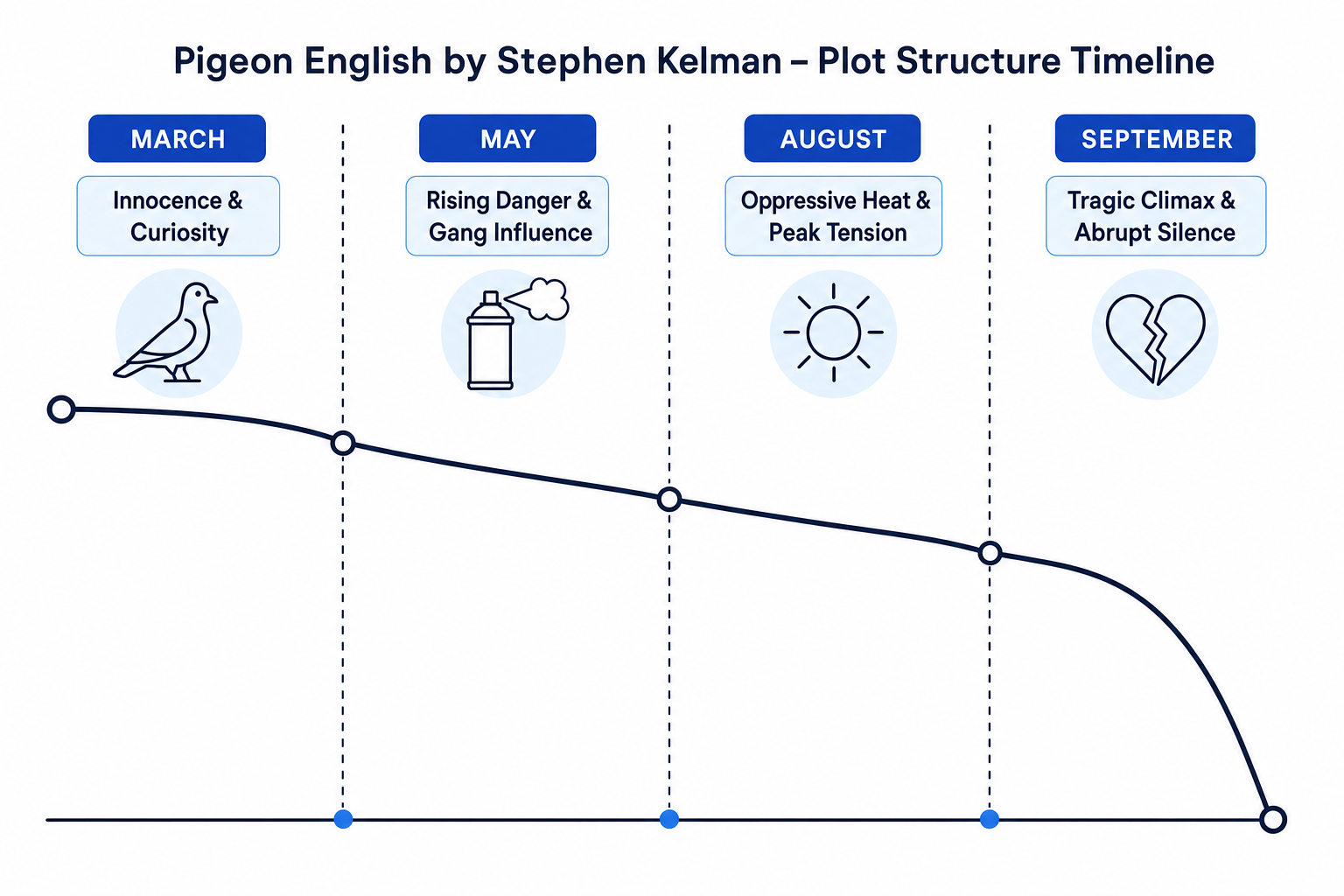
Structure as a Countdown
Kelman's monthly structure is not just a calendar; it is a structural device that heightens dramatic tension. The transition from the fresh hope of "March" to the suffocating heat of "August" and the abrupt end in "September" mirrors the physical and emotional entrapment of the estate's youth.
1. March: The Loss of Sanctuary
The Opening Scene and the Inciting Incident
The novel opens immediately in the aftermath of violence: "You can see the blood if you look close." By placing the murder of the "dead boy" on the very first page, Kelman establishes the setting not as a playground, but as a crime scene.
In "March", Harri’s voice is at its most innocent. He blends Ghanaian culture (his belief in magic, his love for his mother, and his awe of the urban environment) with his new London life.
Key Elements of "March":
- The Voice: Harri uses vibrant, energetic colloquialisms like "bo-moba" (crazy) and "properly" to construct a highly visual, sensory world.
- The Symbol of the Pigeon: We are introduced to the pigeon, which acts as a silent observer. It represents a detached, spiritual perspective on the harsh reality of human concrete jungles.
- The Detective Quest: Harri and his friend Dean decide to investigate the murder. In "March", this investigation is framed as a childish game, reminiscent of adventure stories.
2. May: The Encroaching Shadow
By "May", the playful innocence of the investigation begins to sour. The reality of the Dell Farm Crew (DFC)—the local gang—starts to press in on Harri’s domestic life.
Key Elements of "May":
- The Fingerprint Scene: Harri and Dean attempt to collect fingerprints using sellotape. What began as a game is now turning into a dangerous intersection with real criminals.
- Lydia's Involvement: Harri’s sister, Lydia, is drawn closer to the older gang members (specifically Killa). This introduces a parallel plotline of peer pressure and the vulnerability of young girls on the estate.
- The Pigeon's Voice: The pigeon begins to speak in italics, offering surreal, poetic commentary on the human condition: "You’re only a flock. You’re only a swarm." This shifts the novel's form from simple social realism to magical realism.
Spotting the linguistic shift
Look closely at how Harri’s language changes when he interacts with the DFC in "May". He begins to adopt their aggressive street slang (e.g., "pussyole", "wet") not because he is violent, but as a psychological shield to blend in and survive.
3. August: Peak Tension and Pathetic Fallacy
"August" is the thematic and atmospheric climax of the rising action. Kelman uses pathetic fallacy to mirror the explosive tension within the community.
Pathetic Fallacy
Pathetic fallacy is a literary device where the writer attributes human emotions or traits to nature, the weather, or inanimate objects, reflecting the inner moods of the characters or the atmosphere of the scene.
The oppressive summer heatwave makes the flats feel like a pressure cooker. The estate is claustrophobic, and the safe spaces where Harri used to play are now claimed by the gang.
Key Elements of "August":
- The Physical Heat: The sun is described as an active predator: "The sun was trying to kill us." This physical discomfort reflects the mounting social pressure on Harri to conform to gang demands.
- The Confrontation: The DFC actively pressure Harri to prove his loyalty. The boundary between Harri's innocent childhood games and the brutal code of the street is completely shattered.
Analysing pathetic fallacy and structural tension in August
Walk through the process of writing an analytical paragraph on how Kelman uses structural tension and atmospheric changes in the "August" chapter to foreshadow tragedy.
- State your analytical point clearly, focusing on the writer’s method and intent: Kelman utilizes pathetic fallacy in the "August" chapter to parallel the suffocating, inescapable nature of the estate's gang culture with an oppressive heatwave, preparing the reader for the inevitable eruption of violence.
- Introduce your evidence naturally, keeping the quotation short and precise: This atmospheric pressure is felt acutely by Harri, who notes that "the heat was everywhere" and that it "makes you feel like you’re being squeezed."
- Analyse the linguistic and structural effects of the quotation (AO2): The verb "squeezed" suggests physical entrapment, conveying how the physical climate of London in August mirrors the social claustrophobia of the council estate. This structural placement in late summer, just before the novel’s tragic climax, indicates that the tension has reached its absolute limit.
- Connect your analysis to the wider contextual themes of the novel (AO3): By placing Harri in this oppressive environment, Kelman highlights how socio-economic deprivation and urban confinement limit the choices of immigrant children, leaving them vulnerable to the external pressures of gang recruitment.
4. September: The Tragic Abruptness
"September" is the shortest section, containing the novel’s devastating climax. Structurally, it functions as an anti-Bildungsroman.
Anti-Bildungsroman
While a standard Bildungsroman is a coming-of-age novel tracking a protagonist's growth into adulthood, an anti-Bildungsroman subverts this. It depicts a young protagonist whose potential, growth, and life are cut short by a corrupt or hostile society.
Key Elements of "September":
- The Sudden Attack: Harri is stabbed by a member of the DFC. The violence is not glorified; it is shockingly fast and clinical.
- The Loss of Voice: As Harri dies, his vibrant narrative voice begins to fragment and fail. The short sentences and trailing thoughts reflect his physical decline.
- The Pigeon's Final Departure: The pigeon is present at the end, flying away as Harri's life ends. This final structural image emphasizes the soul's release from the concrete prison of the estate.
Ignoring the Pigeon's Monologues
Many students treat the pigeon’s italicised sections as "weird" or "irrelevant" and ignore them in essays. In GCSE exams, analysing these passages shows high-level structural understanding. The pigeon represents the spiritual perspective that Harri cannot articulate himself, highlighting the tragedy of his lost potential.
In the exam
To achieve a Grade 7, 8, or 9 when writing about the structure or key chapters of Pigeon English, use these three steps:
- Track the Chronological Decay: Do not treat quotes as isolated events. Explain where they happen in the timeline (e.g., "In the early, hopeful chapters of March..." vs. "By the oppressive climate of August..."). Show the examiner you understand the novel's trajectory.
- Anchor Language to Structure: Whenever you analyse a linguistic method (like Harri’s use of slang or magical realism), explain why it appears in that specific month. For example, explain how his voice loses its playful Ghanaian lyricism as the gang threat peaks in late summer.
- Address the Tragic End Structurally: Always address the sudden, abrupt ending of "September". Explain how Kelman uses this sudden termination of the first-person narrative to shock the reader, forcing us to confront the real-world reality of youth knife crime in modern Britain.
Check yourself
- Why does Stephen Kelman choose to structure the novel using months (March to September) instead of conventional, numbered chapters?
- How does the atmospheric description of the weather change from the spring of "March" to the peak of summer in "August", and what does this reflect?
- What are the structural clues in the final chapter ("September") that signal Harri’s narrative voice is fading away?
