What you'll learn
- How to turn a Frankenstein question into a clear argument.
- How to build a three-paragraph plan that covers the extract and the whole novel.
- How to include quotations, methods and context without sounding like a memorised essay.
- How to adapt plans for common themes such as ambition, responsibility, isolation and monstrosity.
Why essay plans matter
An essay plan is a brief route-map for your answer. It stops you from retelling the plot and helps you build a clear argument.
In AQA Paper 1, the 19th-century novel question gives you an extract and asks you to write about the extract and the novel as a whole. That means your plan needs two things: close detail from the printed passage and wider references from elsewhere in Frankenstein.
Plan the argument, not the memory dump
A strong plan is not “everything I know about Victor” or “all my ambition quotes”. It is a sequence of points that answer the exact question.
Step 1: Turn the question into a thesis
A thesis is your overall answer to the question: the main idea your whole essay will prove.
For Frankenstein, a good thesis usually recognises that Shelley is doing something complex. Victor is guilty, but the Creature is not innocent. Knowledge is exciting, but it becomes dangerous without responsibility. Society rejects the Creature, but he still chooses revenge.
Thesis
A thesis is a one-sentence argument that directly answers the question and gives your essay a clear direction.
Turning a responsibility question into a thesis
Question idea: “How does Shelley present Victor as responsible for suffering in the novel?”
- Decide what “responsible” means in this question: Victor causes suffering not only by creating the Creature, but by abandoning him, hiding the truth, and refusing to protect others.
- Balance the argument: the Creature chooses violence, so your thesis should not pretend Victor commits every crime himself.
- Shape the thesis: Shelley presents Victor as deeply responsible because his ambition and neglect create the conditions for tragedy, even though the Creature remains morally accountable for his revenge.
Starting with quotes instead of ideas
Do not begin your plan by listing quotations. Start with your argument, then choose quotations that prove it.
Step 2: Build a line of argument
A line of argument is the way your ideas develop from the start of the essay to the end. For Frankenstein, a beginning–middle–end structure often works well because the novel itself is about consequences growing over time.
You can organise your three main paragraphs like this: early moment, central turning point, final consequence. The flowchart below shows a simple planning route you can reuse.
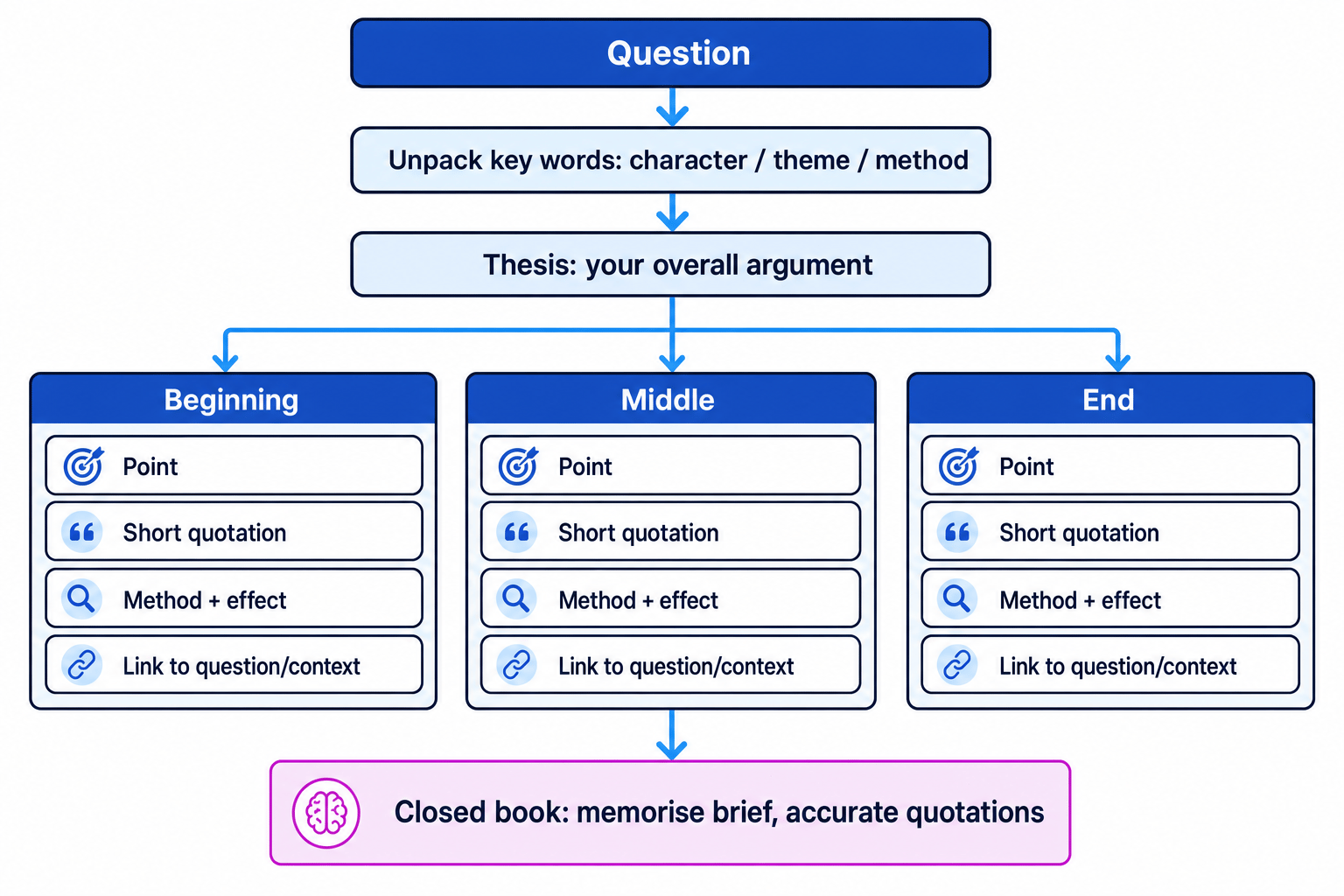
Planning an ambition essay route
Question idea: “How does Shelley present ambition as dangerous?”
- Use an early moment to show ambition as attractive: Victor says in Chapter 2, “I ardently desired the acquisition of knowledge,” while Walton asks in Letter 3, “What can stop the determined heart and resolved will of man?”
- Use the creation scene to show ambition turning into horror: in Chapter 5, Victor says “the beauty of the dream vanished,” so Shelley transforms his dream into a nightmare.
- Use the ending to show the warning clearly: in Chapter 24, Victor tells Walton to “Seek happiness in tranquillity and avoid ambition,” making the novel’s structure feel like a cautionary journey.
Step 3: Make every paragraph analytical
A topic sentence is the first sentence of a paragraph, stating the point you will prove. Evidence means a short quotation or precise reference. A method is a writer’s choice in language, form or structure. Effect means what that choice makes the reader think or feel.
In Frankenstein, useful methods include:
- Frame narrative: a story inside another story. Walton’s letters frame Victor’s story, and Victor’s story frames the Creature’s voice.
- Allusion: a reference to another text, myth or story, such as Paradise Lost or Prometheus.
- Gothic imagery: dark, frightening description linked to fear, secrecy and transgression.
- Pathetic fallacy: weather or setting reflecting mood, as in the “dreary night of November”.
- Semantic field: a group of words linked by meaning, such as prison imagery in “solitary chamber, or rather cell”.
Method
A method is a deliberate choice Shelley makes — in language, form or structure — to shape meaning and affect the reader.
Building one analytical paragraph
- Make the point specific: Shelley presents the Creature as more than a simple villain by giving him moral awareness and a powerful sense of abandonment.
- Choose precise evidence and method: in Chapter 10, the Creature says, “I ought to be thy Adam, but I am rather the fallen angel.” The Biblical allusion contrasts innocent creation with corruption and exile.
- Explain the effect: the reference encourages readers to see Victor as a failed creator who rejects his “Adam”, while the Creature’s comparison to a “fallen angel” foreshadows his movement towards revenge.
- Link back to the question: this supports an argument that Shelley presents monstrosity as something partly created by rejection, not simply born.
Device spotting
Do not write, “This is an allusion, which makes it effective.” Always explain what the method reveals about character, theme or Shelley’s message.
Using the extract properly
The question wording usually begins “Starting with this extract…”. That means the extract is not optional. A sensible plan uses one paragraph mainly on the extract, then connects out to two wider moments in the novel.
A quick extract balance
Aim for one strong extract paragraph and two whole-novel paragraphs. If the extract is very rich, you can mention it again later, but do not stay trapped inside it.
Balancing the creation extract
If the extract is from Chapter 5, when the Creature comes alive:
- Analyse the extract closely: “dreary night of November” uses pathetic fallacy to create a dark, unnatural atmosphere around the creation.
- Connect backwards: in Chapter 4, Victor imagines that a “new species would bless me as its creator and source,” showing that his ambition was self-glorifying before the horror began.
- Connect forwards: Victor’s immediate “horror and disgust” leads to abandonment, so the extract becomes the turning point that causes later suffering.
Flexible essay plans for common questions
Use these as adaptable starting points, not memorised essays.
Plan A: Ambition and dangerous knowledge
Thesis: Shelley warns that knowledge becomes dangerous when ambition is separated from humility, love and responsibility.
- Beginning: Walton in Letter 3 asks, “What can stop the determined heart and resolved will of man?” Link Walton and Victor through the frame narrative.
- Middle: Victor in Chapter 5 admits “the beauty of the dream vanished.” Gothic imagery turns scientific success into horror.
- End: Victor warns Walton in Chapter 24 to “avoid ambition.” The ending makes Victor’s life a cautionary example.
Plan B: Responsibility and creation
Thesis: Shelley presents Victor as a failed creator whose greatest sin is not making life, but refusing responsibility for it.
- Beginning: Victor imagines a “new species” will “bless” him in Chapter 4. His language shows pride and self-worship.
- Middle: The Creature tells Victor in Chapter 10, “I ought to be thy Adam.” The allusion highlights Victor’s duty as creator.
- End: After Elizabeth’s death, Victor becomes trapped in revenge. Shelley shows responsibility ignored until it becomes irreversible.
Plan C: The Creature as victim and villain
Thesis: Shelley makes the Creature sympathetic through his suffering, but also shows that pain does not excuse cruelty.
- Beginning: In Chapter 5, Victor focuses on the Creature’s “yellow skin” and feels “horror and disgust”. The Creature is rejected before he speaks.
- Middle: In Chapter 10, the Creature says, “I was benevolent; my soul glowed with love and humanity.” His own narrative challenges Victor’s version.
- End: In Chapter 17, he declares, “If I cannot inspire love, I will cause fear.” Shelley complicates our sympathy by showing his choice of revenge.
Plan D: Isolation
Thesis: Shelley presents isolation as destructive because it cuts characters off from sympathy, moral guidance and community.
- Beginning: Victor works in a “solitary chamber, or rather cell” in Chapter 4. The prison-like image suggests his ambition traps him.
- Middle: The Creature says, “I am malicious because I am miserable” in Chapter 17. Shelley links social rejection to moral damage.
- End: Walton’s loneliness frames the novel, but he finally listens to his crew and turns back. This contrasts with Victor, who ignores human connection too late.
Making context useful
Context means the ideas, beliefs and events surrounding the text’s creation and reception. In a Frankenstein essay, context should support your interpretation, not replace it.
Useful context links include Shelley’s interest in scientific discovery, Romantic concerns about nature and emotion, the Prometheus myth in the subtitle, and religious ideas about creation and duty. Only use context when it helps answer the question.
Context sentence frame
Try: “For Shelley’s readers, this would also suggest…” Then connect the context directly to the quotation and argument.
In the exam
- Spend a few minutes forming a thesis before you write; it will make the whole essay more focused.
- Plan three paragraphs: one close extract point, then two wider novel points that show development or consequence.
- Use short quotations accurately, name Shelley’s method, and always link back to the question.
Check yourself
- Can you write a one-sentence thesis for a question on Victor’s responsibility?
- Can you name three moments from different parts of the novel for an essay on ambition?
- Can you explain the effect of “I ought to be thy Adam” without just labelling it as an allusion?
