

Planning is the single most important step in writing a successful GCSE English Literature essay. In the pressurized environment of the exam, it can be tempting to start writing immediately. However, an unplanned essay often becomes a plot summary, losing track of the question and failing to show the examiner a clear, structured argument.
This guide will teach you how to design a high-scoring, cohesive essay plan specifically for Stephen Kelman's Pigeon English.
What you'll learn
- How to deconstruct an exam question to find its core focus
- How to write a sophisticated, debate-driven thesis statement
- How to structure a three-part essay that tracks the novel's trajectory
- How to select high-yield quotes and link them to Kelman’s methods and social context
Understanding the Exam Requirements
Before putting pen to paper, you must understand what the examiners are looking for. For Paper 2, Section A (Modern Texts), your essay is assessed on three main areas:
- Your Response to the Text (AO1): Presenting a clear, personal, and logical argument that directly answers the question, supported by well-selected, precise quotations.
- Analysis of Writer's Methods (AO2): Exploring how Kelman uses language, form, and structure to build meaning, using terms like colloquialism, symbolism, foreshadowing, and first-person narrative.
- Understanding of Context (AO3): Linking the text to the social, historical, and cultural ideas surrounding its creation, such as the struggles of working-class immigrant communities, urban gang culture, and the real-world inspiration of the Damilola Taylor case.
Thesis Statement
A thesis statement is a one- or two-sentence summary of your main argument. It acts as a roadmap for your entire essay, telling the examiner exactly what your overarching perspective is on the character, theme, or relationship in the question.
The Three-Stage Essay Structure
A highly effective way to structure an essay on a novel is chronologically or progressively. Instead of writing random points, you should track how a theme or character develops from the beginning, through the middle, to the climax and resolution of the novel.
This structural approach shows the examiner that you understand the novel as a deliberate, constructed piece of art, rather than just a sequence of real events.
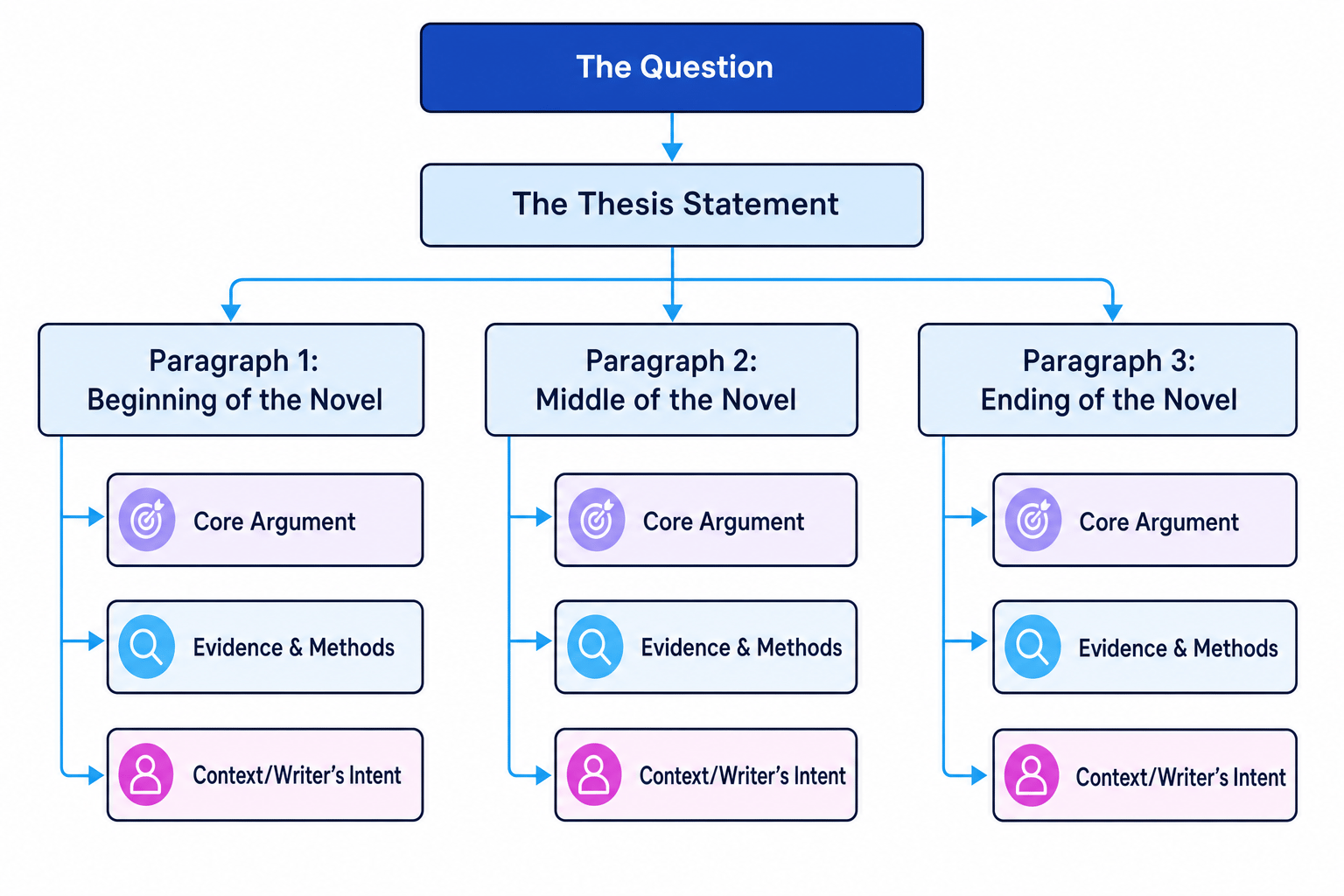
1. The Introduction (The Thesis)
Your introduction should never just repeat the question. Instead, it must offer a conceptual answer. It should introduce why Kelman is presenting this theme or character. What is his broader message to the reader?
2. Paragraph 1: The Beginning
Explore the initial state of the character or theme.
- For example: How does Harri's innocence manifest at the start of the novel? How does he view his environment?
- Focus: Set up the baseline of your argument and analyze early linguistic patterns (like Harri's playful, Ghanaian-inflected slang).
3. Paragraph 2: The Middle (The Rising Action)
Analyze how the theme or character changes as conflicts arise.
- For example: How is Harri's innocence threatened by the reality of the Dell Farm Crew (DFC)? How does the pressure to conform start to build?
- Focus: Highlight key turning points, shifts in tone, or structural changes.
4. Paragraph 3: The Climax and Resolution
Analyze the tragic culmination of the novel and what it teaches the reader.
- For example: What does Harri's sudden, tragic death reveal about the vulnerability of innocence in this environment? What is the symbolic role of the pigeon at the end?
- Focus: Look at the resolution and tie the writer's ultimate message directly to his context and purpose.
Think of the Novel as a Construct
Always remember that Harri Opoku is not a real person—he is a construct. Kelman created him to represent the vulnerability of young, working-class immigrants in urban environments. Every word and structural shift is a deliberate choice by the author.
How to Deconstruct a Question and Plan
When you are presented with an essay prompt, you must break it down systematically before you start planning. Use the following worked example to see this process in action.
Developing an Essay Plan on the Theme of Violence
Let's walk through how to plan an essay for the prompt: "Explore how Kelman presents the impact of violence in Pigeon English."
-
Deconstruct the prompt to identify the core focus and key themes.
- Focus: "presents the impact of violence".
- Keywords: "presents" (demands AO2 analysis of methods) and "impact of violence" (demands analysis of how violence affects characters, the community, and the atmosphere).
-
Formulate a sophisticated thesis statement (the "big idea").
- Drafting the thesis: Kelman presents violence not just as a physical act, but as a corrosive, inescapable force on the estate that gradually strips away the innocence of young children like Harri, ultimately demonstrating how systemic neglect and toxic environments trap and destroy vulnerable youths.
-
Map out Paragraph 1 (Beginning: The normalized and distant threat of violence).
- Focus: At the start, violence is normalized but kept at a distance by Harri's childlike innocence.
- Quote: "Somebody got dead under the grill" / the bloodstain on the pavement.
- Method: First-person narrative voice, childish colloquialisms ("got dead"), juxtaposition of playful innocence with horrific reality.
- Context: Social alienation, high crime rates on inner-city London estates, and the desensitization of youth.
-
Map out Paragraph 2 (Middle: The escalating pressure and temptation of violence).
- Focus: Violence becomes an active, seductive force represented by the DFC, forcing characters to choose between victimhood and aggression.
- Quote: "If you're small they want to eat you," and the gang initiating members through violence.
- Method: Animalistic metaphors ("eat you"), aggressive verbs, peer-pressure dialogue.
- Context: The lure of street gangs as a substitute for family, protection, and economic security in neglected communities.
-
Map out Paragraph 3 (Climax/Ending: The ultimate, tragic consequence of violence).
- Focus: The final, devastating impact of violence is the absolute destruction of innocence and life, showing that the system fails to protect the vulnerable.
- Quote: "I'm checking the blood. It's coming out of my tummy."
- Method: Short, simple sentences, sudden structural climax, tragic irony (Harri was just trying to do good).
- Context: Inspired by the tragic, real-life stabbing of 10-year-old Damilola Taylor in London in 2000, reminding readers of the immediate, human cost of ignoring youth violence.
Feature Spotting
Do not just identify literary devices (e.g., saying "Kelman uses a metaphor here") without explaining why he used it and what its effect is on the reader. Method identification must always serve your main argument.
Integrating Quotations and Context Seamlessly
To achieve high marks in your essay, your planning must integrate context (AO3) smoothly with your analysis of language (AO2). Rather than tacking a paragraph of historical facts onto the end of your essay, weave it into your analysis of the writer's intent.
The 'Why' Chain
When planning a paragraph, ask yourself:
- What does the character say/do? (Point)
- How does the writer show this? (Method/Quote)
- Why did the writer choose this specific word/image? (Effect)
- Why did the writer want to send this message to the reader in modern Britain? (Context/Intent)
Example of Planning an Integrated Segment
If you are planning a section on the character of Mamma (Harri's mother), you might plan like this:
- Point: Kelman shows the intense pressure on immigrant parents trying to protect their children from the hostile urban environment.
- Evidence: Mamma praying intensely, trying to keep "the devil" away, and working exhausting hours.
- Method: Religious imagery, symbolic refuge of their small flat.
- Context/Intent: Highlighting the systemic struggles of the "Windrush generation" and subsequent West African immigrant communities in the UK. Kelman exposes the lack of state support, forcing families to rely solely on faith and intensive labor to survive.
In the exam
- Spend 5 to 8 minutes planning. It may feel like you are losing writing time, but a solid plan will make you write much faster, clearer, and more persuasively once you begin.
- Write your thesis statement out in full on your planning sheet. Having this clearly written down will keep you focused and prevent your essay from drifting off-topic.
- Select only 2 or 3 high-quality quotes per paragraph. It is far better to analyze one word or phrase deeply (exploring multiple connotations) than to write out long, chunky block quotes that you only skim over.
- Draw a quick timeline. Map your three paragraphs across the chronological timeline of the novel (Beginning →\rightarrow→ Middle →\rightarrow→ Ending) to ensure your essay demonstrates a thorough understanding of the text's structure.
Check yourself
- Can you write a thesis statement on how Kelman presents the character of Jordan in under two minutes?
- Do you have a bank of at least three short, memorable quotes for each of the main themes (Innocence, Violence, Identity, and Hope)?
- Does your three-part plan track the structural trajectory of the novel rather than jumping randomly between scenes?
