

When studying Stephen Kelman’s Pigeon English, it is easy to get swept up in Harri Opoku’s vibrant, energetic voice. However, to achieve the highest marks in your GCSE English Literature exam, you must understand why Kelman wrote this novel and how the world outside the book shaped the story inside it.
This guide explores the historical, social, and cultural contexts of the novel. It will show you how to weave this knowledge (assessed as Assessment Objective 3 / AO3) seamlessly into your literary analysis.
What you'll learn
- The real-life tragedy that inspired Stephen Kelman to write the novel.
- The social realities of urban deprivation, youth violence, and gang culture in 21st-century London.
- The cultural background of the Ghanaian diaspora, including the blending of languages and spiritual beliefs.
The Core Contextual Pillars
To write a sophisticated essay, you need to understand the five main contextual pillars that underpin Pigeon English.
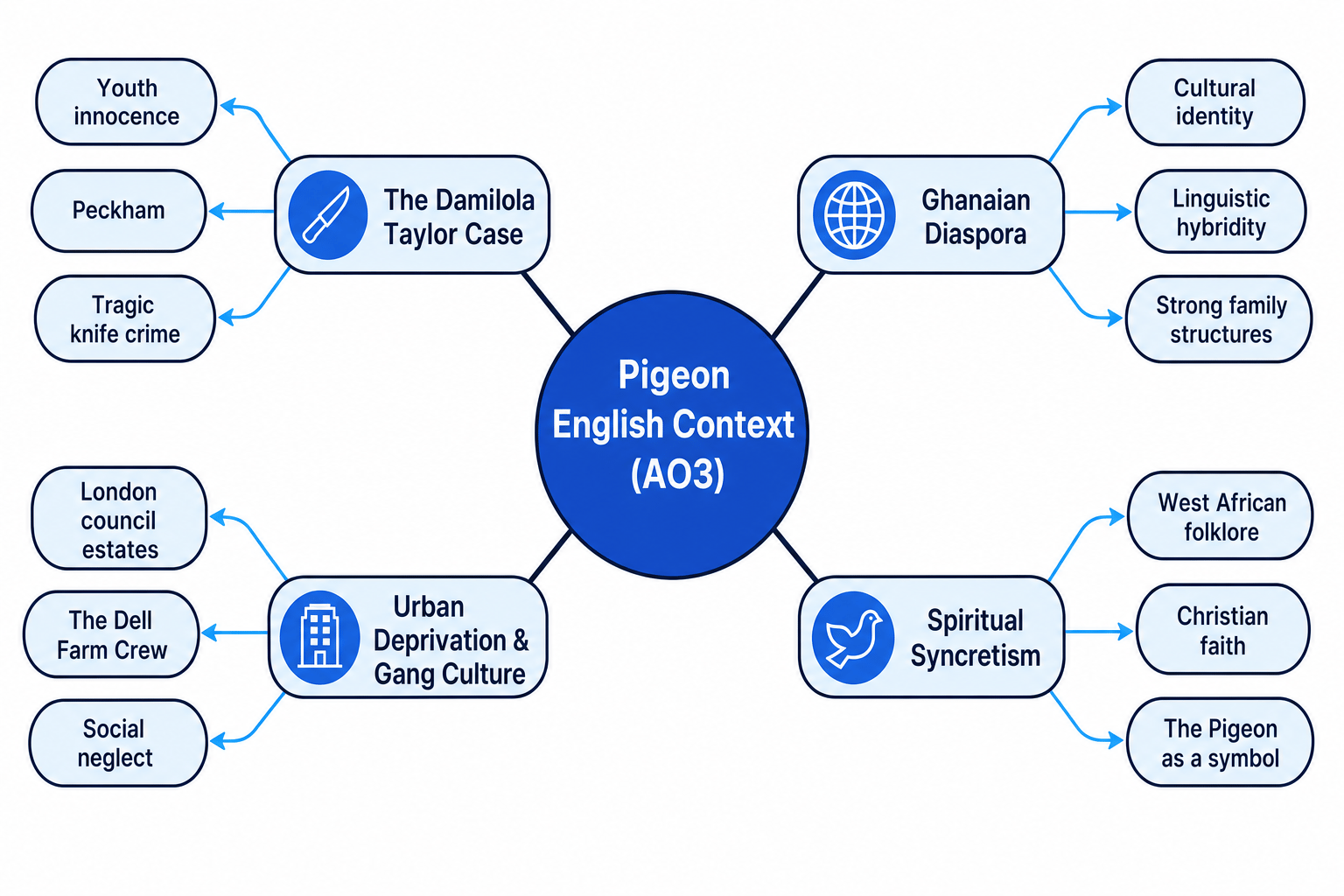
1. The Real-Life Inspiration: The Death of Damilola Taylor
In November 2000, a ten-year-old Nigerian boy named Damilola Taylor was stabbed to death with a broken bottle in Peckham, South London. He had moved to the UK from Nigeria only a few months prior.
Damilola’s death shocked the nation. It exposed the stark realities of youth vulnerability, knife crime, and the struggles faced by new immigrant communities in London's inner-city estates.
Catalyst
A catalyst is an event, person, or thing that precipitates or hastens a change or action. In literature, a real-world catalyst is the specific event that inspires a writer to produce a work.
Stephen Kelman lived in Peckham at the time of the killing. He was deeply affected by the tragedy and the media's representation of the area as a hopeless, violent wasteland. Kelman wrote Pigeon English as a direct response to this event.
His goal was to write from the perspective of a boy like Damilola—focusing not just on his tragic end, but on his innocence, his joy, his sense of wonder, and his humanity.
The Power of Harri's Voice
Kelman did not want Harri Opoku to be remembered merely as a statistic or a victim. By using a first-person narrator, Kelman forces the reader to experience the world through the eyes of an innocent child, making the eventual tragedy feel deeply personal and preventable.
2. Urban Deprivation and the "Inner-City Estate"
The novel is set on a fictional South London council estate. During the late 20th and early 21st centuries, many social housing estates in the UK suffered from systemic underinvestment, high unemployment, and social exclusion.
- Physical Environment: The architecture of these estates—high-rise tower blocks, concrete walkways, and dark stairwells—often created isolated, prison-like environments. In the novel, Harri describes his estate as a place of restricted horizons, where the flats are small and the outside world feels both chaotic and dangerous.
- Social Deprivation: The lack of funding for youth clubs, community centres, and local services left young people with very few positive outlets. Kelman highlights this through the lack of supervision and the empty spaces where the children play, such as "the building site" and the concrete courtyards.
Blaming the characters
Avoid writing that characters like the Dell Farm Crew are "inherently evil." Instead, use your understanding of AO3 to explain how systemic poverty, social neglect, and a lack of opportunities drive these young people toward criminal behaviour as a survival mechanism.
3. Youth Violence, Knife Crime, and Gang Culture
During the early 2000s, British media and politicians focused heavily on the rise of "postcode wars"—territorial disputes between rival youth gangs operating in specific urban neighbourhoods.
- The Dell Farm Crew: Kelman models the Dell Farm Crew on real-life street gangs. These groups targeted vulnerable, younger boys for recruitment.
- Grooming: Gangs offer younger children a false sense of security, belonging, identity, and financial reward in an environment where they feel otherwise powerless. We see this when the Dell Farm Crew try to recruit Harri, using peer pressure and intimidation.
- Knife Crime: Carrying a weapon is presented in the novel not just as an act of aggression, but as a tragic symptom of fear. Many young people carried knives because they believed everyone else was carrying one, creating a self-perpetuating cycle of violence.
4. The Ghanaian Diaspora and Cultural Identity
Harri and his family are part of the Ghanaian diaspora in London.
Diaspora
A diaspora is a scattered population whose origin lies in a separate geographic locale. In this context, it refers to Ghanaian immigrants who have moved to the UK but maintain strong ties to their homeland's culture, language, and traditions.
Kelman explores the dual identity experienced by first-generation immigrants:
- Linguistic Hybridity: Harri’s language is a rich blend of Ghanaian Pidgin English (e.g., "chale", "obruni") and London street slang (e.g., "safe", "innit"). This hybrid language reflects his attempt to navigate two very different worlds: his traditional Ghanaian upbringing and his new British reality.
- Family Structures: Traditional Ghanaian family units are often matriarchal, deeply religious, and collectivist, placing a high value on respect for elders and community responsibility. Mamma’s strict rules and work ethic represent these values, which clash directly with the individualistic, lawless environment of the London estate.
Watch the slang!
When writing your essay, do not just list Harri’s slang words. Explain why he uses them. The juxtaposition of gentle Ghanaian terms and harsh London street slang illustrates his transition from innocent child to a street-smart urban teenager.
5. Spiritual Syncretism and Folklore
Many West African cultures practice a blend of traditional beliefs (such as animism or folklore) and imported monotheistic religions (predominantly Christianity or Islam).
Syncretism
Syncretism is the combining or merging of different beliefs, religions, or schools of thought.
In Pigeon English, this syncretism is highly visible:
- The Christian Faith: Harri’s mother is devoutly Christian, and Harri frequently mentions God, heaven, and prayer.
- Animistic Beliefs: Animism is the belief that non-human entities—such as animals, plants, and inanimate objects—possess a spiritual essence. Harri’s relationship with the pigeon reflects this. The pigeon acts as a guardian angel, a spiritual observer, and a connection to the natural world that is largely missing from the concrete estate.
Integrating Context with Literary Analysis
AQA examiners do not want a "history dump." You will not get high marks for simply writing a paragraph about Damilola Taylor if it is not tied directly to the language and structure of the novel.
To gain top marks, you must use AO3 (Context) to explain the writer's intentions (AO2).
Integrating context into text analysis
Analyze how Kelman presents the theme of vulnerability in the opening chapter of Pigeon English, using your knowledge of context.
- Formulate a clear point linking the theme to the author's social message:
- Drafting: Kelman immediately establishes the vulnerability of young boys in urban environments to highlight the tragic realities of knife crime and systemic neglect in early 2000s London.
- Select and embed precise evidence:
- Drafting: This is illustrated when Harri observes the blood of the dead boy on the pavement: "You could see where his blood was... It was like a spray paint of blood."
- Analyze the writer's methods (AO2):
- Drafting: The simile "like a spray paint of blood" is highly significant. The comparison of a child's life-blood to "spray paint"—a common form of urban graffiti—suggests how cheapened and normalised violence has become on the estate. Graffiti is an everyday feature of urban decay; by comparing the blood to it, Kelman suggests that the death of young Black boys risks being dismissed as just another unsightly mark on the concrete landscape.
- Weave in relevant context (AO3) to explain the writer's intent:
- Drafting: Here, Kelman directly channelled his shock at the real-life murder of ten-year-old Nigerian immigrant Damilola Taylor in 2000. By showing how quickly the physical evidence of the boy's death is washed away and ignored by passers-by, Kelman criticises a desensitised society that quickly forgets these young victims, urging the reader to look past the media sensationalism and recognise the tragic loss of human potential.
In the exam
- Never write a standalone "context paragraph" at the beginning of your essay. This is a major pitfall. Instead, weave your context throughout your entire essay, linking it directly to your language analysis.
- Use the formula: Point →\rightarrow→ Quote →\rightarrow→ Method →\rightarrow→ Analysis →\rightarrow→ Context/Intention. This ensures your context always serves to explain why Kelman wrote the scene.
- Use active verbs to link context to the writer. Write: "Kelman reflects...", "Kelman criticises...", "Kelman exposes...", or "Kelman was influenced by...". This keeps your focus on the writer's craft.
- Remember that context includes literary context. You can discuss the novel’s genre as a picaresque novel (a story featuring a roguish but appealing hero of low social class who lives by their wits in a corrupt society).
Check yourself
- How does the real-life case of Damilola Taylor differ from, and align with, the story of Harri Opoku?
- Why does Kelman use Ghanaian Pidgin English alongside London street slang, and what does this tell us about Harri’s identity?
- In what ways does the physical architecture of the council estate affect the choices available to characters like the Dell Farm Crew?
