What you'll learn
- What “context” means for Frankenstein in AQA GCSE English Literature.
- How Mary Shelley’s life, science, Romanticism, Gothic fiction and social debates shaped the novel.
- How to use context without bolting on random historical facts.
- Short, memorable quotations you can connect to context in a closed-book exam.
What context means
Context
Context means the historical, social, literary and personal circumstances surrounding a text’s writing and reception. In Frankenstein, context includes Mary Shelley’s life, early nineteenth-century science, Romantic ideas about nature, Gothic fiction and debates about responsibility.
For AQA, context is rewarded when you explain the relationship between the novel and the world around it. That means: do not simply say “Mary Shelley lived in the Romantic period.” Instead, explain how that period helps us understand Shelley’s warnings about ambition, creation, isolation or responsibility.
Context is not a history lesson
Use context to deepen your interpretation of a quotation. The best context sentence helps answer: why might Shelley present this idea in this way at this moment in history?
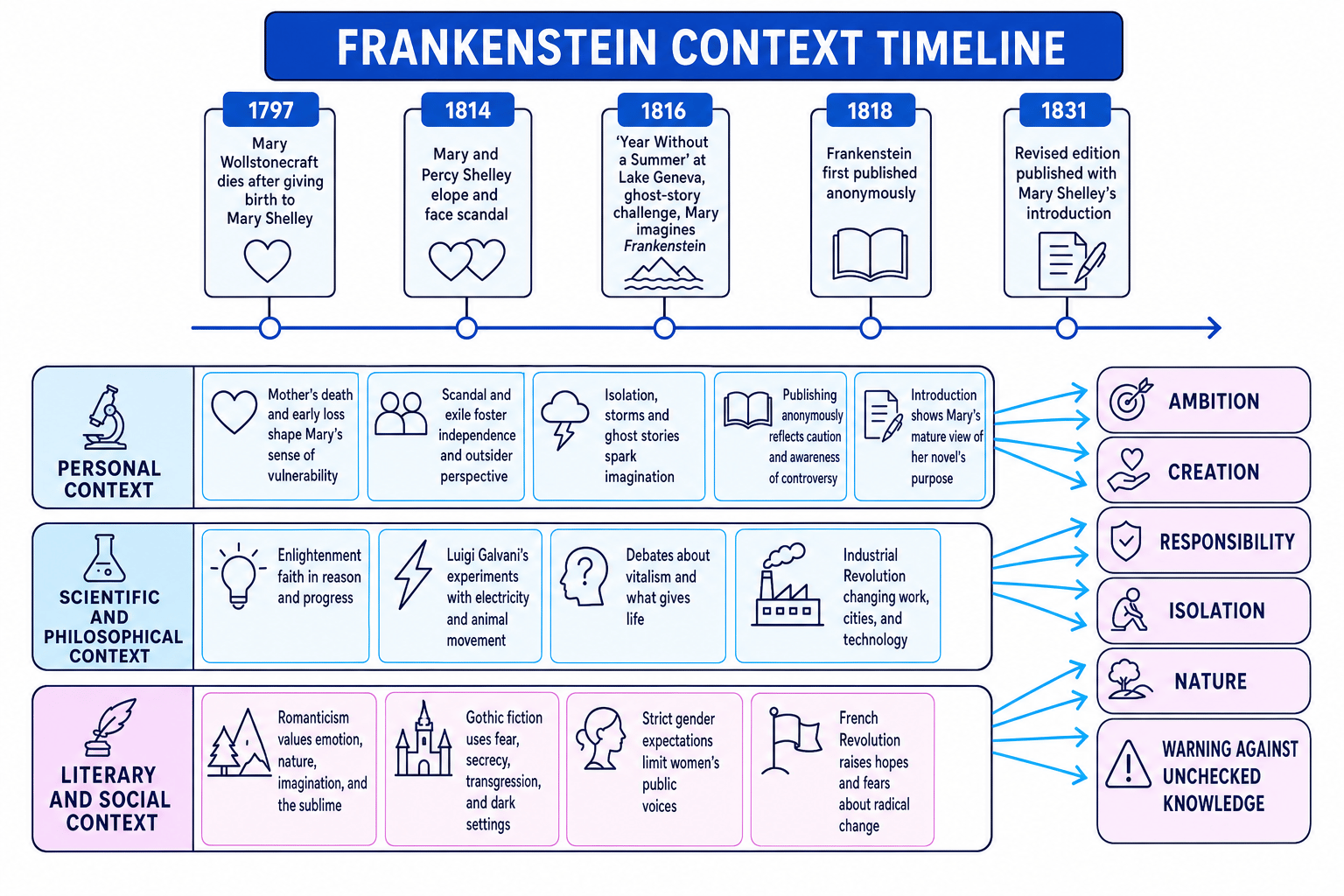
This timeline gives you the main contexts to keep in mind as you revise.
Frankenstein was Romantic, not Victorian
Frankenstein was first published in 1818, before the Victorian period began in 1837. It belongs to the Romantic period, a literary movement that valued emotion, imagination, individual experience, childhood, nature and the sublime.
The sublime
The sublime is an experience of nature that feels beautiful, terrifying and overwhelming at the same time, making humans feel small beside mountains, storms, ice or vast landscapes.
This matters because Shelley often places human ambition beside huge natural settings. Walton dreams of reaching a “country of eternal light”, while Victor finds that “sublime and magnificent scenes” offer temporary consolation. Nature is not just background: it reminds readers that human knowledge has limits.
Calling the novel Victorian
Do not write that Frankenstein is a Victorian novel. Shelley writes in the Romantic / Regency period, when writers were reacting against cold reason, industrial change and overconfidence in progress.
Mary Shelley’s personal context
Mary Shelley was the daughter of two radical thinkers: Mary Wollstonecraft, who argued for women’s education and rights, and William Godwin, a political philosopher. Wollstonecraft died shortly after Mary’s birth, so Shelley grew up with a powerful sense of maternal absence.
Shelley also experienced scandal and loss. She eloped with Percy Bysshe Shelley as a teenager, lived outside conventional respectability, and suffered the deaths of children. This does not mean the novel is “just about” her life, but it helps explain why Frankenstein is so interested in birth, abandonment, care and responsibility.
Turning biography into analysis
- Start with the textual detail: the Creature says, “No father had watched my infant days, no mother had blessed me with smiles and caresses.” The repeated negatives “No father” and “no mother” make his identity feel built around absence.
- Choose the relevant context: Shelley knew the emotional weight of parental loss, and her society strongly valued family care as a moral duty.
- Make the interpretation about the novel: Shelley suggests that creating life is not enough; a creator must nurture and guide what they bring into the world.
- Link to a theme: the Creature’s violence is therefore presented not as simple evil, but as partly produced by neglect.
Science, reason and dangerous ambition
In Shelley’s time, “science” was often called natural philosophy: the study of nature, including chemistry, anatomy and electricity. The Enlightenment was an earlier intellectual movement that valued reason, experiment and progress. Shelley inherits this excitement about knowledge, but also questions its dangers.
One important scientific context is galvanism, named after Luigi Galvani. It involved experiments where electricity made dead animal muscles twitch, raising disturbing questions about the boundary between life and death. Related debates about vitalism asked whether life depended on a special “vital spark” or could be explained materially.
Victor’s ambition reflects this world. He says, “I became myself capable of bestowing animation upon lifeless matter.” The phrase “bestowing animation” makes him sound almost godlike, as if life is a gift he can hand out.
Linking science to Victor’s warning
- Begin with the quotation: Victor tells Walton, “Learn from me… how dangerous is the acquirement of knowledge.” The adjective “dangerous” turns learning into a moral risk.
- Identify the method: Shelley uses Victor’s retrospective narration, meaning he tells the story after the disaster, so his warning carries guilt and hindsight.
- Connect context precisely: early nineteenth-century discoveries in electricity and anatomy made reanimation seem imaginable, not pure fantasy.
- Refine the argument: Shelley is not rejecting knowledge itself; she is warning against knowledge pursued in isolation, without ethics or responsibility.
- Link to the reader: a contemporary reader might admire scientific progress but fear what happens when ambition outruns moral judgement.
Saying Shelley is anti-science
Shelley does not simply say “science is bad.” The problem is Victor’s secrecy, pride and refusal to care for what he creates. Phrase it as a warning against unchecked ambition, not a rejection of discovery.
Gothic context: fear, secrecy and transgression
Gothic fiction
Gothic fiction is a literary tradition that uses fear, darkness, mystery, extreme settings, secrets and moral transgression to disturb the reader.
Frankenstein uses Gothic conventions, but it is more than a horror story. The creation scene happens on a “dreary night of November”, and the Creature’s “yellow skin” and visible “muscles and arteries” create physical horror. Shelley uses Gothic detail to make Victor’s transgression feel unnatural and morally disturbing.
A transgression is a crossing of a moral, social or natural boundary. Victor transgresses by trying to take control of life and death. The Gothic atmosphere makes the reader feel that he has crossed a line before the novel fully explains the consequences.
Literary and religious context: Prometheus and Paradise Lost
Shelley’s full title was Frankenstein; or, The Modern Prometheus. In Greek myth, Prometheus steals fire from the gods for humanity and is punished for overreaching. In some versions, he is also linked with creating human beings. By calling Victor a “Modern Prometheus”, Shelley presents him as a brilliant but punished overreacher.
Allusion
An allusion is a reference to another text, myth, historical figure or story. Shelley’s allusions to Prometheus and Milton’s Paradise Lost add layers of meaning to Victor and the Creature.
Milton’s Paradise Lost is an epic poem about Adam, Eve, Satan, rebellion and the Fall. The Creature compares himself to these figures when he says, “I ought to be thy Adam, but I am rather the fallen angel.” This is one of the most useful context quotations in the novel.
Reading the Paradise Lost allusion
- Compare the figures: Adam is created and cared for by God, while the “fallen angel” suggests Satan, rejection and rebellion.
- Apply this to the Creature: he believes Victor should have been a loving creator, but instead abandoned him.
- Analyse the effect: the allusion makes the Creature sound educated and morally thoughtful, not merely monstrous.
- Link to Shelley’s purpose: Shelley questions who is truly responsible for evil — the being who commits violence, or the creator and society that reject him.
Gender, family and responsibility
Shelley wrote in a patriarchal society, meaning one where men held most public, legal and intellectual power. Women were often associated with the private world of family, care and domestic virtue. This makes Victor’s project especially unsettling: he tries to create life without women, family or nurture.
Victor imagines, “A new species would bless me as its creator and source.” The nouns “creator” and “source” make his ambition sound divine and parental, but also selfish. He wants glory, not responsibility. His language about science can feel invasive too: “I pursued nature to her hiding-places.” This personification gives nature human qualities, making Victor seem aggressive in his desire to dominate it.
Shelley’s female characters often suffer because of male decisions, silence or ambition. You do not need to turn every paragraph into a feminist reading, but you can argue that the novel exposes the danger of creation without care and power without accountability.
Political and social context
Shelley grew up around radical political ideas. A radical is someone who supports major social or political change. The French Revolution had raised hopes for equality, but also fears of violence and chaos. This context helps us read the Creature as partly shaped by social rejection.
When the Creature says, “I was benevolent and good; misery made me a fiend,” Shelley suggests that people are not born monstrous: they can be made monstrous by cruelty, isolation and exclusion. This connects to wider debates about education, class, justice and society’s responsibility for outsiders.
The Industrial Revolution also forms part of the background: machines, factories and rapid technological change were transforming Britain. Frankenstein is not a factory novel, but it does share the period’s anxiety about progress becoming inhuman when separated from moral responsibility.
How to use context in your paragraphs
A strong context link usually follows this pattern:
- Make a point about Shelley’s idea.
- Use a short quotation.
- Analyse a method or word choice.
- Add a precise context link.
- Explain how the context deepens your interpretation.
Make context do analytical work
Use phrases like “Shelley’s context helps explain…”, “For a Romantic reader…”, or “This reflects contemporary anxieties about…”. Avoid vague openings such as “Back in those days…” or “In the olden times…”
For example, instead of writing, “Galvanism was popular then,” write: “Shelley draws on contemporary interest in galvanism to make Victor’s creation seem disturbingly possible, but his warning about the ‘dangerous’ acquirement of knowledge shows that the real issue is irresponsible ambition.”
In the exam
- Use one precise context link per analytical paragraph; do not unload everything you know at once.
- Always attach context to a quotation and a method, such as narration, allusion, Gothic setting, symbolism or word choice.
- Remember the exam is closed book, so revise short quotations: “dangerous”, “creator and source”, “fallen angel”, and “misery made me a fiend”.
Check yourself
- How can galvanism help explain Victor’s experiment without making Shelley sound anti-science?
- Why does the subtitle The Modern Prometheus matter?
- How could Romantic ideas about nature help you analyse the novel’s mountain or Arctic settings?
