

Stephen Kelman’s choice of narrative voice is the defining feature of Pigeon English. The entire novel—barring a few unusual sections—is told through the eyes and voice of Harrison "Harri" Opoku, an eleven-year-old Ghanaian boy who has recently migrated to a high-rise council estate in London.
In these study notes, you will learn how Kelman constructs this highly distinctive voice, how it bridges different cultures, and how Harri's innocence creates a powerful emotional impact on the reader.
What you'll learn
- How to define and analyze Harri's first-person limited narrative perspective.
- How Kelman blends Ghanaian dialect and London slang to create a unique "hybrid" voice.
- How the narrative voice uses dramatic irony to highlight the dangers of urban gang culture.
- The thematic purpose of the secondary narrative voice: the Pigeon.
1. The Innocent Observer: First-Person Limited
To understand Pigeon English, we must first look at who is telling the story. Kelman uses a specific narrative perspective to ground us in Harri's immediate world.
First-Person Limited Narrator
A first-person limited narrator is a storytelling voice that uses "I" or "we" and is restricted strictly to the thoughts, feelings, and immediate experiences of that single character. The reader only knows what this character sees, hears, and interprets.
Because Harri is only eleven years old, he is also an innocent narrator (sometimes called an naive or unreliable narrator). He does not have the life experience to fully comprehend the adult world, the systemic poverty, or the extreme danger of the gang culture surrounding him on the estate.
The Power of Dramatic Irony
Because Harri's perspective is limited by his youth, Kelman relies heavily on dramatic irony.
Dramatic Irony
Dramatic irony is a literary device where the reader understands the significance of a situation or event, but the character experiencing it does not.
When Harri observes the Dell Farm Crew (DFC) or interacts with older boys like Killa, he views their behavior as a thrilling game or a set of "cool" rules to follow. You, the reader, recognize the grooming, exploitation, and life-threatening danger of these interactions. This gap in understanding creates a persistent underlying tension and a deep sense of pathos (pity) throughout the novel.
Innocence vs. Experience
The central tension in the novel's narrative voice is the clash between Harri’s vibrant, innocent perspective and the bleak, violent reality of his environment. Harri's voice acts as a shield that temporarily softens the harsh world, making his ultimate fate even more devastating.
2. A Hybrid Voice: "Ghetto Globish" and Ghanaian Heritage
Harri does not speak standard English. His voice is a rich, energetic mixture of his West African heritage and the multicultural London English spoken by his peers on the estate.
To analyze how Kelman constructs this voice, we need to look at two linguistic concepts: idiolect and sociolect.
Idiolect & Sociolect
- An idiolect is an individual’s unique, personal way of speaking, including their specific vocabulary and speech habits.
- A sociolect is a variety of language (or slang) used by a particular social group or subculture.
Harri’s voice is a highly personalized idiolect constructed from two distinct sociolects:
- London Youth Slang ("Ghetto Globish"): To fit in and survive on the estate, Harri quickly adopts the language of his peers. He uses terms like "safe", "allow it", "innit", and "bo-mellow". He refers to things as "mad structural" or "massively" to show excitement.
- Ghanaian Dialect and Pidgin: Harri's internal thoughts and family conversations are steeped in his Ghanaian roots. He uses terms like "asake" (a word of greeting/respect), "chachy" (meaning fake or cheap), and "hutax" (a term for a police officer or authority figure).
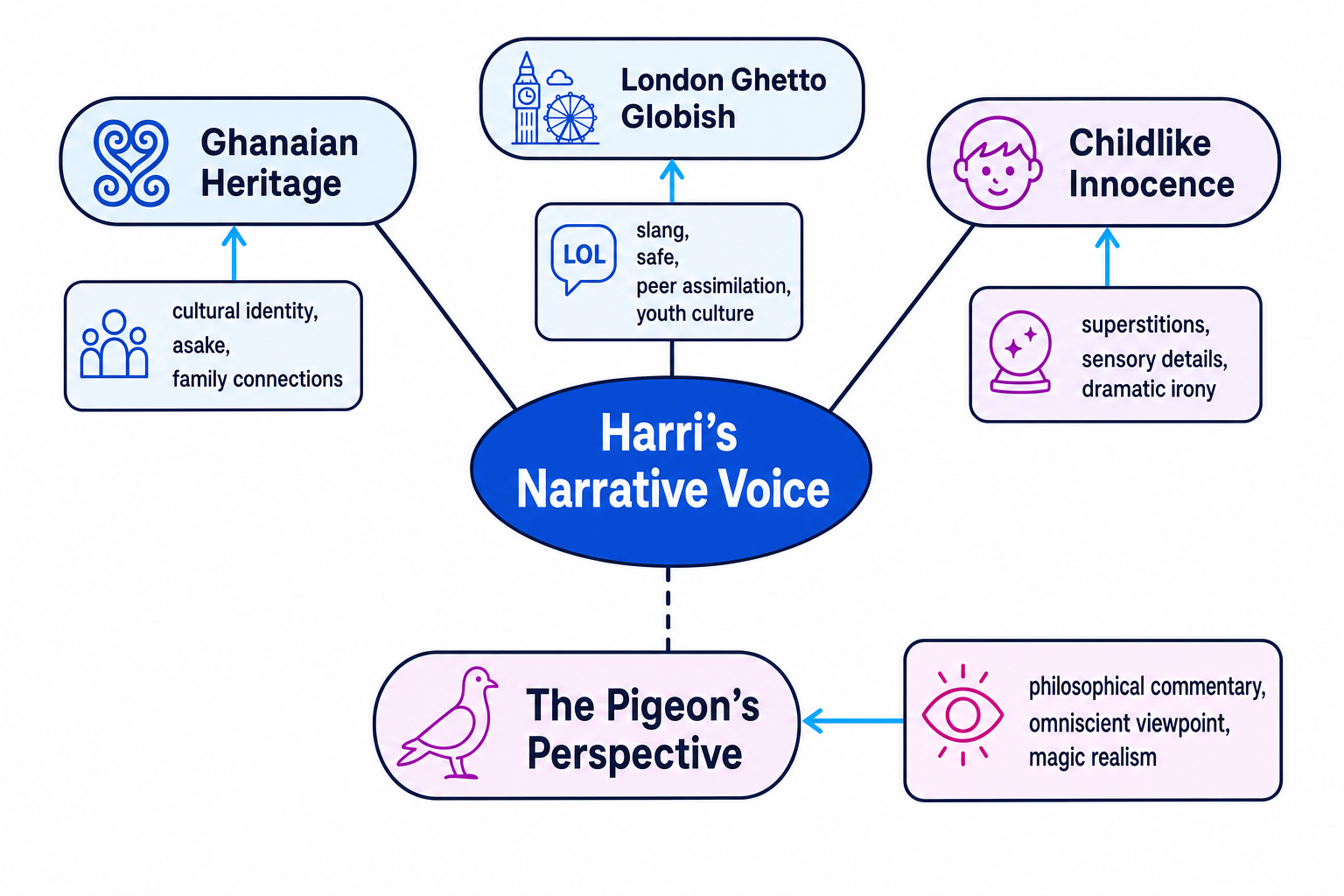
By blending these two languages, Kelman shows Harri’s struggle for identity. He is caught between the warm, community-focused traditions of his homeland and the aggressive, survival-ist culture of his new London home.
Spotting the dual voice
When analyzing quotations, look for sentences where Harri uses local slang and Ghanaian words in close proximity. This linguistic juxtaposition proves his dual identity and his attempt to navigate two very different worlds simultaneously.
3. Step-by-Step Analysis: How Harri's Voice Shapes Meaning
In the exam, you must prove how Kelman uses narrative voice to achieve a specific effect. Rather than just identifying the slang, you must analyze how Harri's unique phrasing and childlike focus reveal deeper thematic truths.
Let’s look at a worked example of how to build an analytical paragraph focusing on Harri's reaction to the novel's opening tragedy: the murder of the unnamed boy.
Analyzing Harri's perspective on the murder scene
Example Question: Explore how Kelman uses narrative voice to present Harri's reaction to violence at the start of the novel.
-
State your analytical point clearly (AO1): Kelman uses Harri’s innocent, childlike narrative voice to highlight the tragic normality of violence on the estate, creating immediate pathos for the young protagonist.
-
Introduce and embed precise evidence (AO1): When looking at the physical evidence of the young boy's murder, Harri notes: "You can see the blood. It’s a very bright red, like standard poppy day red... It’s clean. The rain didn't wash it away yet."
-
Analyze the writer's methods and language choices (AO2): Kelman uses a simple, domestic simile comparing the victim's blood to "standard poppy day red". The poppy is a symbol of remembrance and youth cut short, yet Harri uses it as a basic sensory point of comparison. Furthermore, the adjective "clean" to describe the blood is deeply ironic and jarring; blood from a violent assault is inherently messy and disturbing, but to Harri's young eyes, its bright purity is simply an object of curiosity.
-
Explain the effect on the reader (AO2): This childlike detachment creates a powerful sense of dramatic irony. The reader feels the sickening gravity of a child being stabbed on a street corner, while Harri focuses on the sensory purity of the color. This contrast emphasizes how desensitized the children on the estate are to extreme violence.
-
Link to context and authorial intent (AO3): Through Harri's naive voice, Kelman critiques a society that allows children to grow up in environments where murder is as ordinary as the weather. Inspired by the real-life murder of Damilola Taylor in 2000, Kelman uses this innocent lens to force the reader out of their own complacency, urging them to see the tragic loss of human life through the eyes of a child who still believes the world is a playground.
4. The Magical Voice: The Pigeon's Perspective
While Harri narrates almost the entire novel, Kelman occasionally breaks this structure by introducing a second, highly unusual narrative voice: the Pigeon.
These brief, poetic passages shift the novel into the realm of magic realism.
Magic Realism
Magic realism is a literary style that incorporates fantastic, surreal, or mythical elements into otherwise realistic, gritty settings.
The Pigeon’s voice contrasts sharply with Harri’s:
- It is philosophical, detached, and omniscient (all-knowing).
- It speaks in sophisticated, lyrical English, looking down on the human characters with a mixture of pity and wonder.
- It acts like a classical Greek Chorus, commenting on the tragic path Harri is walking without being able to step in and save him.
The Pigeon represents nature, spiritual protection, and a perspective that transcends the concrete walls of the estate. While Harri is trapped in his physical environment, the Pigeon’s voice reminds us of a wider, freer world.
Ignoring the Pigeon's narrative
Many students ignore the Pigeon chapters because they find them confusing. However, top-grade essays frequently analyze the contrast between Harri's fast-paced "Ghetto Globish" and the Pigeon’s slow, poetic, philosophical voice. This contrast highlights the spiritual decay of the urban estate.
In the exam
If you get a question on characters, violence, or setting in Pigeon English, you should always weave analysis of the narrative voice into your response:
- Never treat Harri's voice as accidental: Every "safe", "proper", or "asake" was chosen by Stephen Kelman for a reason. Argue that the voice is a deliberate construct designed to manipulate the reader’s emotional response.
- Track the voice's progression: At the start of the novel, Harri's voice is full of light, humor, and curiosity. As the threat of the DFC closes in, notice how his sentences become shorter, more fearful, and dominated by the rigid "rules" of the estate (e.g., "It's a rule").
- Analyze sentence structure (syntax): Harri often writes in long, rambling, syndetic coordination (sentences joined by "and... and... and"). This structure mirrors the fast-paced, unedited thoughts of a child, sweeping the reader along in his innocence.
Check yourself
- Why does Stephen Kelman use an eleven-year-old child to narrate a story about gang violence and murder? What is the main structural effect of this choice?
- Find three examples of "Ghetto Globish" and three examples of Ghanaian dialect in the text. How do these terms show Harri's split identity?
- What does the Pigeon's narrative voice offer the reader that Harri's first-person limited perspective cannot?
