What you'll learn
- How Shelley blends Gothic fiction with early ideas about science.
- How to analyse key methods such as setting, body imagery, frame narrative, allusion and doubling.
- How to connect methods to meaning: ambition, fear, transgression and responsibility.
- How to write about Gothic/science methods in a closed-book AQA answer.
First: what “methods” means
In English Literature, methods are the choices a writer makes to create meaning. For AQA, this usually means language, form and structure: the words Shelley chooses, the type of narrative she uses, and the order in which events and voices are presented.
Writer's methods
A writer’s methods are deliberate choices in language — words and imagery, form — the type of text or narrative style, and structure — how the text is organised.
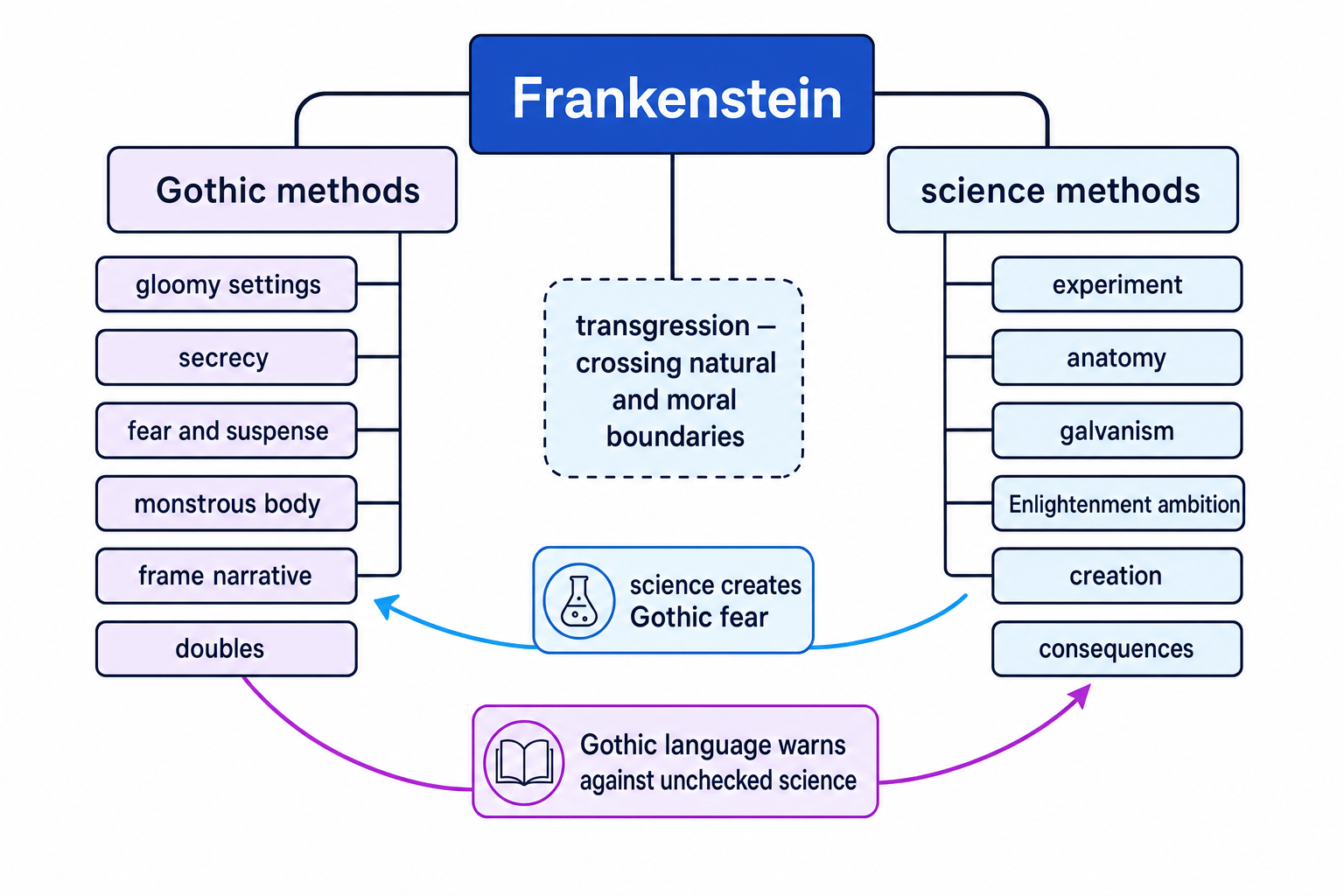
In Frankenstein, Gothic and scientific methods are not separate. Shelley makes Victor’s scientific experiment feel Gothic: secretive, frightening, morally dangerous and full of consequences.
The big idea: science becomes Gothic
Gothic fiction
Gothic fiction is a genre that uses fear, mystery, isolation, death, strange settings and disturbing events to explore human anxieties.
Natural philosophy
Natural philosophy was an early term for the study of nature, including what we would now call science. Victor describes it as “the genius that has regulated my fate”, making science sound powerful and almost supernatural.
The diagram below shows the central pattern: Shelley takes scientific ambition and presents it through Gothic methods, so discovery becomes a warning rather than a simple achievement.
The blend
Shelley’s key technique is to make science create Gothic fear. Victor does not meet a ghost or demon from outside the world; he manufactures the horror himself.
Gothic atmosphere around scientific discovery
Atmosphere
Atmosphere is the mood or feeling created by a scene, often through setting, weather, sound and imagery.
The creation scene is not presented like a glorious scientific breakthrough. Victor says, “It was on a dreary night of November” and describes how “the rain pattered dismally against the panes” while his “candle was nearly burnt out” in Chapter 5. These details create a dark, exhausted, deathly atmosphere.
Shelley also uses pathetic fallacy, where weather or surroundings reflect mood. The rain, darkness and dying candle make the experiment feel unnatural before the Creature even opens his eyes.
Analysing Gothic atmosphere
-
Shelley places Victor’s scientific success in a “dreary night of November”, so the expected triumph of discovery is immediately undercut by gloom and decay.
-
The adjective “dreary” and the “dismally” pattering rain create pathetic fallacy, making the natural world seem to respond negatively to Victor’s experiment.
-
The “candle” being “nearly burnt out” symbolises exhausted life and moral darkness, so the scene feels more like a deathbed or graveyard than a laboratory.
-
This makes the reader see Victor’s science as transgressive: he has crossed a boundary between life and death, and the Gothic atmosphere warns us that this crossing is dangerous.
Shelley’s Gothic settings are not only dark rooms. She also uses the sublime: nature that feels vast, beautiful and terrifying. The Alps, glaciers and Arctic wastes dwarf Victor and Walton, reminding readers that human ambition is small compared with natural power.
The sublime
The sublime is a kind of beauty that overwhelms the viewer because it is huge, powerful or frightening, such as mountains, storms or icy landscapes.
Science language: ambition, secrecy and violation
Shelley often makes Victor’s scientific language sound aggressive. In Chapter 4, he says, “Life and death appeared to me ideal bounds, which I should first break through.” The noun “bounds” means limits or borders. Victor treats life and death as barriers to be conquered.
Transgression
Transgression means crossing a moral, social or natural boundary that should not be crossed.
Victor’s science is also surrounded by secrecy and death. He gathers materials from “the dissecting room and the slaughter-house” and calls his work the “filthy process”. This creates a semantic field of death, dirt and bodily horror.
Semantic field
A semantic field is a group of words connected by meaning, such as words linked to death, religion, violence or science.
Reading scientific ambition as transgression
-
In “Life and death appeared to me ideal bounds”, Shelley makes Victor imagine life and death as limits rather than sacred mysteries.
-
The verb phrase “break through” suggests force and conquest, so Victor’s scientific ambition sounds violent rather than careful.
-
Shelley then connects this ambition with “the dissecting room and the slaughter-house”, shifting the reader’s attention from abstract knowledge to dead bodies.
-
The effect is that science becomes Gothic: Victor’s experiment is frightening because it depends on secrecy, corpses and a refusal to accept natural limits.
Do not overclaim the science
Shelley does not give a clear “recipe” for making the Creature, and she does not explicitly describe the creation as an electrical procedure in the key scene. You can mention contemporary interest in galvanism — the idea that electricity could stimulate dead muscle — but your main evidence should be Shelley’s actual language.
The Creature’s body: scientific success becomes Gothic horror
When Victor brings the Creature to life, Shelley focuses on the body in disturbing detail: “His yellow skin scarcely covered the work of muscles and arteries beneath” in Chapter 5. This sounds almost anatomical, as if the reader can see beneath the skin.
Grotesque
The grotesque is a style that presents the body or world as distorted, disturbing or unnaturally mixed, often creating both fascination and disgust.
Shelley uses juxtaposition, placing contrasting ideas side by side. The Creature has “lustrous black” hair and “teeth of a pearly whiteness”, but these beautiful details make the body more horrifying because they form “a more horrid contrast” with his “watery eyes” and “straight black lips”.
Analysing the grotesque body
-
Shelley begins with near-scientific detail: “muscles and arteries” makes the body seem exposed, anatomical and unfinished.
-
She then juxtaposes attractive features like “lustrous” hair and “pearly” teeth with disturbing features like “yellow skin” and “watery eyes”.
-
This creates an uncanny effect: the Creature is recognisably human but disturbingly wrong, so the reader feels both pity and revulsion.
-
Victor’s scientific “success” is therefore transformed into Gothic horror, showing that technical achievement without responsibility can become monstrous.
The name problem
Do not call the Creature “Frankenstein”. Frankenstein is Victor’s surname. You can call him the Creature, the being or the monster, depending on the argument you are making.
Form and structure: frames make the warning stronger
Frame narrative
A frame narrative is a story inside another story. In Frankenstein, Walton’s letters frame Victor’s story, and Victor’s story contains the Creature’s story.
The novel also uses an epistolary form, meaning parts of it are written as letters. Walton’s letters open the novel before Victor appears. This matters because Walton is another ambitious explorer. He asks, “What may not be expected in a country of eternal light?” in Letter 1, showing his hunger for discovery.
Victor’s story then becomes a warning to Walton. Victor says, “Learn from me… how dangerous is the acquirement of knowledge” in Chapter 4. Structurally, Shelley makes Walton and Victor mirror each other, so the reader sees ambition repeating across generations and locations.
Comparing Walton and Victor structurally
-
Walton begins the novel with hopeful language about exploration, especially “eternal light”, which suggests discovery, glory and almost spiritual enlightenment.
-
Victor’s embedded narrative shows the dark result of a similar desire for knowledge, turning “light” into danger, isolation and death.
-
Because Walton hears Victor’s warning inside the frame narrative, the structure turns Victor’s life into evidence: unchecked ambition is not just a theme but a pattern the novel asks Walton to break.
Form counts as method
If you write only about individual words, you may miss important marks. Shelley’s frame narrative, delayed revelations and shifting narrators are methods too.
Allusion and doubling: science becomes mythic
Allusion
An allusion is a reference to another story, myth, religion or text, used to add extra meaning.
The novel’s subtitle, The Modern Prometheus, alludes to the Greek myth of Prometheus, who stole fire from the gods and was punished. This makes Victor’s scientific creation seem like a rebellion against divine or natural order.
Shelley also uses Biblical allusion. In Chapter 10, the Creature tells Victor, “I ought to be thy Adam; but I am rather the fallen angel.” Adam suggests innocence, creation and a duty of care from the creator. The “fallen angel” suggests rejection, rebellion and punishment.
Using the Adam allusion
-
The Creature’s phrase “thy Adam” presents Victor as a creator figure, so the scientific experiment is given religious weight.
-
The contrast “but I am rather the fallen angel” shows that Victor has failed in his responsibility: the Creature has been made, rejected and morally damaged.
-
Shelley therefore turns a scientific act into a moral and spiritual crisis, making the reader question not just whether Victor can create life, but whether he should.
Shelley also uses doubling, where two characters mirror each other. Victor calls the Creature “my own vampire, my own spirit let loose from the grave” in Chapter 7. This suggests the Creature is not simply an external monster; he reflects Victor’s own ambition, secrecy and guilt.
Doubling
Doubling is when characters, settings or ideas mirror each other, often to show hidden similarities or conflicts.
Device-spotting
Avoid writing, “Shelley uses pathetic fallacy” and stopping there. Always explain what the method makes the reader think or feel, and how it links to science, fear or responsibility.
A strong way to write about this topic
A good paragraph on Gothic/science methods usually moves like this:
- Make a clear point about how Shelley presents science as dangerous or disturbing.
- Use a short quotation you can remember accurately.
- Name the method: semantic field, Gothic setting, grotesque imagery, frame narrative, allusion, doubling.
- Explain the effect on the reader.
- Link to the bigger idea: transgression, responsibility, ambition, nature or creation.
For example, if using “filthy creation”, you could argue that Shelley’s adjective “filthy” makes Victor’s scientific work sound morally polluted, not heroic. The phrase combines the language of science with Gothic disgust, warning that creation without care becomes corruption.
In the exam
-
Choose short, precise quotations: “dreary night”, “filthy creation”, “yellow skin”, “thy Adam”, “my own vampire”.
-
Analyse methods, not just ideas: explain how Shelley’s language, form or structure creates fear around scientific ambition.
-
Link Gothic and science together: the strongest answers show that the horror comes from Victor’s experiment and his failure to take responsibility.
-
Add context lightly: mention natural philosophy, Romantic anxieties about reason, or galvanism only when it helps explain Shelley’s choices.
Check yourself
- How does Shelley make the creation scene feel more like Gothic horror than scientific triumph?
- Why is the Creature’s body described through both beautiful and disgusting details?
- How does the frame narrative make Walton a warning echo of Victor?
