

What you'll learn
- How the main themes in My Name is Leon connect rather than sit separately.
- How Kit de Waal presents themes through Leon’s child’s-eye viewpoint, contrast, symbolism and structure.
- How to turn a theme into a strong GCSE paragraph with evidence and methods.
- How to avoid vague “theme spotting” and write about meaning, effect and context.
First: what is a theme?
A theme is not just a topic like “family” or “race”. A theme is what the novel seems to suggest about that topic.
For example, “family” is a topic. A sharper theme statement would be: de Waal presents family as loving and necessary, but also fragile when poverty, illness and the care system place pressure on it.
Theme
A theme is a central idea or concern explored across a text. In an essay, you should write about what the writer suggests about that idea, not just where the idea appears.
The themes in My Name is Leon are closely linked. Leon’s separation from Jake is also about identity, race, childhood, adult power and the care system.
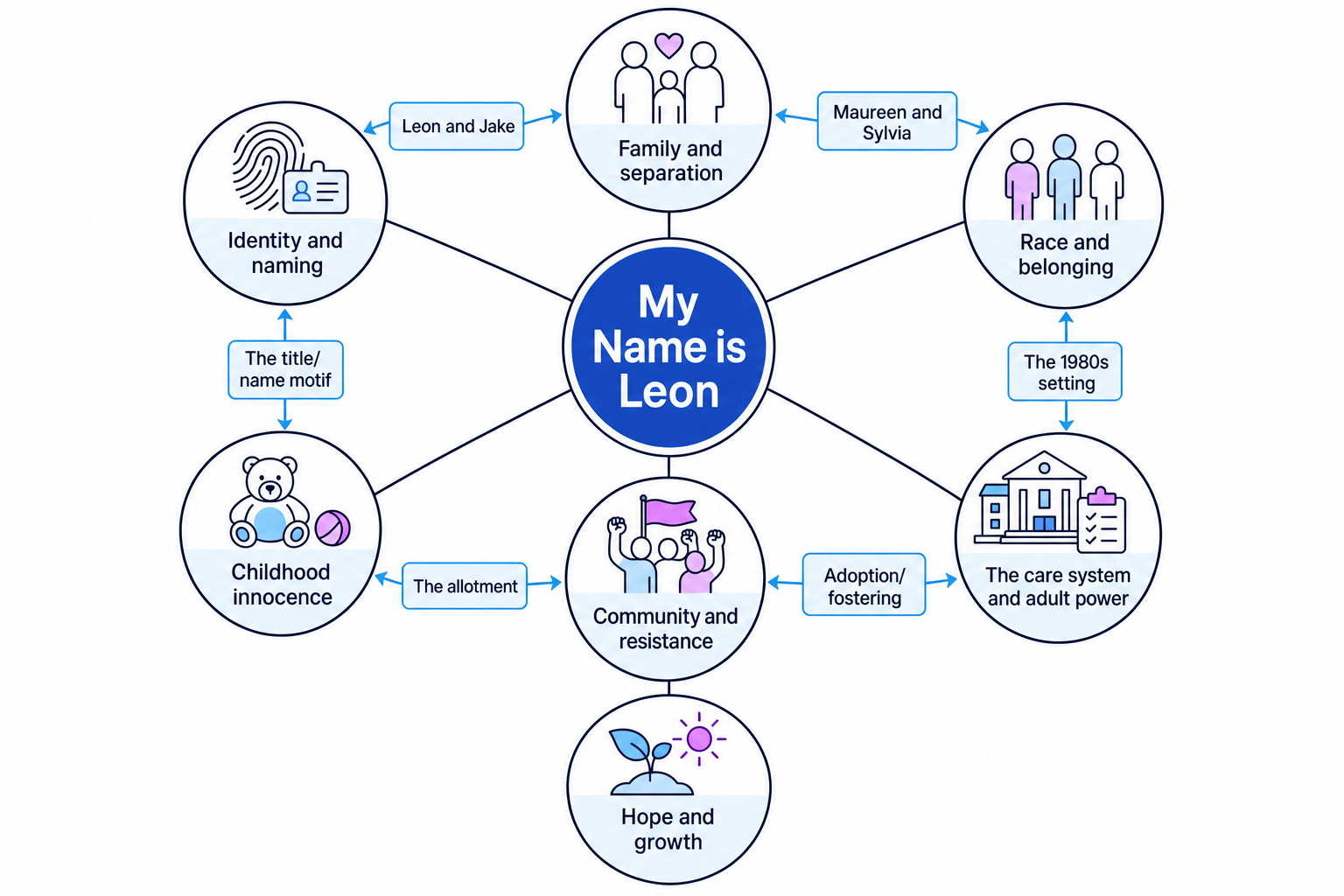
Themes work as patterns
In My Name is Leon, de Waal builds themes through repeated patterns: Leon being separated from people he loves, adults making decisions for him, racial difference shaping opportunities, and the allotment offering a space for growth.
Only naming the theme
Do not write, “Family is a theme in the novel” and stop there. Push it into an argument: “De Waal presents family as something Leon desperately needs, but also something that can be broken by adult decisions and social inequality.”
Turning a topic into a theme
-
Start with a broad topic: family.
-
Add de Waal’s viewpoint: family in the novel is not simple or secure; it can be loving, painful, biological, fostered or chosen.
-
Choose moments that prove the pattern: Leon’s bond with Jake, his separation from Jake, Maureen’s care, and the support he later finds through Sylvia, Tufty and Mr Devlin.
-
Add method: de Waal uses Leon’s child-centred narration so the reader feels the confusion and unfairness of family separation through Leon’s limited understanding.
-
Turn it into a theme sentence: De Waal presents family as essential to Leon’s sense of self, but shows that children can lose family through systems and decisions they do not control.
Identity and naming
The title, “My Name is Leon”, is one of your most useful pieces of evidence. It is short, memorable and thematically rich.
The phrase sounds simple, but it matters because Leon is a child who is often defined by other people: social workers, foster carers, adopters, police, adults and institutions. The title lets him assert himself first.
Narrative perspective
Narrative perspective means the viewpoint through which the story is told. My Name is Leon uses a child-centred third-person perspective: the narrator says “he”, but stays close to Leon’s thoughts, feelings and misunderstandings.
De Waal’s choice of perspective helps us see how identity feels from inside Leon’s experience. He is not just a “looked-after child” or a problem in a system. He is Leon: a brother, a son, a mixed-race child, and a person with a name.
Analysing the title as identity
-
Use the quotation “My Name is Leon” as evidence because it directly foregrounds identity before the plot even begins.
-
Analyse the method: the phrase sounds like a declarative statement, meaning a clear statement of fact. This creates a firm, self-assertive tone.
-
Zoom in on “My” and “Leon”. The possessive pronoun “My” suggests ownership of identity, while the proper noun “Leon” makes him individual rather than anonymous.
-
Link to the theme: de Waal suggests that children in care can be reduced to cases or decisions, but Leon’s name insists on his humanity.
Family, love and separation
Family is one of the most important themes in the novel, but de Waal does not present it as neat or idealised.
Leon’s love for Jake is central. Jake is not just a baby brother; he gives Leon a role and a purpose. When Jake is adopted separately, Leon loses more than a sibling. He loses part of how he understands himself.
Family is not only biology
De Waal shows that biological family matters deeply, but care can also come from non-biological relationships: Maureen, Sylvia, Tufty and Mr Devlin all help Leon survive emotionally.
This means the novel avoids a simple message. Carol loves her children, but she cannot consistently care for them. Maureen is not Leon’s birth mother, but she offers warmth and stability. The care system protects Leon in some ways, yet it also causes pain by separating him from Jake.
How de Waal presents family
De Waal often presents family through structure, meaning the order and arrangement of events in the novel. Leon begins with Jake close to him, then experiences loss, anger and searching. This structure makes the reader feel family as something Leon tries to hold onto.
Structure
Structure is how a writer organises a text: beginnings, endings, contrasts, repeated moments, turning points and the order of events.
Tracing family and separation
-
Compare Leon’s early closeness with Jake to the later separation caused by adoption.
-
Notice the structural shift: Jake moves from being physically present in Leon’s daily life to becoming absent and longed for.
-
Connect this to identity: Leon’s role as Jake’s brother is threatened, so the separation damages his sense of who he is.
-
Link to the reader: because the story stays close to Leon’s viewpoint, the separation feels emotionally unfair rather than merely administrative.
Race, belonging and inequality
Race is not a background detail in My Name is Leon. It shapes how Leon is seen and treated.
Leon and Jake are brothers, but their different racial identities affect their futures. Jake, who is white, is more easily placed for adoption, while Leon, who is mixed-race and older, remains in care. De Waal uses the contrast between the brothers to expose racial inequality without needing Leon to fully understand it.
Contrast
Contrast is when a writer places two people, ideas or situations side by side so that their differences become clear.
The novel is also set against 1980s Britain, a period marked by racial tension, distrust of police in many Black communities, and social division. This context matters because Leon’s personal story is connected to a wider society where race affects power, safety and belonging.
Context
Context means the social, historical or cultural circumstances surrounding a text. In GCSE essays, context should explain meaning; it should not be bolted on as a random fact.
Treating race as a side issue
Do not write about Jake’s adoption as if it is only about age or luck. De Waal invites the reader to notice how race, age and the care system work together to shape Leon’s loss.
Connecting race to the care plot
-
Start with the key contrast: Leon and Jake are brothers, but society does not treat them as equally “placeable”.
-
Add interpretation: this suggests that racial identity affects who is protected, desired and included.
-
Analyse method: de Waal filters events through Leon’s limited understanding, so the reader often recognises the injustice more clearly than Leon can express it.
-
Link to context: the 1980s setting helps show that Leon’s experience is personal, but not isolated; it reflects wider racial inequalities in Britain.
Childhood innocence and adult power
Leon is a child trying to make sense of adult systems: social services, fostering, adoption, mental illness, policing and political unrest.
A major theme is the gap between what children feel and what adults decide. Leon often experiences decisions after they have already been made. This creates sympathy because the reader sees how little control he has.
Dramatic irony
Dramatic irony happens when the reader understands more than a character does. In this novel, readers often understand the adult situation more fully than Leon can.
Leon’s misunderstandings are not a weakness in the writing. They are part of de Waal’s method. His child perspective makes painful events more powerful because he cannot always name what is happening to him, but the reader can feel the impact.
Why this matters in essays
If a question asks about childhood, innocence or vulnerability, do not just say “Leon is young”. Explain how de Waal’s narrative method makes his youth shape the whole story.
You might write about:
- Leon’s confusion when adults make decisions.
- His emotional responses to separation.
- His attempts to regain control.
- The reader’s protective sympathy towards him.
The care system and adult institutions
The novel does not present the care system as purely cruel. Maureen and Sylvia are caring figures, and some adult intervention is necessary because Carol cannot cope. However, de Waal shows that systems can still hurt children even when adults mean well.
This is a subtle theme. The novel criticises the emotional consequences of institutional decisions, especially when children are not fully heard.
Use balanced language
Instead of writing “the care system is evil”, write: de Waal presents the care system as necessary but emotionally damaging, especially when its decisions separate children from the people who give them identity and security.
The best essays show this balance. Leon needs safety, but he also needs love, continuity and a voice. De Waal makes the reader question whether official systems can fully understand a child’s emotional life.
Community, resistance and growth
The allotment is one of the most important symbolic spaces in the novel. It offers Leon something different from official institutions: community, patience, practical care and growth.
Symbolism
Symbolism is when a concrete person, place or object represents a bigger idea. The allotment can symbolise healing, growth and alternative community.
At the allotment, Leon meets adults who are not simply professionals managing him. Tufty and Mr Devlin become part of a wider network of support. The setting suggests that healing is slow and practical, like growing plants.
Motif
A motif is a repeated image, object or idea that helps develop a theme. In this novel, growth and gardening form a motif linked to recovery and hope.
The theme of community also connects to resistance. The novel shows people responding to injustice not only through anger, but through solidarity, humour, conversation and care. Leon’s world expands beyond his immediate loss.
Hope is practical, not magical
De Waal does not pretend Leon’s pain disappears. Hope comes through small acts of care, new relationships, and places where Leon can begin to grow again.
How to write about themes in a GCSE essay
A strong theme paragraph usually does five things:
- Makes a clear point about what de Waal suggests.
- Uses a short quotation or precise textual reference.
- Names a method, such as narrative perspective, contrast, structure or symbolism.
- Explains the effect on the reader.
- Links to relevant context where it genuinely helps.
Useful theme pairings
For higher-level answers, try pairing themes:
- Family and identity: Leon’s bond with Jake shapes who he believes he is.
- Race and the care system: the brothers’ different treatment exposes inequality.
- Childhood and adult power: Leon feels the effects of decisions he cannot control.
- Community and hope: healing comes through relationships beyond the biological family.
- Loss and growth: the novel shows pain, but also survival.
In the exam
-
Begin with an argument, not a theme label: write what de Waal suggests about the theme.
-
Use short evidence you can remember accurately, especially the title “My Name is Leon”, plus precise references to key moments such as Jake’s adoption, Maureen’s care and the allotment.
-
Analyse methods as part of meaning: explain how child-centred narration, contrast, structure or symbolism shapes the reader’s response.
-
Keep context relevant: link 1980s race, adoption and social inequality to Leon’s experience rather than adding disconnected facts.
-
Aim for connected paragraphs: show how themes overlap instead of treating family, race, childhood and care as separate boxes.
Check yourself
-
Can you explain how the title “My Name is Leon” links to identity and the care system?
-
How does de Waal use the contrast between Leon and Jake to explore race and belonging?
-
Why is the allotment important as a symbol of community, growth and hope?
