Jane Austen’s Pride and Prejudice is far more than a simple Regency love story. It is a sharp, witty critique of a society obsessed with wealth, class, and social decorum. By exploring how individual attitudes clash with social expectations, Austen exposes the limitations of her world.
In this guide, we will break down the three central themes of the novel:
- Love and Marriage: How different unions represent various social and moral choices.
- Pride and Prejudice: How these twin flaws act as barriers to self-knowledge and happiness.
- Social Class and Status: How wealth and birth dictate behavior, and where true moral worth lies.
Love and Marriage
In early 19th-century England, marriage was rarely just a romantic choice. For women of the gentry, it was a vital economic necessity. Women could not inherit land (due to legal restrictions like the entail on the Bennet estate), and there were very few respectable ways for middle-class women to earn a living.
Austen uses the novel to explore the tension between pragmatic marriage (marrying for financial security) and companionate marriage (marrying for love, mutual respect, and intellectual compatibility).
Companionate Marriage
A 19th-century ideal of marriage based on mutual affection, respect, and intellectual equality, rather than purely financial convenience or social advancement.
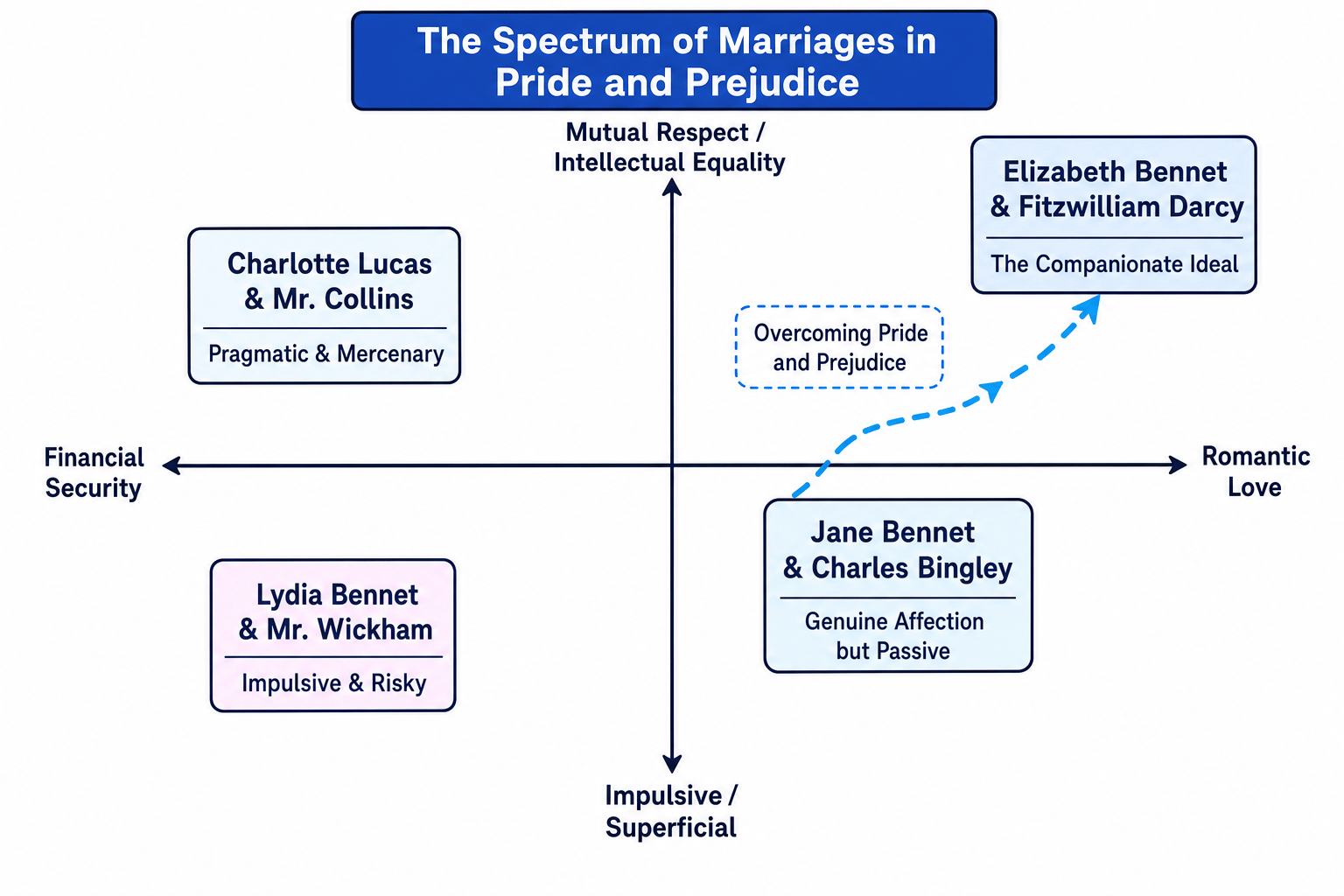
Austen presents us with a spectrum of marriages, each serving as a warning or an ideal:
- Charlotte Lucas and Mr. Collins (The Pragmatic/Mercenary Marriage): Charlotte is twenty-seven, has no fortune, and is a burden to her family. She marries the ridiculous Mr. Collins purely for "preservation from want." Austen does not condemn Charlotte, but she presents this choice as a cold, compromise-driven transaction.
- Lydia Bennet and Mr. Wickham (The Impulsive Marriage): Based entirely on physical attraction and youthful infatuation. It is reckless, lacks moral or intellectual foundation, and nearly ruins the Bennet family's reputation. Austen warns that marriages built solely on lust and superficial charm quickly decay.
- Jane Bennet and Mr. Bingley (The Passive Marriage): A union of genuine affection, but one that lacks intellectual challenge. Both characters are highly agreeable but passive, making them vulnerable to the manipulation of others (like Darcy and Caroline Bingley).
- Elizabeth Bennet and Fitzwilliam Darcy (The Companionate Ideal): The ultimate marriage of equals. It is achieved only after both characters undergo a painful process of self-correction. They balance each other: Darcy's seriousness is lightened by Elizabeth’s wit, and Elizabeth’s quick judgments are steadied by Darcy’s deep sense of judgment.
The Companionate Ideal
Austen's novel acts as a moral argument for companionate marriage. She suggests that a successful marriage requires a delicate balance of financial stability, physical attraction, and intellectual respect.
Pride and Prejudice
The title of the novel highlights its two main psychological barriers. While it is easy to say that Darcy represents "Pride" and Elizabeth represents "Prejudice," Austen's presentation is much more nuanced: both characters exhibit both traits.
Pride
An inflated sense of one's own status, achievements, or self-worth, which leads to a patronising or dismissive attitude towards others.
Prejudice
A preconceived opinion or judgment of others that is not based on reason or actual experience; a rush to make assumptions.
How the Twin Flaws Interact
- Darcy's Pride Feeds Elizabeth's Prejudice: Darcy's initial pride at the Meryton assembly ("she is tolerable; but not handsome enough to tempt me") deeply wounds Elizabeth’s self-esteem. This injury to her pride makes her highly receptive to Wickham's lies, blinding her to Darcy’s true character.
- Elizabeth's Pride in Her Own Discernment: Elizabeth prides herself on being an excellent judge of character. However, this very pride makes her stubborn. When she decides Darcy is a villain, she interprets every subsequent action of his through that negative lens.
- The Path to Self-Knowledge: Both characters must experience anagnorisis—a moment of sudden realization and breakthrough. For Elizabeth, this occurs when she reads Darcy’s letter and admits, "Till this moment, I never knew myself." For Darcy, it occurs when Elizabeth rejects his first proposal, forcing him to confront his arrogant manners.
Pride and Prejudice as Distorting Lenses
Think of pride and prejudice as a pair of distorted glasses. Darcy's "pride" glasses make him look down on everyone as socially inferior, while Elizabeth's "prejudice" glasses color every action of Darcy's as malicious. Only when they take these glasses off can they see each other—and themselves—clearly.
Social Class and Status
Austen’s characters exist within the tightly regulated hierarchy of the British landed gentry (wealthy landowners who did not have to work) and the rising middle class of trade and commerce (people who made money through business).
The Illusion of Social Superiority
Austen uses irony to expose the hypocrisy of those who believe high social class equates to high moral worth:
- Lady Catherine de Bourgh: She sits at the very top of the social hierarchy, yet she is rude, dictatorial, and completely lacks manners. Her attempt to bully Elizabeth reveals her inner vulgarity.
- Caroline Bingley: She looks down on the Bennets because their relatives are in trade, yet her own family's wealth was acquired through trade just one generation earlier. Her snobbery is a desperate attempt to hide her own social insecurity.
True Gentility vs. Superficial Class
In contrast, Austen presents the Gardiners (Elizabeth’s aunt and uncle). Mr. Gardiner is in trade and lives near the warehouses in London—a fashionable "black mark" in the eyes of Caroline Bingley. Yet, the Gardiners are the most polite, sensible, and morally upright characters in the novel. They prove that true gentility is a matter of conduct and character, not birth or bank balance.
Austen is not a revolutionary
Do not write in your exam that Austen wanted to destroy the class system. She was a conservative writer who valued social order and the hierarchy of the landed gentry. However, she wanted the upper classes to deserve their status by behaving with moral responsibility and kindness, rather than arrogance.
Analysing a Theme in the Text
In the exam, you must show how Austen uses language and character perspectives to build these themes. Let's look at how to construct an analysis of Charlotte Lucas's view on marriage.
Analysing Charlotte Lucas's pragmatism
Analyze Charlotte's statement in Chapter 6: "Happiness in marriage is entirely a matter of chance."
- Identify the character's perspective: Charlotte argues that marital happiness is not something that can be planned or cultivated through deep romantic connection; it is a random gamble.
- Analyse the language methods: The noun "chance" implies a lottery or a roll of the dice. By reducing marriage to a game of "chance," Charlotte strips it of its romantic or spiritual value, presenting it as a cold, mathematical calculation. Her tone is dry, detached, and unsentimental, contrasting sharply with Elizabeth’s idealistic view.
- Integrate context (AO3): This pragmatic outlook reflects the harsh economic reality for unmarried women in the Regency era. Without a husband, Charlotte faces social insignificance and financial dependency on her brothers. Her view is not cynical; it is a survival strategy.
- Connect to Austen's thematic purpose: Austen uses Charlotte's view to challenge the reader. While Elizabeth rejects this cold view of marriage, Austen does not mock Charlotte. Instead, she uses Charlotte to critique a social system that forces women to sacrifice their personal happiness for financial security.
In the exam
- Avoid looking at themes in isolation: Always connect themes to each other. For example, show how the theme of Social Class creates the Prejudice that nearly ruins Elizabeth and Darcy's chance at Marriage.
- Focus on character growth: Show how characters move from being symbols of a theme to overcoming it. Darcy changes from a figure of aristocratic Pride to a man who understands that true nobility is shown through quiet, humble actions.
- Address Austen's authorial intention: Never talk about characters as if they are real people. Use phrases like "Austen uses Charlotte to illustrate...", "Austen critiques the Regency class system by...", or "The novel acts as a warning against...".
Check yourself
- Why is Mr. Darcy's letter to Elizabeth in Chapter 35 a turning point for both the theme of Pride and the theme of Prejudice?
- How do the Gardiners challenge the snobbish class assumptions held by characters like Lady Catherine de Bourgh and Caroline Bingley?
- What are the main differences between Lydia's marriage to Wickham and Elizabeth's marriage to Darcy in terms of what they say about love?
