

What you'll learn
- What “context” means for My Name is Leon in AQA GCSE English Literature.
- How 1980s Britain shapes the novel’s ideas about care, race, poverty and family.
- How Kit de Waal’s choices as a writer turn historical context into emotion and meaning.
- How to use context in essays without bolting on random history.
What is context?
Context
Context means the circumstances surrounding a text: the time it is set, the society it represents, the writer’s background, and the ideas readers may bring to it.
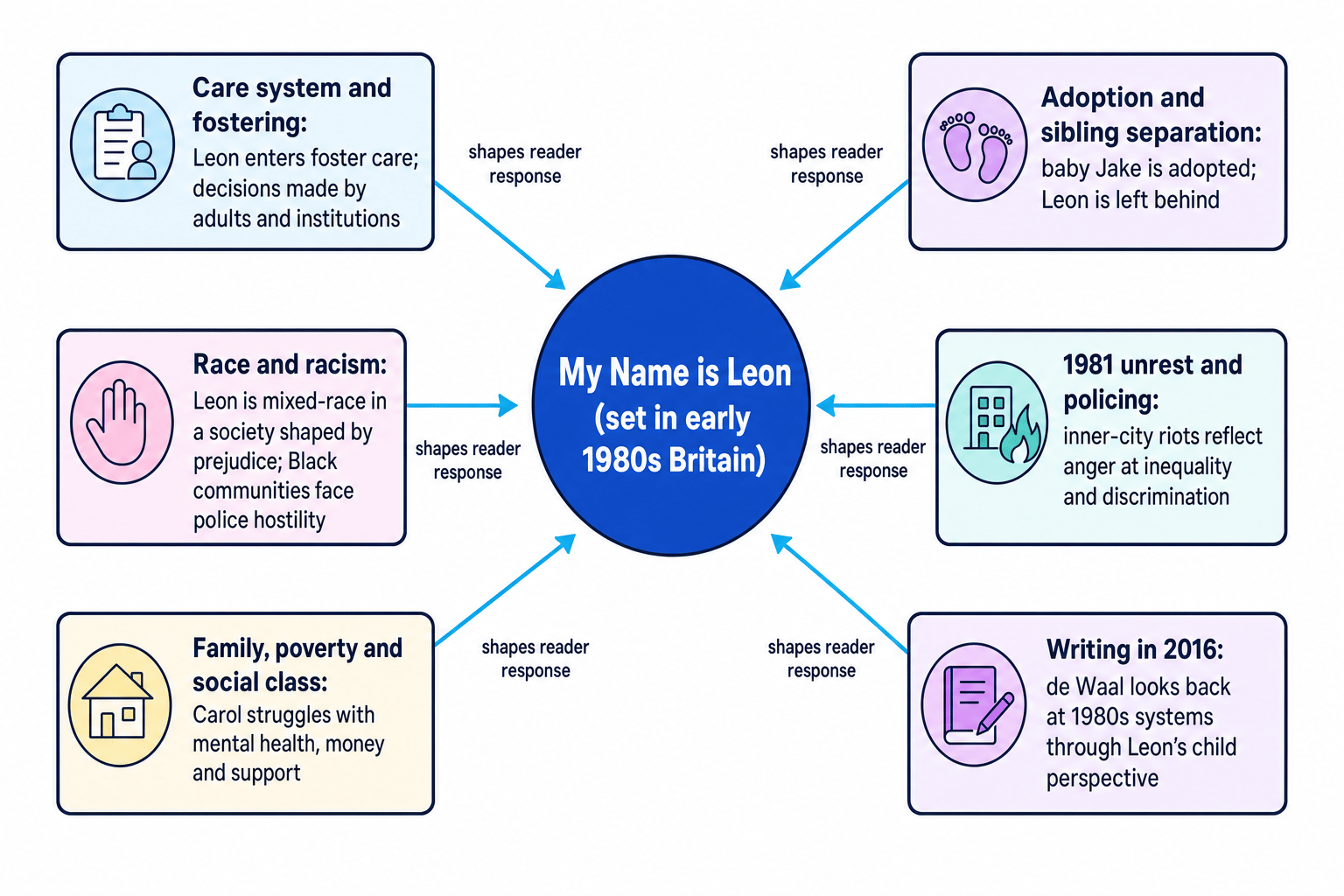
For My Name is Leon, context is not just “the 1980s”. It includes the care system, adoption, race and racism, poverty, policing, family expectations, and Kit de Waal’s decision to look back at this period from a modern perspective.
In the exam, context is rewarded when it helps you explain why de Waal presents something in a particular way and how that affects the reader.
Context must explain meaning
Strong context sounds like: “This matters because…” Weak context sounds like: “In the 1980s…” with no link to the novel.
This map shows the main contextual areas you can connect to the novel.
The novel’s setting: early 1980s Britain
My Name is Leon is set in early 1980s Britain, largely in the Midlands. This was a period of social tension: unemployment was rising, many working-class communities were under pressure, and public services were often stretched.
The novel does not give you a history textbook version of the 1980s. Instead, de Waal shows national problems through Leon’s daily life: foster homes, social workers, family breakdown, racial prejudice, and adults making decisions he cannot control.
Thatcher’s Britain and social inequality
Margaret Thatcher became Prime Minister in 1979. Her government is associated with free-market politics, reduced power for trade unions, and a belief in individual responsibility. For many working-class families, the early 1980s brought unemployment, insecurity and a sense that some communities were being left behind.
This matters because Leon’s story is not presented as one family’s private failure only. Carol’s struggles happen in a society where poverty, mental health problems and lack of support can make family life fragile.
Turning context into blame
Do not write as if Carol’s difficulties are simply “because of Thatcher”. That is too crude. Better: de Waal places Carol’s family within a wider society where vulnerable people may not receive enough support.
The care system, fostering and adoption
Care system
The care system is the network of social services, foster carers, children’s homes, courts and adoption processes that becomes responsible for children who cannot safely live with their birth families.
Fostering and adoption
Fostering is usually temporary care by approved carers. Adoption is a permanent legal change where adoptive parents become the child’s legal parents.
Leon enters care because the adults around him cannot keep him and Jake safe. De Waal presents the care system as complicated: it can protect children, but it can also separate them, confuse them and make them feel powerless.
Maureen is important because she shows that care can be warm, practical and loving. However, the system itself often feels impersonal to Leon. Adults discuss placements, visits and decisions, but Leon experiences these as loss and uncertainty.
Sibling separation
One of the most painful contextual issues is the separation of Leon and Jake. Jake is a baby, white, and easier to place for adoption. Leon is older and mixed-race, so his situation is more complicated.
In adoption contexts, younger children and babies have often been seen as easier to place because adoptive parents may feel they can bond with them more quickly. Children with more complex needs, older children, and children from minority ethnic backgrounds have historically faced more barriers.
De Waal uses this context to make the separation feel socially significant, not just personally sad. Leon loses Jake partly because of adult systems that categorise children.
A useful context sentence
You can write: “De Waal uses Leon and Jake’s separation to expose how care and adoption systems can protect one child while traumatising another.”
Race, racism and identity
Leon is mixed-race in a society where race shapes how people are seen and treated. This matters deeply because the novel is about identity: who Leon is, where he belongs, and whether adults recognise his full humanity.
The title, My Name is Leon, is useful here. It sounds simple, but it is an assertion of identity. The first-person phrase “My Name” suggests Leon’s need to define himself in a world where adults and institutions often define him through categories: child in care, older sibling, mixed-race boy, problem, case.
Social identity
Social identity means the way a person understands themselves, and is understood by others, in relation to groups such as race, class, gender, family and community.
Racism and policing in the 1980s
The early 1980s saw serious tensions between Black communities and the police in Britain. Many Black British people experienced discrimination, over-policing and suspicion. The “sus” laws, connected to stop-and-search powers, were widely criticised because they were often used disproportionately against Black men.
The 1981 riots in Brixton and other cities reflected anger about racism, unemployment, poverty and policing. Birmingham and the wider Midlands were also associated with racial tension and urban unrest in this period.
In the novel, this context helps us understand why Leon’s encounters with adult authority matter. Authority is not neutral for everyone. For Black and mixed-race communities, police and state systems may feel threatening rather than protective.
Race is personal and political
De Waal links Leon’s private search for belonging to a wider society where race affects opportunity, safety and trust.
Family, motherhood and mental health
Carol is not presented as a simple villain. She is vulnerable, overwhelmed and unable to care properly for her children. De Waal encourages readers to feel sadness and frustration at the same time.
In the early 1980s, mental health problems were often more stigmatised than they are today. Single mothers and working-class mothers could be judged harshly, especially if they needed state support. This context helps you write about Carol with nuance.
Nuance
Nuance means showing a careful, balanced understanding rather than making a simple one-sided judgement.
A nuanced response might say that de Waal presents Carol as damaging to Leon, but also as someone damaged by poverty, isolation and mental ill-health. That does not excuse neglect, but it does make the reader consider the wider causes of family breakdown.
Kit de Waal’s background
Kit de Waal was born in Birmingham to an Irish mother and Caribbean father. She has spoken and written about class, race and belonging, and she also worked in areas connected to family law and adoption.
This background matters because My Name is Leon is deeply interested in children who are spoken about by adults but not always listened to. De Waal writes with sympathy for children, foster carers and struggling parents, while still criticising systems that fail to see the emotional cost of their decisions.
Do not reduce the novel to the writer’s life
It is useful to know de Waal’s background, but do not write “Leon is Kit de Waal”. Leon is a fictional character. Use biography only to explain possible interests and perspectives in the writing.
Literary context: social realism and child focalisation
Social realism
Social realism is a style of writing that represents ordinary people’s lives, often focusing on class, poverty, work, housing, family and social institutions.
My Name is Leon fits social realism because it focuses on everyday details: homes, meals, visits, social workers, money worries, shops, streets and allotments. These ordinary details make the emotional pain feel believable.
Focalisation
Focalisation means the viewpoint through which events are filtered. In this novel, the third-person narration is closely focused through Leon’s understanding.
This is one of de Waal’s most important methods. The narration is not an adult lecture about policy. Instead, readers experience the care system as Leon experiences it: confusing, unfair, frightening and sometimes comforting.
That makes the context more powerful. You do not just learn that sibling separation is painful; you feel it through Leon’s limited understanding.
How to write about context well
Good context is woven into analysis of de Waal’s methods. You should connect:
- Textual moment: what happens in the novel.
- Method: how de Waal presents it.
- Context: what wider issue it reflects.
- Effect: what the reader understands or feels.
Linking context to narrative method
How could you write about the care system without bolting on context?
-
Start with the precise idea: de Waal presents the care system as both protective and emotionally damaging, because it gives Leon safety but separates him from Jake.
-
Choose a method that creates this effect: the close child focalisation means readers understand events through Leon’s confusion, so official decisions feel personal rather than abstract.
-
Link to context: in the 1980s care and adoption systems often had to make difficult decisions about placements, but de Waal emphasises that those decisions could reduce children to cases rather than fully heard individuals.
-
Connect back to meaning: this makes the reader sympathise with Leon and question whether institutions that intend to protect children always understand their emotional needs.
The Royal Wedding contrast
The 1981 wedding of Prince Charles and Lady Diana was presented by the media as a national celebration and a romantic fairy tale. In the novel’s world, that public image of perfect family life contrasts sharply with Leon’s reality: separation, instability and longing for home.
This contrast helps you discuss structure. De Waal places private suffering against public celebration, so the reader sees the gap between national myths and ordinary lives.
High-level phrasing
Try this kind of sentence: “The Royal Wedding context creates an ironic contrast between the public fantasy of family unity and Leon’s private experience of family separation.”
What context should not do
Context should not take over your paragraph. The question is still about the novel. A strong answer keeps returning to de Waal’s choices: narrative viewpoint, symbolism, contrast, structure, characterisation and setting.
Avoid vague claims like:
- “People were racist in the 1980s.”
- “The care system was bad.”
- “This shows society was different then.”
Instead, make precise claims:
- De Waal shows how racism affects Leon’s sense of belonging.
- The novel presents the care system as necessary but emotionally imperfect.
- The 1980s setting exposes tensions around class, race, policing and family support.
In the exam
-
Use context to deepen your point, not replace analysis: always link it to de Waal’s methods and the reader’s response.
-
Keep contextual references precise: care and adoption, racial tension, 1980s policing, poverty, mental health stigma, and the Royal Wedding contrast are all useful.
-
Avoid judging characters too simply: write with nuance, especially about Carol, Maureen, social workers and the institutions around Leon.
Check yourself
- How does the 1980s setting help explain Leon and Jake’s separation?
- Why is the title My Name is Leon important for ideas about identity?
- How can you include context in a paragraph without making it sound like a history essay?
