

To score highly in your GCSE English Literature exam, you need a firm grasp of the plot of My Name is Leon. However, simply memorising a list of events is not enough. You must understand why Kit de Waal structures the story the way she does, how the plot reflects the social context of 1980s Britain, and how Leon’s emotional journey unfolds.
What you'll learn:
- The five key stages of the novel's narrative arc.
- How the 1981 Brixton riots and the British foster care system act as structural forces in the story.
- How to analyse structural turning points to meet assessment objectives (AO1 and AO2).
Understanding the Narrative Arc
To analyse a novel effectively, we must look at its structural framework.
Narrative Arc
A narrative arc is the chronological construction of a story, tracking the rise and fall of tension as the main character moves from a starting situation, through a crisis, and finally to a resolution.
In My Name is Leon, Kit de Waal crafts a deeply moving narrative arc seen through the eyes of a nine-year-old boy. Because the story is told from Leon's perspective, the plot is shaped by his limited understanding of the adult world around him.
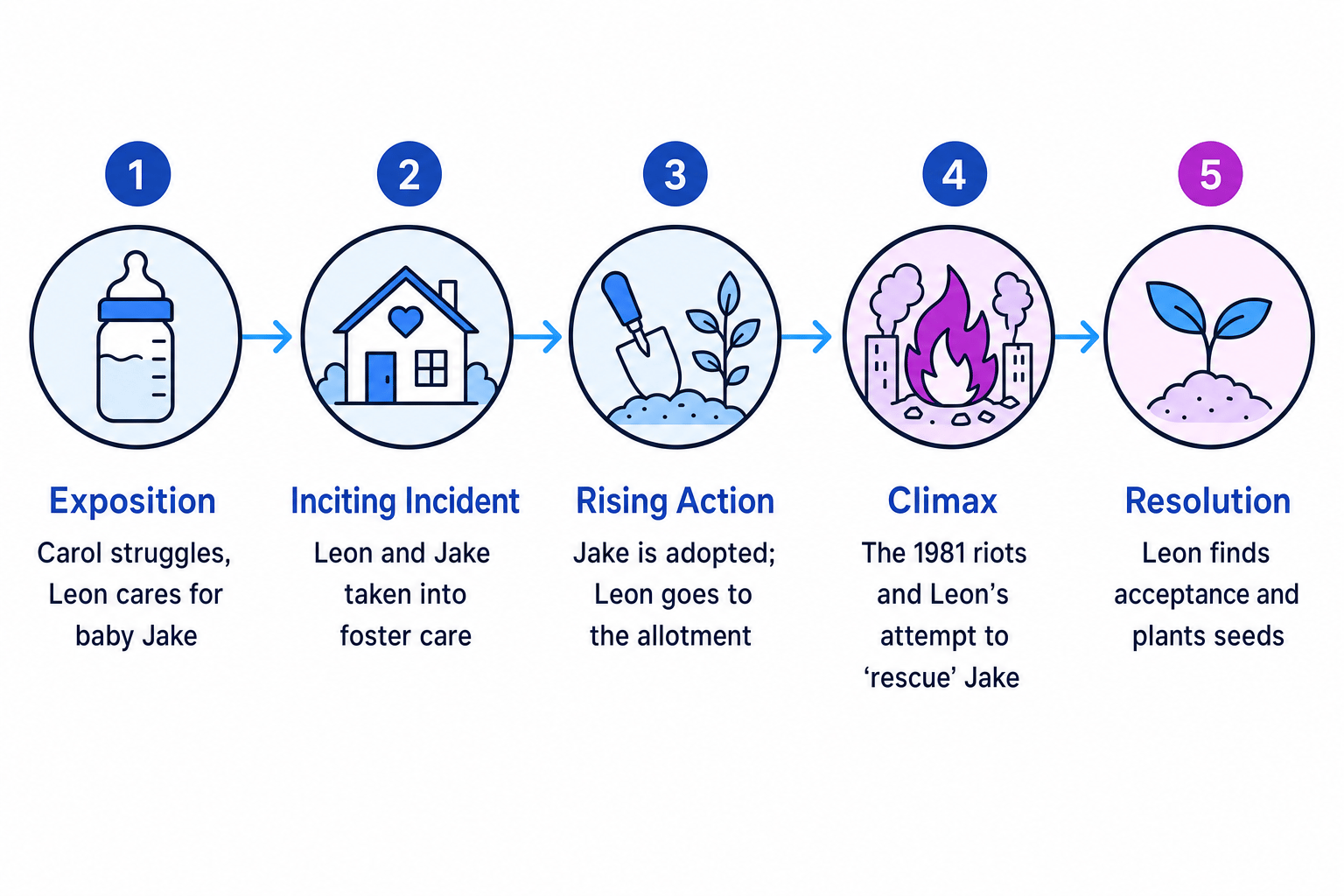
Section-by-Section Breakdown
1. The Exposition: Life with Carol and Baby Jake
Exposition
The exposition is the opening portion of a narrative where the writer establishes the setting, introduces the main characters, and reveals the initial conflict.
The novel opens in a suburban English town in the early 1980s. Leon is a nine-year-old mixed-race boy of Caribbean and white British heritage. His mother, Carol, has just given birth to a white baby boy, Jake.
- The Conflict: Carol suffers from severe postnatal depression and struggles with neglect, leaving Leon to take on the role of primary caregiver for his baby brother.
- Leon’s Motivation: From the very first page, Leon's identity is wrapped up in his love for Jake. He feeds him, changes him, and vows to protect him.
The Power of the Title
The novel's title, My Name is Leon, is a declaration of identity and agency. In a world where adults constantly make decisions for him, Leon's name is the one thing he can truly own.
2. The Inciting Incident: The Intervention
Inciting Incident
The inciting incident is the specific event that disrupts the status quo of the exposition and sets the main plot and conflict in motion.
When Carol becomes entirely unable to cope, social services step in. This is the inciting incident of the novel. Leon and Jake are taken from their mother and placed into temporary foster care with Maureen, an overweight, kind-hearted, and experienced foster carer.
Although Leon is frightened, Maureen's home becomes a place of safety. However, the system is designed to be temporary, and the shadow of permanent placement hangs over the brothers.
3. The Rising Action: Foster Care and Separation
The rising action of the novel is dominated by a devastating separation that exposes the institutional biases of the era.
- The Separation: Because Jake is a white baby, he is deemed highly "adoptable" by the social care system. Leon, being older and mixed-race, is left behind. Jake is adopted by a white, middle-class family, while Leon remains in foster care.
- The Emotional Fallout: Leon is shattered. He feels he has failed in his duty to protect his brother.
- A Shift in Care: Maureen falls seriously ill, and Leon is moved to live with her sister, Sylvia. Sylvia is sterner than Maureen, but she offers her own form of practical, structured support.
Overlooking the Social Context
Do not view the separation of Leon and Jake as merely a sad plot twist. It is a direct reflection of historical social biases. In 1980s Britain, transracial adoption policies and systemic prejudices meant that Black and mixed-race children often spent significantly longer in the care system than white children.
4. The Climax: The Allotment, Tufty, and the 1981 Riots
Seeking escape from his grief, Leon discovers a local allotment. Here, he meets Tufty, a gentle Caribbean man of the "Windrush generation", along with other men like Devlin and Castro.
Structural Catalyst
A structural catalyst is an event or character that accelerates the action, forcing the protagonist into new experiences and driving the story toward its climax.
The allotment acts as a structural catalyst. It exposes Leon to:
- His own Black heritage, which Carol had ignored.
- The political tensions of 1981 Britain, marked by high unemployment, police brutality (specifically the "Sus laws"), and systemic racism.
The plot reaches its climax when civil unrest—inspired by the real-world 1981 Brixton and Handsworth riots—erupts in Leon's town. Caught in the chaos, Leon witnesses the anger of the Black community. Driven by a desperate, childlike logic, Leon attempts to steal money and keys to "rescue" Jake, believing he can put his family back together by force.
The Role of the Allotment
In your essays, contrast the allotment with the city streets. The allotment is a sanctuary of growth, nature, and quiet mentorship, whereas the streets represent the turbulent, loud, and hostile realities of 1980s racial tension.
5. The Resolution: Acceptance and Growth
After the climax, the tension begins to fall. Leon is not punished harshly for his actions during the riots; instead, the adults around him realize the depth of his pain.
- Acceptance: Leon visits Jake and realizes that his brother is safe, happy, and loved in his new home. He accepts that he cannot bring Jake back, but that their bond still exists.
- The Ending: The novel ends with a sense of hope. Leon returns to Sylvia and Maureen's care. He plants seeds at the allotment, symbolising his own roots taking hold in his new life.
Structural Analysis and the Writer's Craft (AO2)
To secure a Grade 7, 8, or 9, you must analyse how the author constructs the text. Kit de Waal uses a third-person limited perspective, which means we only see and understand the plot through Leon's nine-year-old eyes.
Third-Person Limited Perspective
A narrative voice that uses "he", "she", or "they" to describe characters but limits its access to the thoughts, feelings, and perceptions of one single character.
Because of this perspective, there is a constant tension between what Leon sees and what the reader understands (dramatic irony). For example, Leon thinks his mother is just "tired" or "having a lie-down," but we, as readers, recognise her severe depression and substance abuse.
Analyzing a structural turning point
Read the following prompt: "Analyse how Kit de Waal uses structure to present Leon’s feelings of isolation in the middle of the novel." Here is how you can build a high-scoring analytical response step-by-step.
-
Identify the structural shift: Locate the moment in the mid-point of the narrative where the status quo changes. This is the physical separation of Leon and Jake.
- Drafting your point: De Waal structures the novel so that the physical separation of the brothers acts as a sudden emotional fracture, plunging Leon into deep isolation.
-
Select precise evidence of Leon’s internal state: Choose a quote that reflects this structural shift. When Jake is taken, Leon notes that his hands feel "empty" and he tries to keep his "eyes shut so he can keep the picture of Jake inside."
- Integrating evidence: Following Jake’s adoption, Leon attempts to preserve his brother's memory by keeping his "eyes shut so he can keep the picture of Jake inside," illustrating how his world has shrunk to his own internal thoughts.
-
Analyse the writer's craft (AO2): Explain how the author uses language and the limited perspective to highlight this isolation.
- Analysing methods: The tactile imagery of "empty" hands paired with the physical action of shutting his eyes demonstrates how Leon actively withdraws from the external foster environment. De Waal uses third-person limited perspective to show that Leon cannot comprehend the social workers' explanations; to him, the loss is absolute and silent.
-
Link to the wider context and theme (AO3): Connect Leon's isolation to the broader theme of institutional treatment of children in the 1980s.
- Synthesising context: This structural turning point highlights the cold, bureaucratic nature of the 1980s care system, which prioritised the "adoptability" of a white baby over the psychological trauma inflicted on his mixed-race brother, leaving Leon structurally and emotionally isolated.
The Danger of Plot Retelling
The most common mistake students make in modern prose essays is telling the story of what happens (e.g., "First Leon does this, then this happens..."). The examiner already knows the plot! You must always frame the plot as a deliberate choice by Kit de Waal to convey a message about race, family, and belonging.
In the exam
- Focus on the 'Why': If you are writing about a plot event (like the Brixton riots), ask yourself: Why did De Waal place this event here? How does it help Leon grow?
- Track the character's development: Ensure your essay has its own mini-arc. Show how Leon's feelings change from the vulnerable child in the exposition to the self-aware boy in the resolution.
- Use structural terms: Boost your AO2 marks by using terms like exposition, catalyst, climax, foreshadowing, and resolution instead of just saying "at the start" or "at the end."
Check yourself
- Why is the separation of Leon and Jake a key turning point in the rising action of the novel?
- How does the setting of the allotment contrast structurally with the setting of the city streets during the riots?
- What is the effect of telling the story through a third-person limited perspective instead of a first-person perspective ("I")?
