

Welcome to your study guide for My Name is Leon by Kit de Waal. First published in 2016, this moving novel is one of the modern prose choices for AQA GCSE English Literature Paper 2, Section A.
By studying this text, you will explore a poignant story about family, identity, and resilience, set against the backdrop of a turbulent period in modern British history.
What you'll learn:
- The essential storyline and structure of Leon's journey through the care system.
- How Kit de Waal uses a child's narrative perspective to highlight complex social issues.
- The historical context of 1981 Britain and how it shapes the novel’s themes.
Understanding the Plot and Structure
At its heart, My Name is Leon is a coming-of-age story (sometimes called a bildungsroman) about a nine-year-old mixed-race boy named Leon.
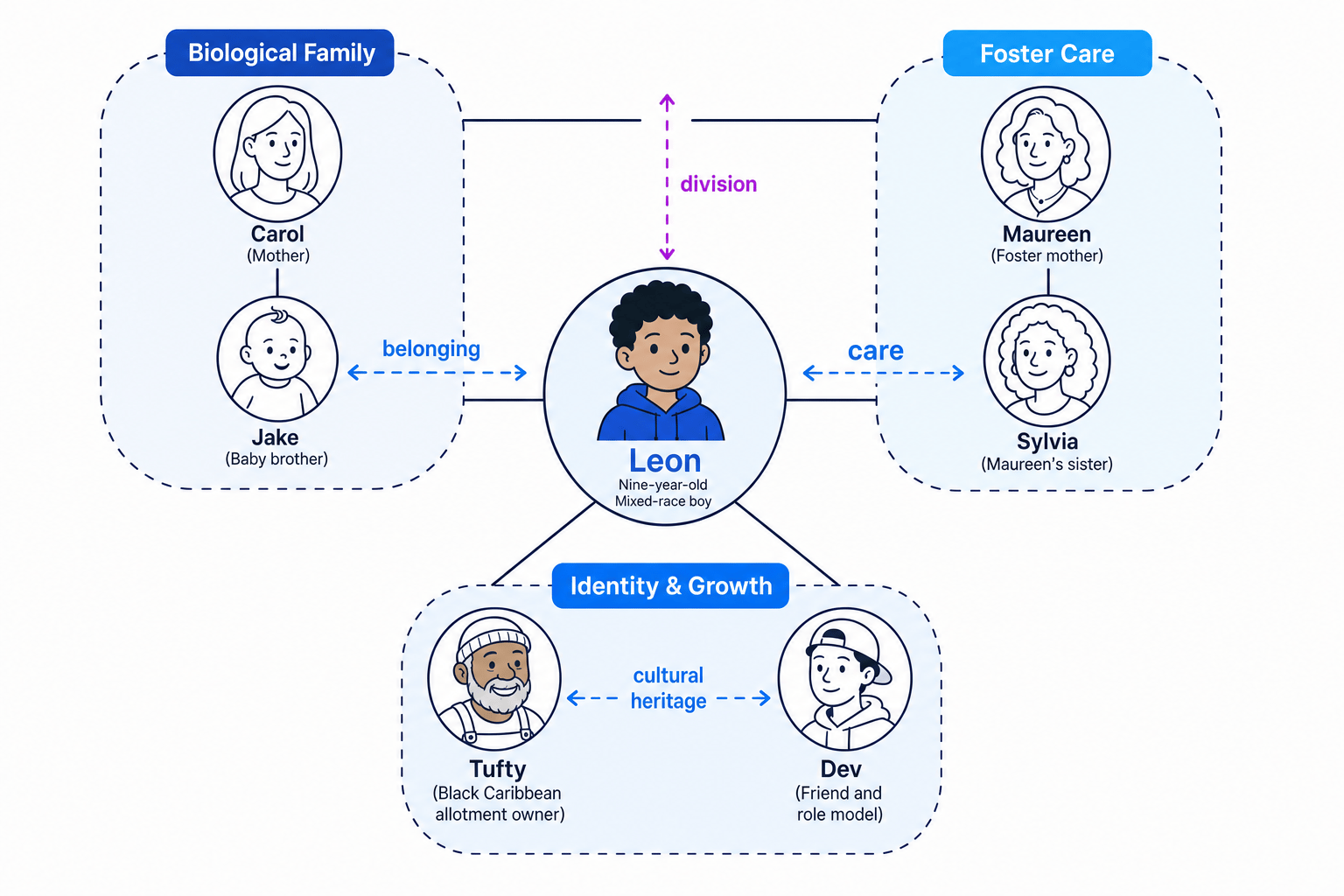
The novel begins in 1981. Leon’s mother, Carol, is struggling with severe postnatal depression and substance abuse following the birth of Leon's baby half-brother, Jake. Leon tries desperately to care for both his mother and baby Jake, but the situation becomes unsustainable. The state steps in, and the two boys are placed into foster care with a warm, experienced foster carer named Maureen.
Because Jake is white and a baby, he is quickly adopted by a new family. Leon, who is older and mixed-race, is left behind in foster care, eventually moving to live with Maureen’s sister, Sylvia, when Maureen becomes ill.
Leon's journey is a search for belonging, a desire to reunite with his brother, and a quest to find his own identity. He discovers a sense of community and male mentorship at a local allotment run by Tufty, a welcoming man from the Windrush generation, and his friend Dev.
The Central Conflict
The emotional core of the novel lies in the forced separation of Leon and Jake. Because the care system prioritises the rapid adoption of white infants, the brothers are divided. Leon's entire journey is driven by his love for Jake and his struggle to understand why they cannot be together.
Narrative Perspective: The Power of Focalisation
One of the most important literary techniques Kit de Waal uses is the novel's perspective. The story is told from a third-person limited narrative perspective, which means the writer uses "he" and "she" but keeps the focus entirely on Leon's thoughts, feelings, and experiences.
Focalisation
Focalisation is a literary term for the perspective through which a narrative is presented. In My Name is Leon, the narrative is focalised through a nine-year-old boy, meaning we only see, hear, and understand the world as Leon does.
By focalising the story through Leon, de Waal creates a powerful form of dramatic irony. As adult readers, we understand the harsh realities of Carol's mental illness, systemic racism, and the limitations of the social care system. However, we have to view these issues through the eyes of a child who interprets them literally and innocently.
For example, Leon refers to social workers as "the social" and identifies them by sensory details, like the "red lady" (Maureen) or the "musty" smell of social services offices. This technique forces the reader to look past the bureaucratic language of the care system and feel the raw, emotional impact of these decisions on a young child.
Confusing the narrator with the protagonist
Do not write that Leon is the narrator. The novel is not written in the first person ("I"). It is written in the third person ("Leon did this"), but the camera of the story is placed directly over Leon's shoulder. Refer to this as "third-person limited narrative" or "focalised through Leon".
Analysing Narrative Perspective in Action
To get top marks in your GCSE (especially for AO2, which assesses how the writer uses language and structure), you must be able to analyse how de Waal’s choice of perspective creates meaning.
Let's look at how we can analyse a passage where Leon is observing his mother's depression and his own responsibilities.
Analysing Leon's perspective
Passage: "He has to do everything. He has to make the bottles and put the cream on Jake’s bum... Carol is still in the dark room. She doesn’t come out, not even for a cup of tea."
Walk through these steps to write a high-level analytical response:
- Identify the focalisation and voice: Notice how the syntax (sentence structure) is simple and repetitive ("He has to..."). This mimics the repetitive, exhausting reality of a child being forced into an adult caregiving role.
- Examine the linguistic choices: Look at how Leon refers to his mother as "Carol" rather than "Mum" at various points, or how he notices simple, concrete details like "a cup of tea" and the "dark room". The "dark room" is a physical description that symbolizes Carol's clinical depression, which Leon cannot name but experiences physically.
- Analyse the emotional effect on the reader: Explain how the contrast between Leon's matter-of-fact tone and the tragic reality of parentification (a child acting as a parent) creates deep empathy. The reader feels the weight of Leon's burden because he does not complain about it; he simply accepts it as his duty.
Social and Historical Context (AO3)
To fully understand My Name is Leon, you must understand the year in which it is set: 1981. Kit de Waal deliberately chose this year because of two major contrasting events happening in England.
1. The Royal Wedding vs. Civil Unrest
In July 1981, millions of people celebrated the spectacular Royal Wedding of Prince Charles and Lady Diana Spencer. This event was promoted as a national fairytale, representing unity, wealth, and British pride.
At the exact same time, Britain's inner cities—such as Handsworth in Birmingham and Brixton in London—were erupting in riots. These riots were sparked by high unemployment, poverty, and systemic police racism targeting Black and mixed-race communities.
De Waal uses this contrast brilliantly:
- Leon's foster mother, Maureen, is obsessed with the Royal Wedding, representing a traditional, optimistic, and white British identity.
- Meanwhile, Leon’s experiences at the allotment with Tufty and Dev expose him to the harsh realities of the Handsworth riots and police hostility.
Look for the symbolism of the Royal Wedding memorabilia
The mugs, tea towels, and television broadcasts of the Royal Wedding represent a mainstream British society that Leon is pushed to the margins of. While the country celebrates a fairytale union, Leon's own family is being permanently broken apart.
2. The 1980s Foster Care System
In the 1980s, the UK social care system was struggling to deal with the complexities of transracial adoption (placing children of one ethnic background with adoptive parents of another). Because Jake was white, he was deemed easily "adoptable" into a white nuclear family.
Leon, as a older mixed-race child, faced systemic biases that made his adoption much less likely. The separation of siblings based on racial categorisation was a tragic reality of the system at the time, which de Waal critiques through the novel.
In the exam
When writing your essay on My Name is Leon in the exam, keep these strategies in mind:
- Answer the question, not your own plan: Make sure your opening sentence directly addresses the prompt (e.g., if the question is about foster care, focus on how foster care is presented, rather than just writing a general character study of Maureen).
- Integrate context naturally: Do not dump a history paragraph about the 1981 riots at the end of your essay. Instead, weave it into your analysis (e.g., "De Waal uses the backdrop of the 1981 Handsworth riots to mirror Leon's internal feelings of anger and exclusion").
- Focus on the 'Why': Always ask yourself why de Waal chose a child's perspective. How does Leon's innocence make the social criticism of 1980s Britain more powerful?
- Remember there are no SPaG marks here: AO4 (Spelling, Punctuation, and Grammar) is only assessed on the Shakespeare question in Paper 1. Do not panic about a minor spelling mistake here; focus entirely on the quality of your literary argument and analysis.
Check yourself
- Why is the setting of 1981 so significant to the themes of the novel?
- What is the difference between a first-person narrator and a third-person limited (focalised) narrator?
- How does Leon's relationship with Tufty at the allotment help him develop his sense of identity?
