What you'll learn
- The main events of Pride and Prejudice in the right order.
- How Austen’s plot is built around misunderstanding, reputation, money, and marriage.
- The key turning points you can use in exam answers.
- How to summarise plot without falling into simple retelling.
Before the plot: the situation Austen sets up
Pride and Prejudice is a 19th-century novel by Jane Austen, first published in 1813. It follows Elizabeth Bennet, the second of five daughters in a respectable but financially insecure family.
The plot begins with a problem: the Bennet daughters cannot inherit Longbourn, the family estate. This means their future security depends heavily on marriage.
Entailment
An entailment is a legal restriction that controls who can inherit property. In the novel, Longbourn is entailed away from the Bennet daughters and will pass to Mr Collins, their male cousin.
This matters because the plot is not just about romance. Marriage in the novel is also linked to money, class, reputation, and survival.
The plot problem
The Bennet sisters need socially and financially secure marriages, but Austen tests whether marriage should be based on money, attraction, family pressure, or real understanding.
Plot and story: what is the difference?
Plot
Plot means the arranged sequence of events in a text, especially how one event causes another. A plot is not just “what happens”; it is how the writer shapes events to create tension, surprise, and meaning.
In Pride and Prejudice, Austen’s plot depends on first impressions. Elizabeth misjudges Darcy because of his pride and Wickham’s charm. Darcy misjudges Elizabeth’s family and social position. As the novel develops, both characters are forced to correct their views.
The famous opening sentence — “It is a truth universally acknowledged” — immediately links marriage with wealth, irony, and social expectation. Austen then builds the plot through visits, balls, letters, proposals, and scandals.
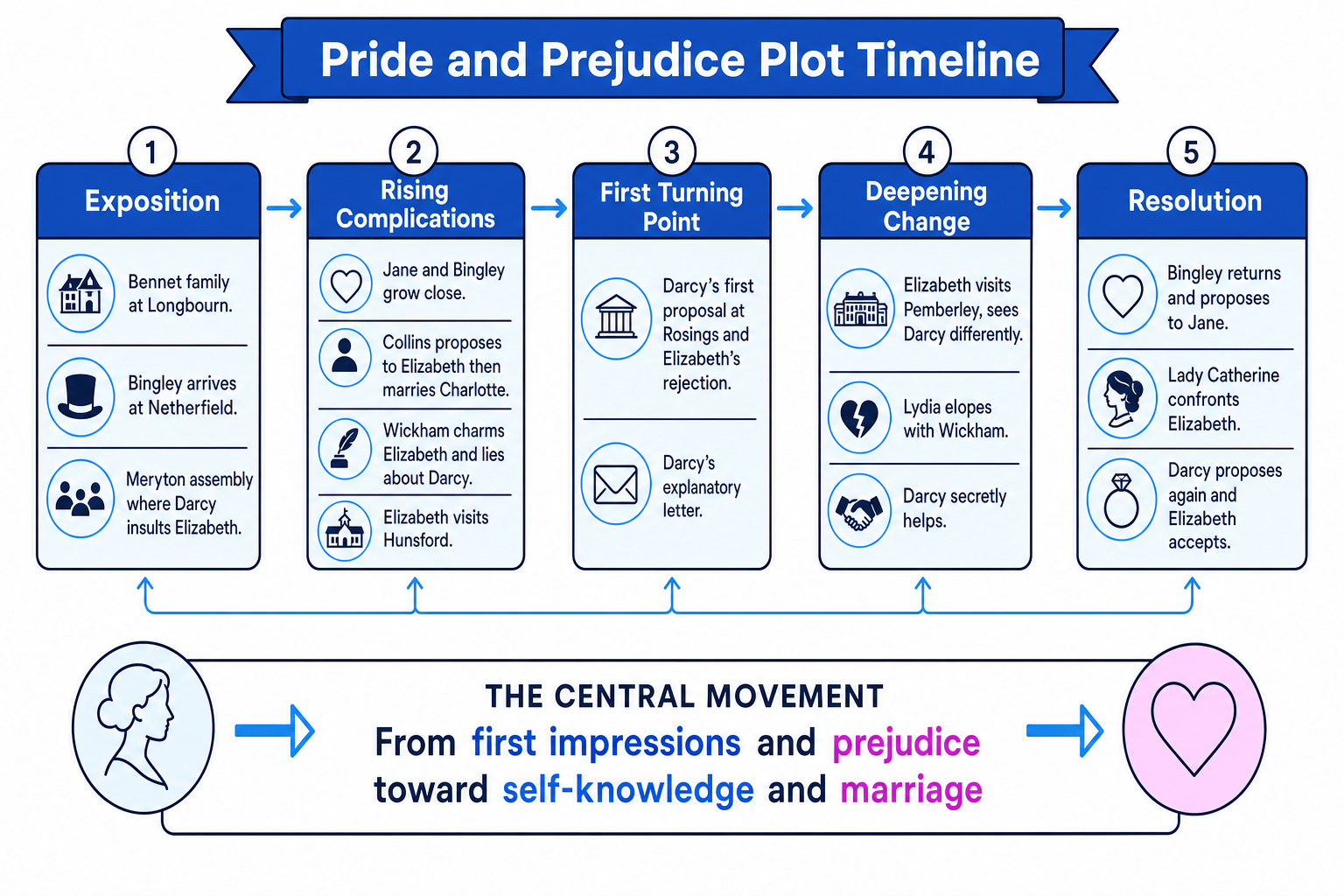
Following a cause-and-effect chain
- Darcy insults Elizabeth at the Meryton assembly, calling her “tolerable; but not handsome enough to tempt me”, so Elizabeth forms a negative first impression of him.
- Because she already dislikes Darcy, Elizabeth is more ready to believe Wickham’s false story about being mistreated by him.
- When Darcy proposes at Rosings, Elizabeth rejects him fiercely because she thinks he has harmed Wickham and separated Jane from Bingley.
- Darcy’s letter corrects Elizabeth’s mistaken beliefs, so the plot shifts from social comedy into self-examination and moral change.
Stage 1: Exposition — Longbourn, Netherfield, and first impressions
Exposition
Exposition is the opening part of a story where the writer introduces the setting, main characters, and central problems.
The novel opens at Longbourn, the Bennet family home. Mrs Bennet is desperate for one of her daughters to marry Mr Bingley, a wealthy young man who has rented Netherfield Park nearby.
At the Meryton assembly, Bingley is friendly and immediately admires Jane Bennet. Darcy, however, seems proud and rude. His insult to Elizabeth begins one of the novel’s central conflicts.
This opening establishes three important plot lines:
- Jane and Bingley’s gentle romance.
- Elizabeth and Darcy’s tense, mistaken relationship.
- The Bennet family’s vulnerability because of money, inheritance, and reputation.
Remember the double plot
The novel has two connected marriage plots: Jane and Bingley’s relationship is interrupted by class prejudice, while Elizabeth and Darcy’s relationship develops through conflict, correction, and growth.
Stage 2: Rising complications — Collins, Wickham, and Hunsford
Rising action
Rising action means the middle part of a plot where problems become more complicated and tension increases.
Mr Collins, the cousin who will inherit Longbourn, arrives and proposes to Elizabeth. She refuses him because she cannot respect or love him. He then marries Charlotte Lucas, Elizabeth’s close friend.
Charlotte’s decision is practical rather than romantic. She marries for security, showing the limited options available to women. This part of the plot helps you see why Elizabeth’s refusal is brave, but also risky.
At the same time, George Wickham appears charming and tells Elizabeth that Darcy has treated him cruelly. Elizabeth believes Wickham because he confirms what she already wants to think about Darcy.
Elizabeth later visits Charlotte at Hunsford, near Lady Catherine de Bourgh’s estate, Rosings. Darcy is also there, and the tension between him and Elizabeth grows.
Treating Wickham as a side character only
Wickham is not just a minor romantic distraction. His lies shape Elizabeth’s prejudice against Darcy, and his later elopement with Lydia creates the main family crisis.
Stage 3: First major turning point — Darcy’s proposal and letter
Turning point
A turning point is a moment when the direction of the plot changes significantly. After a turning point, the characters cannot simply return to how they were before.
At Rosings, Darcy proposes to Elizabeth. However, he does so badly, stressing her lower social connections and the struggle he has had against loving her. His phrase “In vain I have struggled” shows both passion and arrogance.
Elizabeth rejects him. She accuses him of separating Jane and Bingley and of ruining Wickham’s future. Her reply — “Had you behaved in a more gentlemanlike manner” — attacks his pride and manners.
The next day, Darcy gives Elizabeth a letter. In it, he explains that Wickham is dishonest and that he separated Bingley from Jane partly because he doubted Jane’s feelings and disapproved of the Bennet family’s behaviour.
This is one of the most important structural moments in the novel because the plot turns inward. Elizabeth has to question her own judgement.
Choosing the main turning point
- Darcy’s first proposal is more than a romantic failure because it exposes the two central faults in the title: Darcy’s pride and Elizabeth’s prejudice.
- The letter changes Elizabeth’s understanding of previous events, especially Wickham’s story and Darcy’s role in Jane’s unhappiness.
- Because Elizabeth now reinterprets the past, the reader also reconsiders earlier scenes, so Austen uses structure to make judgement feel unstable and changeable.
Stage 4: Deepening change — Pemberley and Lydia’s elopement
Resolution
Resolution is the final part of a plot where the main conflicts are settled. Before Austen reaches the resolution, she creates one last major crisis.
Elizabeth visits Pemberley, Darcy’s estate, with the Gardiners. She does not expect Darcy to be there, but when he appears he behaves with warmth, politeness, and generosity.
Pemberley changes Elizabeth’s view of Darcy. She hears good reports of him as a landlord, brother, and master. Austen shows that Elizabeth’s judgement is becoming more balanced. The narrator says Elizabeth “never had she so honestly felt that she could have loved him, as now”.
Then the plot suddenly darkens: Lydia runs away with Wickham.
Elopement
An elopement is when a couple runs away together, usually to marry without family permission. In Austen’s society, if Lydia and Wickham do not marry, Lydia’s reputation — and her sisters’ marriage prospects — could be ruined.
Darcy secretly finds Lydia and Wickham and pays for the marriage to happen. Elizabeth only discovers this later. This action matters because Darcy does not help in order to impress her publicly. Austen uses it to prove that he has changed, or at least that his better qualities are now visible.
Why Lydia’s elopement matters
The Lydia crisis tests Darcy’s character in action. It also turns private romance into a family and social emergency, making the final marriages feel earned rather than easy.
Stage 5: Resolution — proposals, confrontation, and marriage
After Lydia’s marriage, Bingley returns to Netherfield and proposes to Jane. This resolves the first major relationship plot.
Lady Catherine then visits Elizabeth and tries to force her to promise she will never marry Darcy. Her snobbish question — “Are the shades of Pemberley to be thus polluted?” — shows her obsession with class and inheritance.
Elizabeth refuses to be intimidated. Ironically, Lady Catherine’s interference encourages Darcy. When he proposes again, he has changed his tone. His words, “My affections and wishes are unchanged”, are direct and respectful.
Elizabeth accepts him. The novel ends with marriages that reward self-knowledge, emotional honesty, and improved judgement.
Calling the ending simply a fairy tale
The ending is happy, but it is not random wish-fulfilment. Austen has made Elizabeth and Darcy confront their faults before they can marry.
The whole plot in one clear sequence
Use this sequence when revising:
| Plot stage | Main events | Why it matters |
|---|---|---|
| Opening | Bingley arrives; Darcy insults Elizabeth | Sets up marriage pressure and first impressions |
| Early complications | Jane loves Bingley; Collins proposes; Wickham lies | Shows different kinds of courtship and judgement |
| Rosings | Darcy proposes; Elizabeth rejects him; Darcy writes his letter | Major turning point in Elizabeth’s understanding |
| Pemberley | Elizabeth sees Darcy differently | Darcy’s character is reassessed |
| Crisis | Lydia elopes with Wickham | Reputation and family security are threatened |
| Ending | Darcy helps; Bingley and Jane marry; Elizabeth accepts Darcy | Social and emotional conflicts are resolved |
How to use plot summary in an exam answer
In the exam, you should not retell the whole story. A strong answer uses plot events as evidence for an interpretation.
For example, if the question is about Elizabeth’s changing attitude to Darcy, you would not summarise every meeting. You would choose the moments that show change: Meryton, Rosings, the letter, Pemberley, and the second proposal.
Turning plot summary into analysis
- Choose a plot moment that proves a clear idea: Darcy’s first proposal shows that his love is mixed with pride and class prejudice.
- Select short evidence: “In vain I have struggled” suggests emotional conflict, but also makes the proposal sound like Elizabeth is a problem he has tried to overcome.
- Analyse Austen’s method: the structure places the proposal before Darcy’s letter, so Elizabeth and the reader must first experience his arrogance before reconsidering him.
- Link back to the wider plot: this failed proposal becomes necessary because it forces both characters to begin changing before the final resolution.
Mini summary to memorise
Pride and Prejudice begins with the Bennet family’s need for secure marriages. Bingley loves Jane, but Darcy separates them because of class concerns and doubts about Jane’s feelings. Elizabeth dislikes Darcy after his insult and believes Wickham’s lies. Mr Collins proposes to Elizabeth, is rejected, and marries Charlotte. At Rosings, Darcy proposes badly and Elizabeth rejects him. His letter makes her reconsider Wickham, Darcy, and herself. At Pemberley, Elizabeth sees Darcy more positively, but Lydia’s elopement with Wickham threatens the family. Darcy secretly arranges their marriage. Bingley returns and marries Jane; Darcy proposes again, and Elizabeth accepts.
In the exam
- Use plot events selectively: choose the moment that best supports your argument rather than retelling the novel from the beginning.
- Link events by cause and effect: show how insults, letters, proposals, and scandals change what characters understand.
- Mention structure when useful: Austen places the failed proposal before the letter so that Elizabeth’s judgement can visibly develop.
Check yourself
- Why is Darcy’s letter such an important turning point in the plot?
- How does Lydia’s elopement affect more than just Lydia herself?
- Which three plot moments best show Elizabeth changing her opinion of Darcy?
