

In GCSE English Literature, analysing how a story is told is just as important as what is being told. Kit de Waal's choices in structuring and narrating My Name is Leon are deliberate, powerful, and central to how we experience Leon's journey through the care system in 1981.
By looking at the novel through the lens of narrative craft, you will discover how De Waal builds empathy, critiques the state, and presents the world through the eyes of a vulnerable child.
What you'll learn
- How third-person limited focalisation creates a "child's-eye view" of a complex, adult world.
- How the novel uses defamiliarisation to highlight Leon's vulnerability and lack of power.
- How sensory language and structural pacing reflect Leon's psychological state.
- How to analyse key motifs and symbols like the allotment, toy soldiers, and sweets.
The Power of Perspective: Third-Person Limited Focalisation
The most crucial narrative method in My Name is Leon is the perspective from which the story is told. While the novel is written in the third person, it is entirely restricted to what Leon experiences, thinks, and feels.
Third-Person Limited Narrative
A narrative style where the story is told from an external perspective (using "he," "she," "they") but is restricted to the inner thoughts, feelings, and knowledge of a single character.
Focalisation
The perspective or sensory "lens" through which a story's events are filtered. In this novel, Leon is the focaliser; we only see, hear, and understand what a nine-year-old boy can.
Because Leon is only nine years old, his understanding of the adult world is incomplete. He does not fully comprehend his mother Carol’s post-natal depression, the legal mechanics of the foster care system, or the systemic racism that surrounds him in 1981 Birmingham.
This gap between what Leon observes and what the reader understands is a powerful literary tool.
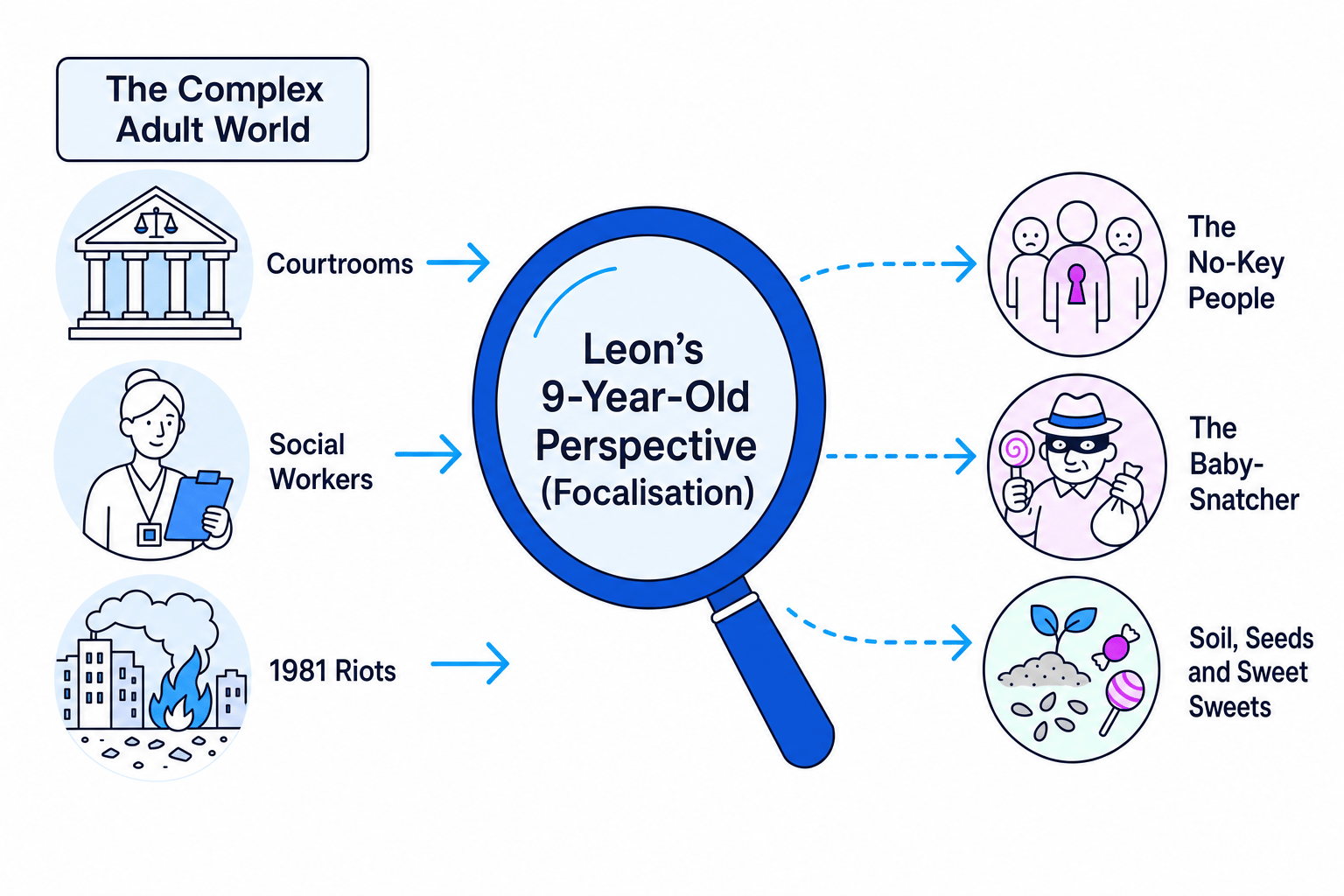
The Adult-Child Gap
De Waal uses Leon's limited perspective to force the reader to do the intellectual work. We recognise the tragedy of Carol's neglect or the finality of baby Jake's adoption long before Leon does. This creates a powerful layer of dramatic irony and heightens our sense of sympathy and frustration.
Defamiliarisation: Seeing the Familiar as Strange
Because Leon is young and trying to make sense of a hostile bureaucratic system, he often renames adult institutions and figures based on his immediate, literal observations.
Defamiliarisation
A literary technique where an author presents common things, people, or situations in an unfamiliar or strange way, forcing the reader to perceive them from a fresh, unbiased perspective.
For example:
- "The No-Key People": Leon's term for the social workers (like Devlin and Miss Kingston) who enter his home but do not possess keys of their own. This highlights his awareness of their lack of belonging in his personal space.
- "The Baby-Snatcher": How Leon views the foster/adoption system that separates him from his baby brother, Jake. This stark term reflects the emotional violence of the separation.
Sensory Language and the Child's Voice
To make Leon's perspective feel authentic, De Waal does not write in complex, abstract adult prose. Instead, she relies heavily on concrete, sensory language. Children experience the world through immediate physical sensations rather than intellectual concepts.
Sensory clues
When writing about De Waal's language choices, look for tactile (touch), olfactory (smell), and auditory (sound) details. These sensory anchors show Leon trying to find stability in a constantly shifting world.
- Smell: Leon identifies people by their scent. Carol smells of "hairspray and cigarettes and outdoor cold," a mixture of artificial glamour and maternal absence. In contrast, Tufty smells of "soil and sweat and old tea," associating him with the grounding safety of the allotment.
- Touch: Physical warmth and closeness are vital. Leon remembers "the weight of Jake in his arms" and the "softness of his skin." This tactile imagery emphasises Leon's maternal instinct and the physical ache of his loss when Jake is adopted.
Structural Pacing and Tension
The structure of My Name is Leon is largely chronological, tracking Leon's journey from his mother's flat, to Sylvia’s foster home, to his interactions at the allotment, and finally to a sense of acceptance. However, the pacing of the narrative is highly elastic and mirrors Leon’s psychological state.
Emotional Pacing
When Leon is overwhelmed, anxious, or frightened, the sentences often become short, fragmented, and repetitive. This stylistic choice mimics the rapid heartbeat and narrow focus of a panicked child.
Flashbacks and Intrusion
Leon’s trauma is structurally represented by intrusive thoughts and sudden memories of Jake. Even when he is safe at the allotment or with Sylvia, a sensory trigger—like a blue cardigan or a baby's cry—will disrupt the linear narrative, showing that his trauma is ever-present.
Don't just list structural terms
Avoid simply stating: "The novel has a linear structure." Instead, ask why the pacing changes. Show how the structure mimics Leon's internal mind. For instance, notice how chapters in the middle of the book often end abruptly, reflecting how Leon's life is repeatedly disrupted by adults making decisions without his consent.
Symbolism and Motifs: Concrete Objects, Abstract Feelings
Because Leon cannot easily articulate his grief, anger, or love in complex speeches, De Waal uses recurring symbols and motifs to represent his internal landscape.
Symbols as Leon's vocabulary
Think of symbols in this novel as a secret language. Because Leon doesn't have the adult vocabulary to express concepts like "systemic prejudice," "grief," or "autonomy," the objects around him speak on his behalf.
1. The Seedlings and the Allotment
The allotment is a physical refuge, but it also functions as a powerful extended metaphor for growth and cultivation:
- Vulnerability: Just like the seedlings that Tufty and Leon plant, Leon is young, delicate, and needs the right "soil" (a stable home) to grow.
- Healing: The physical act of digging in the dirt represents grounding and healing.
- The State vs. Nature: While the state care system tries to standardise and categorise Leon, the allotment represents a diverse, organic community (containing Tufty, Dev, and Mr Bowman) where he can grow naturally.
2. The Toy Soldiers / Action Figures
Leon carries his action figures everywhere. These toys represent control and protection:
- In his real life, Leon has no power; adults make every decision for him.
- With his action figures, he is the commander. He can arrange them, assign them roles, and orchestrate battles where there are clear victors and safe resolutions.
3. The Curly Wurly
Sweets, particularly the Curly Wurly, recur throughout the novel.
- They are a symbol of childhood innocence and the currency of comfort.
- Often, adults use sweets to pacify, bribe, or distract Leon (for example, when social workers want to talk to him or after a distressing meeting). It highlights how adults underestimate his emotional depth, treating his grief as something that can be cured with sugar.
Analysing Narrative Methods in Action
In your GCSE exam, you will need to write analytical paragraphs that explore how De Waal's methods reveal deeper thematic meanings. Let's look at how to construct a high-scoring analytical response based on a key scene.
Analysing child focalisation during family separation
Question: Explore how Kit de Waal uses narrative methods to present Leon’s feelings of powerlessness when social workers separate him from baby Jake.
-
Formulate a clear topic sentence that directly identifies the method (child focalisation) and connects it to the theme of powerlessness.
Example: "De Waal utilizes a tightly restricted third-person limited perspective to expose Leon's profound sense of powerlessness, filtering the agonizing moment of sibling separation through the mundane, literal details of a child's observations."
-
Integrate a precise, short quotation that demonstrates this child-centric focus.
Example: When the social worker prepares to take Jake away, Leon's attention is drawn to the minor physical errors of the adults, noting that 'she’s got her coat on and Jake has got his blue cardigan on... Leon wants to tell her that she hasn’t got the buttons in the right holes.'
-
Analyse the specific language and structural choices (the "methods") and explain how they reveal Leon's internal state.
Example: "By focusing on the domestic, seemingly trivial detail of the 'buttons' not being in 'the right holes,' De Waal highlights how Leon's mind clings to small, fixable issues because the larger reality—the permanent loss of his brother—is too vast and devastating for his nine-year-old mind to process. The simple, childlike syntax and the focus on the domestic garment ('blue cardigan') contrast painfully with the bureaucratic violence of the state intervention."
-
Connect the analysis to the wider context of the care system and the overall themes of the novel.
Example: "This narrative choice forces the reader to experience the coldness of the care system from the perspective of its most vulnerable victims. The social workers are depicted as clumsy and emotionally distant, unable to pay attention to the literal and symbolic details of care (the buttons), which emphasizes how systemic processes fail to recognize the emotional and human needs of the children they govern."
The 'Device-Spotting' Trap
Do not simply list techniques. Writing "De Waal uses sensory imagery and symbols like the Curly Wurly" will not gain you high marks. You must always link the method directly to the effect on the reader and the characters' emotions. Ask yourself: Why did De Waal use this specific method instead of just stating the character's feelings directly?
In the exam
When writing about narrative methods in My Name is Leon:
- Always use the term "focalisation" or "limited perspective" rather than just saying "it is written in the third person." This shows the examiner you have sophisticated subject knowledge (AO2).
- Examine the gap between the narrator and the reader. Point out moments where you, the reader, understand the wider, tragic context of 1981 Britain (racial inequality, the lack of support for mentally ill mothers like Carol) while Leon remains innocent of these larger systemic structures.
- Trace the emotional journey through symbols. Do not treat symbols as static objects. Explain how their meaning changes. (e.g., How the toy soldiers are initially tools of solitary protection, but later, the sharing of objects at the allotment represents Leon's developing sense of community and trust).
Check yourself
- Can you explain the difference between a simple third-person narrator and a third-person limited focalised narrator in the context of this novel?
- What does the term "the no-key people" tell us about how Leon perceives authority figures in his life?
- Why is the sensory focus on the allotment soil so important for representing Leon's emotional healing?
