To truly appreciate Jane Austen’s Pride and Prejudice, you must look beyond the beautiful country estates and elegant balls. Underneath the polite manners of Regency society lies a world of rigid class boundaries, financial desperation, and intense social pressure—particularly for women.
By understanding the historical and social realities of Austen's world, you will unlock the deeper meanings behind her characters' behaviors, motivations, and conflicts.
What you'll learn in this guide:
- How the class structure of the Regency period shapes the actions of characters like Darcy, Wickham, and the Bennets.
- The legal and economic realities of marriage and inheritance (including the "entail") that make finding a husband a matter of survival for the Bennet sisters.
- How Austen uses satire to critique the rigid gender roles and moral expectations of her contemporary society.
1. The Regency Period: An Overview
Jane Austen wrote Pride and Prejudice between 1796 and 1797 under the working title First Impressions, though it was not published until 1813. This time span sits firmly within the Regency period.
Regency Period
The era in British history from 1811 to 1820 when King George III was deemed unfit to rule due to illness, and his son, the Prince Regent (later George IV), ruled in his place. Visually and socially, the term often refers to the wider period from the late 1790s to the 1830s.
While Austen’s novels feel peaceful and rural, they were written against a backdrop of global upheaval, including the French Revolution (1789) and the Napoleonic Wars (1803–1815). The British ruling classes were deeply terrified that the revolutionary ideas of liberty and equality spreading across France would cross the English Channel and dismantle the British class system.
Consequently, there was a heightened social pressure in England to maintain traditional hierarchies, moral decorum, and social order.
2. Class, Status, and Wealth
Regency society was highly stratified. However, Pride and Prejudice does not focus on the poorest members of society (peasants or factory workers) or the highest levels of the monarchy. Instead, it focuses on the nuances and tensions within the wealthy upper classes.
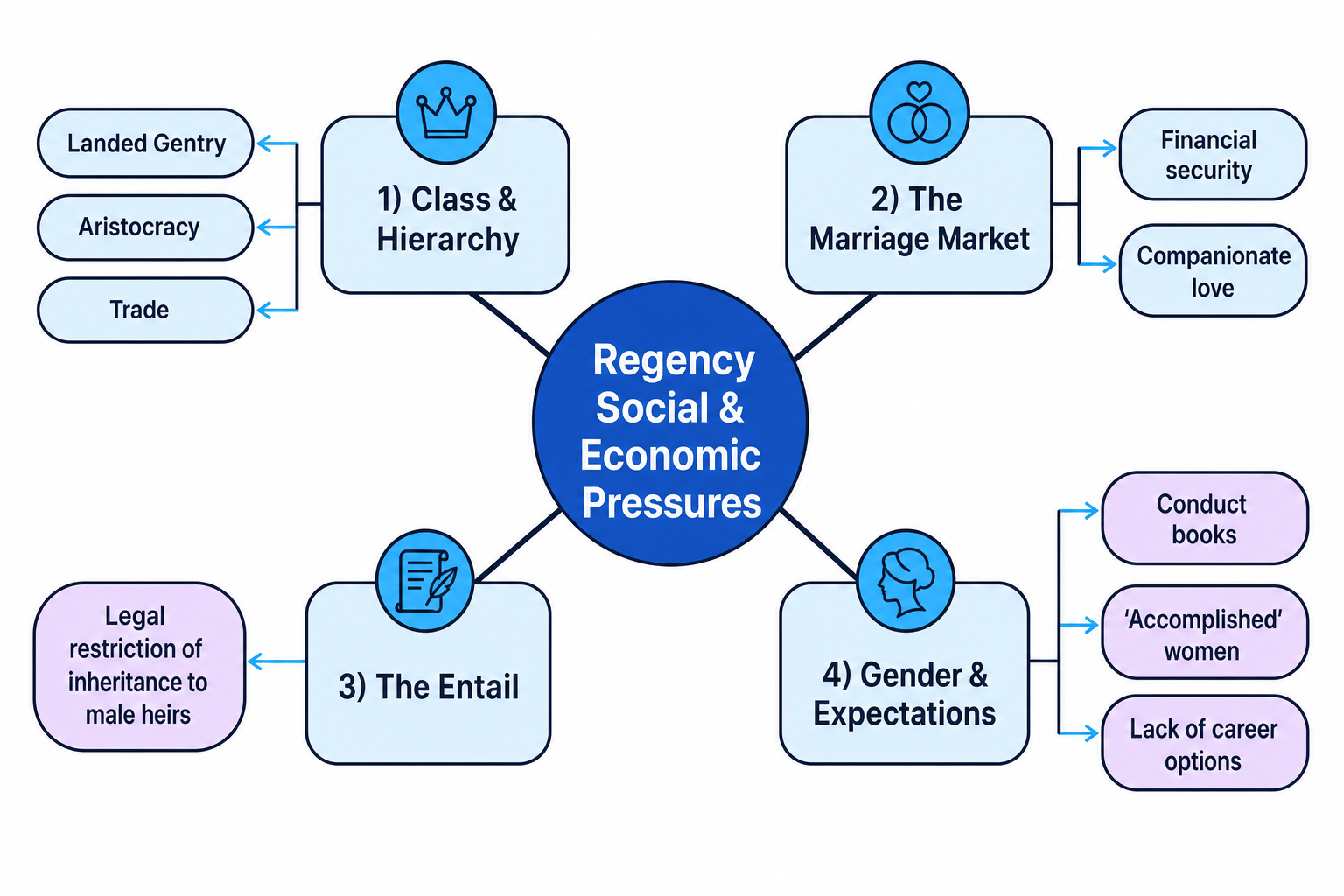
The Aristocracy vs. The Landed Gentry
Austen's world is divided into distinct social tiers, and the friction between them drives the plot:
- The Aristocracy / Nobility: These were individuals with hereditary titles (like Dukes, Earls, or Barons). They held the highest social status and vast wealth. Lady Catherine de Bourgh represents this old, rigid elite.
- The Landed Gentry: This class owned land (estates) but did not hold noble titles. They lived off the rent paid by the farmers who worked their land. Mr. Darcy (an exceptionally wealthy landowner of Pemberley) and Mr. Bennet (owner of the modest Longbourn estate) both belong to this class.
Landed Gentry
The social class of landowners who lived off the rental and agricultural income of their estates rather than manual labour or trade.
- Trade ("New Money"): Below the gentry were those who earned their wealth through commerce, manufacturing, or professional careers (law, medicine). The landed gentry often looked down on trade as "vulgar." Mr. Bingley's family wealth comes from trade, though he is looking to purchase an estate to secure "landed" status. Mrs. Bennet's brother, Mr. Gardiner, is a successful merchant living in London; despite his lower social status, Austen presents him as one of the most sensible and gentlemanly characters in the novel.
Class and Moral Worth
Austen critiques her society by showing that social status does not equate to moral status. High-born characters like Lady Catherine can be rude and arrogant, while lower-status characters like Mr. and Mrs. Gardiner behave with genuine dignity and grace.
3. The Position of Women: Marriage as Survival
In the early 19th century, middle- and upper-class women had almost no avenues for financial independence. They could not go to university, vote, enter professions, or easily own property.
The Law of Coverture
Upon marriage, a woman's legal rights were subsumed by those of her husband.
Coverture
A legal doctrine in English common law whereby a woman's legal rights and property were legally transferred to her husband upon marriage.
If a woman did not marry, she was entirely dependent on her father or brothers. If they died or could not support her, her only respectable employment option was to become a governess (a private live-in tutor for wealthy families)—a position that paid poorly and carried a low social status. Therefore, finding a wealthy husband was not a romantic luxury; it was an economic necessity.
The Entail and Longbourn
The financial vulnerability of the Bennet sisters is worsened by a specific legal device: the entail.
Entail (or Fee Tail)
A legal restriction that prevented an estate from being divided or sold, instead forcing it to pass directly to the nearest male heir in order to keep the estate intact.
Because Mr. and Mrs. Bennet have five daughters and no sons, the Longbourn estate is entailed to Mr. Collins, a distant cousin. When Mr. Bennet dies, his daughters and widow will be evicted from their home with only a tiny inheritance. This context explains Mrs. Bennet's frantic, obsessive determination to marry off her daughters. Without these marriages, her daughters face poverty and social ruin.
The "Accomplished" Woman
To secure a husband, women were expected to acquire "accomplishments." These were non-academic skills designed to entertain a husband and show off a family's wealth.
In Chapter 8, Caroline Bingley and Darcy list the requirements of an "accomplished" woman: drawing, piano playing, singing, dancing, modern languages, and a certain "air and manner." Elizabeth Bennet mocks these impossibly high standards, highlighting Austen's belief that women should be valued for their intellect, character, and "the improvement of her mind by extensive reading" rather than superficial performances.
4. Love vs. Pragmatism: Types of Marriage
Austen uses the different couples in the novel to explore the tension between pragmatic marriage (marriage for money and status) and companionate marriage (marriage based on love, mutual respect, and intellectual compatibility).
Companionate Marriage
A marriage form based on mutual affection, emotional support, and equal intellectual partnership, rather than purely economic or social convenience.
- Charlotte Lucas and Mr. Collins: This is the ultimate pragmatic marriage. Charlotte is 27 (an "old maid" in Regency terms) and a financial burden to her family. She accepts Mr. Collins purely for "preservation from want."
- Lydia Bennet and George Wickham: Based purely on superficial physical attraction and lust. Because they run away together unmarried (elopement), they threaten to ruin the reputation of the entire Bennet family.
- Mr. and Mrs. Bennet: A cautionary tale of a marriage based solely on youth, beauty, and physical attraction. Once those faded, Mr. Bennet lost respect for his wife, leading to a dysfunctional household.
- Elizabeth and Darcy / Jane and Bingley: These represent Austen’s ideal companionate marriages, where financial security is balanced with deep mutual affection and respect.
Judging Charlotte Lucas too harshly
Do not write off Charlotte Lucas as cold or cynical. To a modern reader, marrying the ridiculous Mr. Collins seems foolish. However, in a Regency context, Charlotte is making a highly rational, responsible decision to secure her own survival and protect her family from financial strain. Austen does not condemn Charlotte; she condemns the social system that forces women into such choices.
5. Integrating Context into Your Essays
AQA examiners do not want a "history dump" of isolated facts. Your historical knowledge (AO3) must always serve your analysis of the writer’s craft (AO2) and your interpretation of the characters' journeys (AO1).
Analyzing how context shapes character motivation
Walk through this three-step process to weave context seamlessly into a literary analysis of Charlotte Lucas’s marriage.
- Identify the character's choice or statement: Locate a specific moment. Charlotte Lucas tells Elizabeth, "I am not romantic, you know; I never was. I ask only a comfortable home."
- Weave in the precise historical/social context: Connect this statement to the economic vulnerabilities of Regency women. Mention that as a 27-year-old woman with no fortune, Charlotte faces the grim prospect of becoming a spinster dependent on charity or a low-status governess.
- Analyze Austen's literary method and purpose: Explain how Austen uses Charlotte's pragmatism as a foil (contrast) to Elizabeth's idealism. By using a calm, matter-of-fact tone in Charlotte's dialogue, Austen highlights the bleak social reality that romantic love was a luxury many Regency women simply could not afford, thereby satirizing the unfairness of the marriage market.
In the exam
- Never "history-dump": Do not write paragraphs explaining the Napoleonic Wars or King George III's health unless you can directly link them to a character’s behavior or a thematic point in the text (e.g., linking the presence of the militia in Meryton to the wartime context).
- Use precise terminology: Instead of writing "the law about men getting the house," write about "the system of patrilineal entail." Instead of "women had no rights," reference the legal framework of coverture.
- Anchor context to the writer's intent: Always use verbs of intention. Write: "Austen uses the financial threat of the entail to justify Mrs. Bennet’s frantic behaviour, thereby critiqueing the legal disempowerment of women in Regency England."
Check yourself
- Why is the entail on the Longbourn estate such a critical driving force for the plot of Pride and Prejudice?
- How does the character of Mr. Gardiner challenge the traditional Regency attitudes towards those who earned their money through "trade"?
- What is the difference between a pragmatic marriage and a companionate marriage, and which characters represent these two extremes?
