Jane Austen’s Pride and Prejudice is far more than a simple historical romance. At its heart, it is a brilliant comedy of manners—a literary genre that makes fun of the manners, behaviors, and artificial rules of a specific social class. By laughing at her characters, Austen invites us to critique the very society they live in.
What you'll learn
- How to identify and analyze Austen's primary comedic tools: verbal irony, dramatic irony, and caricature.
- How Austen uses Free Indirect Discourse to blend narrative voice with character perspective for comic effect.
- How to link Austen's comedic methods directly to her critique of Regency marriage, wealth, and class (AO2/AO3).
1. The Basics of Austen's Social Comedy
To understand how Austen constructs her comedy, we must first look at the social landscape of Regency England. In a society where women had very little economic independence, marriage was not just a romantic pursuit—it was a financial necessity.
Austen uses comedy to highlight the absurdity, hypocrisy, and desperation that this social system produced. Instead of writing a tragedy about these harsh realities, she uses humor as a weapon of critique.
Comedy of Manners
A comedy of manners is a play or novel that satirizes (makes fun of) the artificial behaviors, snobbery, and sophisticated conventions of a highly structured social class.
Satire
Satire is the use of humor, irony, exaggeration, or ridicule to expose and criticize people's stupidity or vices, particularly in the context of contemporary politics and other topical issues.
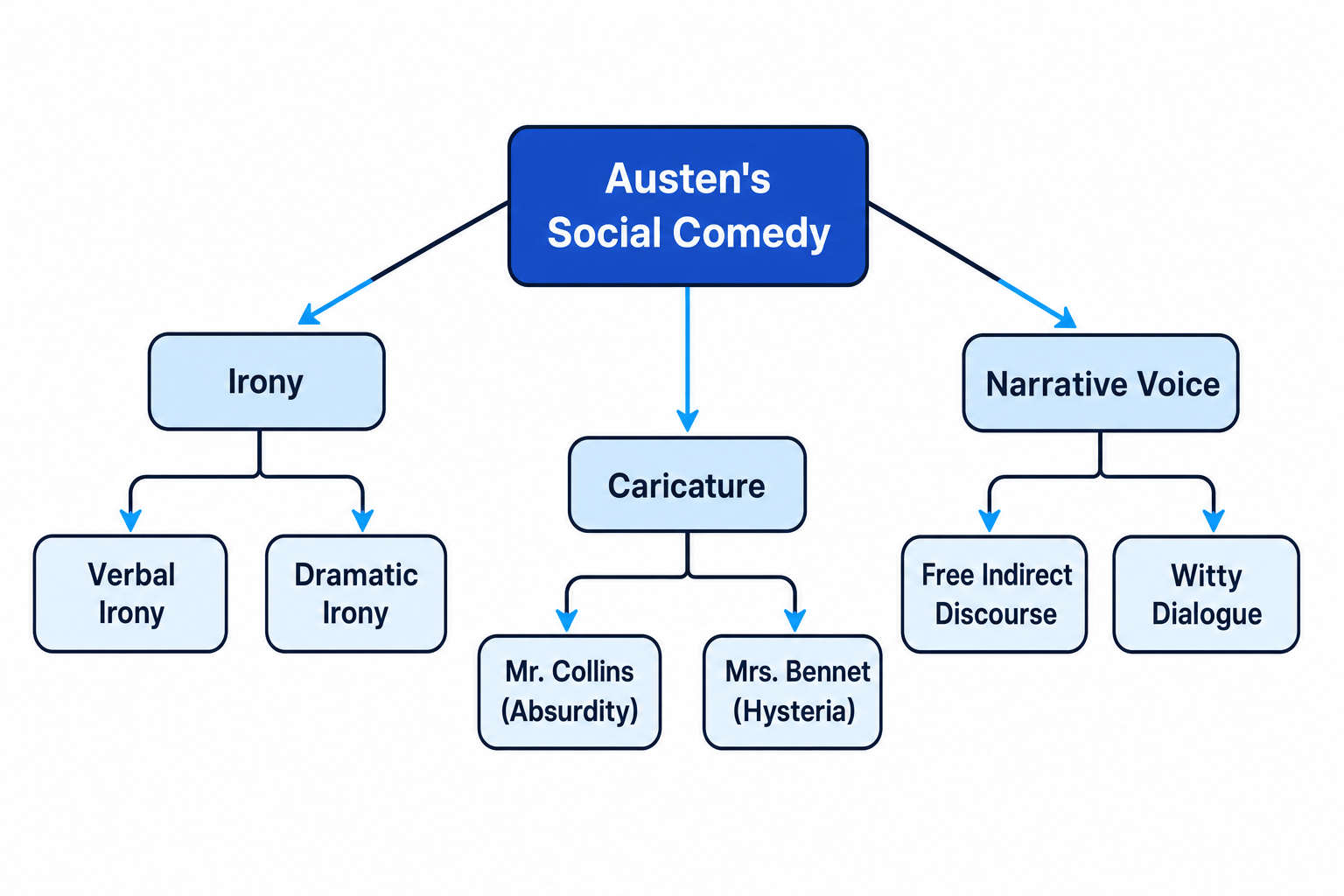
Austen's social comedy relies on a highly structured set of techniques, which we can map out to see how they function together in the novel:
2. Irony: The Engine of the Novel
Irony is Austen's signature tool. It occurs when there is a contrast between expectation and reality, or between what is said and what is actually meant. She uses two main types of irony to drive her social comedy:
Verbal Irony
Verbal irony is when a speaker says one thing but means the exact opposite.
The most famous example in English literature is the opening sentence of the novel:
"It is a truth universally acknowledged, that a single man in possession of a good fortune, must be in want of a wife."
Here, Austen uses verbal irony to mock the desperate ambitions of Regency mothers. To the local gentry (like Mrs. Bennet), a wealthy bachelor is viewed as their rightful property, "in want of a wife." The "truth" is not "universally acknowledged" at all; it is actually a highly biased, desperate pursuit by families wishing to secure their daughters' financial futures.
Dramatic Irony
Dramatic irony occurs when the reader knows crucial information that a character does not.
Austen uses this to expose the pride and prejudices of her main characters. For example, we watch Elizabeth Bennet confidently declare that she is an excellent judge of character, all while she is completely blind to Wickham’s deceit and Darcy's growing admiration for her. This creates a playful, superior position for the reader, who watches the characters stumble through their social misunderstandings.
The function of irony
Austen's irony is never merely decorative. She uses it to expose the gap between appearance (social politeness and wealth) and reality (moral character and genuine human emotion).
3. Caricature and Foil Characters
While Elizabeth and Darcy are complex, psychological characters, many of the supporting characters are caricatures.
Caricature
A caricature is a portrait of a character that exaggerates or distorts certain dominant characteristics, habits, or motives for comic or satirical effect.
Mrs. Bennet: The Hysterical Mother
Mrs. Bennet is a caricature of social desperation. Her entire life is consumed by the singular goal of marrying off her five daughters. Austen exaggerates her lack of tact, her "nervous complaints," and her mercenary views on love.
By making Mrs. Bennet ridiculous, Austen highlights how the real-world pressure of the entail (the legal rule preventing the Bennet girls from inheriting their father's estate) can drive a parent to frantic, embarrassing extremes.
Mr. Collins: The Ultimate Sycophant
Mr. Collins is a caricature of extreme obsequiousness (kissing up to those in power). He is absurdly pompous yet deeply insecure, constantly dropping the name of his wealthy patroness, Lady Catherine de Bourgh.
Austen uses his long, overly formal sentences to show his lack of genuine human feeling. When he proposes to Elizabeth, he lists his reasons in a highly structured, business-like manner, completely ignoring her feelings.
Dismissing caricatures as 'just funny'
GCSE students often write that characters like Mrs. Bennet or Mr. Collins are just there for "comic relief." In a top-grade essay, you must explain why Austen satirizes them. They are comedic warnings of what happens when you let social greed and mindless conformity override moral integrity.
4. Free Indirect Discourse: The Sneaky Narrator
One of Austen's most sophisticated structural techniques is her use of Free Indirect Discourse (sometimes called Free Indirect Style).
Free Indirect Discourse
Free Indirect Discourse is a style of third-person narration that slips into a character’s internal thoughts and feelings without using explicit tags like "he thought" or "she felt."
This technique allows the third-person narrator to mimic the voice and prejudices of a character, letting the reader see exactly how biased or ridiculous that character's thinking is.
Let's look at how this works in practice.
Analyzing Free Indirect Discourse
Analyze how Austen uses Free Indirect Discourse in Chapter 13 to gently mock Mr. Collins’s self-importance before he even arrives at Longbourn.
- Identify the passage and narrative voice: Look at the narrator's description of Mr. Collins’s letter: "He was a tall, heavy-looking young man of five-and-twenty. His air was grave and stately, and his manners were very formal." This starts as standard third-person narration.
- Spot the transition to the character's internal perspective: The narrator continues: "He had not been long seated before he complimented Mrs. Bennet on having so fine a family of daughters; but doubted not her husband’s consent to his marrying one of them..." Austen blends her narrator's voice with Mr. Collins’s inner arrogance.
- Analyze the comedic effect and social critique: The phrase "doubted not her husband's consent" shows Mr. Collins’s supreme, unearned confidence. By presenting his thoughts through the narrator's dry voice, Austen exposes his complete lack of self-awareness. He treats marriage as a transactional obligation where his consent is the only one that truly matters, highlighting the patriarchal power dynamics of the era.
Spotting Free Indirect Discourse
If you see a passage written in the third person (she/he), but the vocabulary and sentence structure sound exactly like a specific character's personal biases or emotional state, you have found Free Indirect Discourse. It is a goldmine for AO2 analysis!
In the exam
When writing about Jane Austen's comedic methods under exam conditions, keep these strategies in mind:
- Avoid device-spotting: Never just write "Austen uses irony here." Always link the device to its effect and theme. For example: "Austen uses verbal irony to satirize the mercenary nature of the marriage market."
- Contrast the dialogue styles: Compare the quick-witted, balanced dialogue of Elizabeth with the lengthy, one-sided monologues of Mr. Collins. This contrast in sentence structure (syntax) is an excellent way to show how character is revealed through form (AO2).
- Embed historical context (AO3): Remember that the comedy is a response to real-world anxieties. Mrs. Bennet’s hysteria is funny, but it is driven by the very real danger of poverty due to the legal entail. Lady Catherine’s snobbery is absurd, but it reflects the rigid class barriers of Regency England.
Check yourself
Before you finish this topic, make sure you can answer these questions:
- What is the difference between verbal irony and dramatic irony, and can you name one example of each from the novel?
- Why is Mr. Collins considered a caricature rather than a realistic, well-rounded character? What social flaw does he represent?
- How does Austen's use of Free Indirect Discourse allow her narrator to mock characters without openly insulting them?
