

In Kit de Waal’s My Name is Leon, characters are not just realistic individuals; they are vehicles used to explore the social, political, and cultural realities of 1980s Britain. By viewing the world through the eyes of a nine-year-old mixed-race boy, the novel highlights the complexities of family, race, and the state care system.
What you'll learn
- How Leon’s perspective acts as a narrative filter for complex adult struggles.
- The structural roles of foster carers and the allotment community in reconstructing Leon’s identity.
- How to analyze character dynamics to meet AO1, AO2, and AO3 assessment objectives in your exam.
1. Leon: The Narrative Lens
Leon is the protagonist and the emotional anchor of the novel. Kit de Waal uses a third-person limited narrative perspective focused entirely on Leon. This technique allows us to experience the harshness of his reality through the innocent, often confused lens of a child.
Third-Person Limited Narrative (Focalization)
A narrative method where the story is told in the third person ("he", "she", "they"), but the narration is strictly limited to the thoughts, feelings, and sensory perceptions of a single character—in this case, Leon.
Leon’s character is defined by his dual roles: he is a vulnerable child needing protection, yet he constantly tries to act as a protector. He feels a deep sense of responsibility for his baby brother, Jake, and his mother, Carol. This premature maturity is a direct consequence of the unstable environment he grows up in.
Key Aspects of Leon's Characterization:
- Resilience and Loyalty: Leon's primary motivation is to keep his family together. Even when separated from Jake, his actions—such as saving money to "buy" Jake back—demonstrate a fierce, unconditional love.
- Internal Conflict: Leon struggles with his identity. As a mixed-race child in 1980s Birmingham, he faces subtle and overt racism, which is compounded by the fact that his white brother, Jake, is adopted quickly while Leon is left behind in foster care.
Leon's Action Figures
Leon’s action figures (the "Action Men") serve as a symbolic motif. They represent his desire for control, strength, and a protective father figure. When things fall apart in his real life, he manipulates these figures to create order.
2. Character Mapping: Navigating Three Worlds
To understand how Leon develops, you must examine how he moves between three distinct social spheres: his biological family, the state foster system, and the informal community at the allotment.
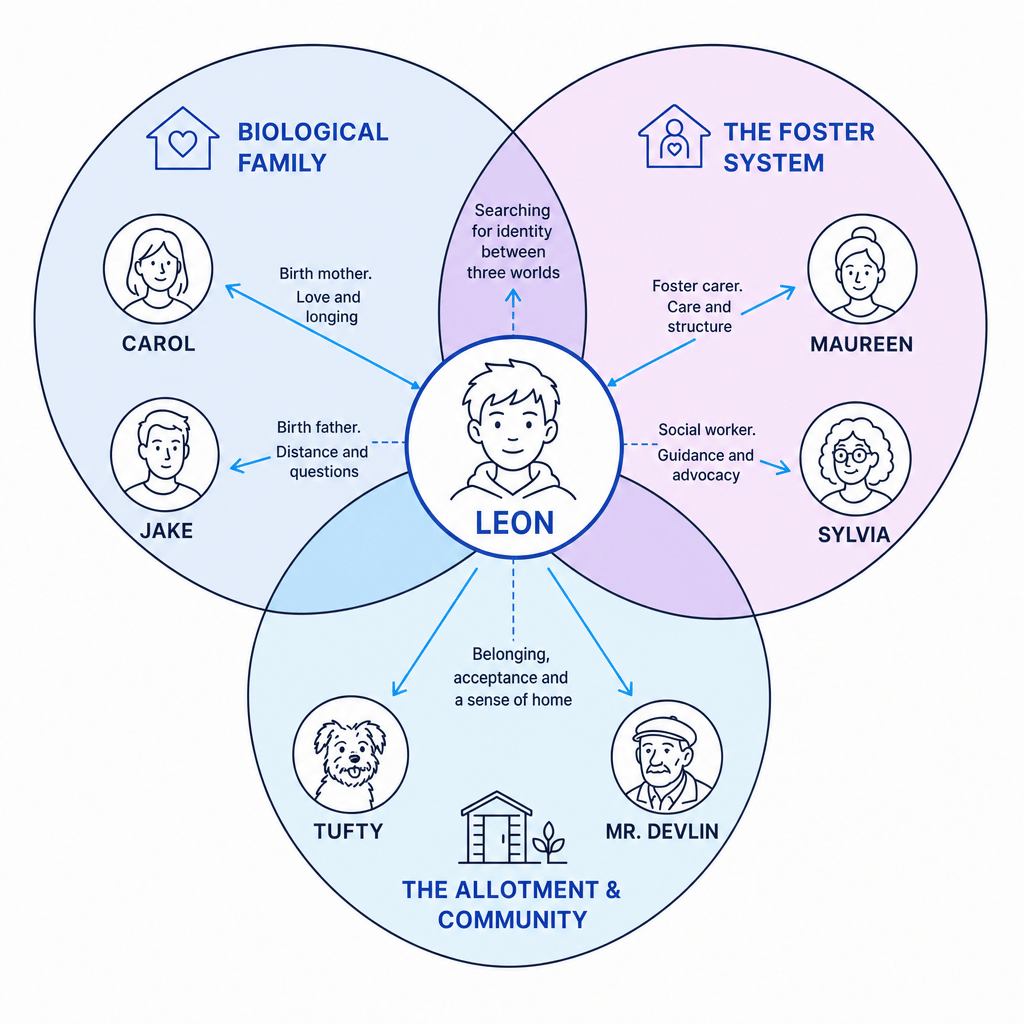
The Biological Family: Carol and Jake
- Carol: Leon’s mother. Rather than presenting Carol as a simple "bad mother," de Waal depicts her as a victim of severe postnatal depression, poverty, and isolation. Through Carol, the novel critiques the lack of social and mental health support for vulnerable mothers in the 1980s. Leon loves her deeply but is forced to become her caretaker, noting how she "smells of old sleep."
- Jake: Leon’s baby half-brother. Jake is white, which makes him highly "adoptable" in the eyes of the 1980s social services. The separation of the brothers is the central tragedy of the novel, exposing how the state care system prioritized bureaucratic efficiency and racial matching over the emotional bonds of siblings.
3. The Foster Care System: Maureen and Sylvia
Maureen and Sylvia represent two different sides of the care system. Through them, de Waal shows how institutional care can still be deeply human and transformative.
Maureen
Maureen is Leon’s first foster mother. She is warm, patient, and uses sensory comfort—such as the smell of toast, hot chocolate, and soft blankets—to soothe Leon's trauma. She represents unconditional love and immediate emotional safety.
Sylvia
Sylvia is Maureen's sister, who takes over when Maureen becomes terminally ill. Initially, Leon views her as strict and cold, but she eventually becomes a crucial source of stability. Sylvia represents structural order, resilience, and a realistic preparation for the challenges of the wider world.
Viewing Sylvia as an antagonist
Do not write Sylvia off as a harsh or unfeeling character. While she lacks Maureen's soft, nurturing approach, her practical care and advocacy for Leon are acts of deep love. She represents the resilience required to survive in a hostile society.
4. The Allotment Community: Tufty and Mr. Devlin
When Leon runs away to the local allotments, he enters an informal community of marginalized adults. This space provides him with the education, cultural connection, and father figures that the state care system cannot offer.
Tufty
Tufty is an older Black man who becomes a surrogate father figure for Leon.
- Cultural Identity: Tufty introduces Leon to his Caribbean heritage, music, and food. This helps Leon construct a positive sense of his Black identity in a predominantly white society.
- Contextual Link (AO3): Through Tufty and his friend Castro, de Waal introduces the political landscape of 1981, including the Handsworth Riots. These riots were a response to systemic police harassment and racial inequality, matching the structural barriers Leon faces.
Mr. Devlin
Mr. Devlin is an elderly Irish immigrant. Like Leon and Tufty, he is an outsider in 1980s British society.
- The Power of the Allotment: Mr. Devlin teaches Leon how to plant seeds. This act of gardening is highly symbolic: it represents patience, growth, and the idea that with the right care, things can thrive even in poor soil.
The Allotment as a Metaphor
In your essays, analyze the allotment not just as a setting, but as an extended metaphor for emotional growth. Just as seeds need nurturing to grow, Leon needs a supportive community to heal and find his identity.
5. Analyzing Characterization in Your Essays
In the exam, you must show how de Waal constructs these characters to convey deeper thematic messages. You should always link your analysis of character dialogue or actions to the writer's methods (AO2) and the historical context (AO3).
Let's look at a step-by-step example of how to build an analytical paragraph about Carol's characterization.
Analyzing the presentation of Carol's vulnerability
Analyze how Kit de Waal presents Leon’s mother, Carol, in the early chapters of the novel.
-
Formulate a clear, context-linked thesis statement (AO1/AO3): Begin by stating what Carol represents. Example: "De Waal presents Carol not as a malicious figure, but as a deeply vulnerable victim of systemic neglect and mental illness in 1980s Britain, prompting the reader to feel sympathy rather than judgment."
-
Select and embed precise textual evidence (AO1): Choose a short, high-quality quotation that highlights her state of mind or physical appearance. Example: Leon describes how Carol "stayed in her room with the curtains closed" and "smelled of old sleep."
-
Analyze the writer's methods and language choices (AO2): Focus on specific words, sensory details, or imagery. Example: "The sensory description 'smelled of old sleep' uses olfactory imagery to convey the oppressive weight of Carol's depression. The word 'old' implies stagnation, a lack of energy, and a prolonged state of neglect. The metaphor of the 'curtains closed' symbolizes her self-isolation and her inability to face the outside world, turning her bedroom into a physical manifestation of her mental illness."
-
Connect your analysis back to the historical/social context (AO3): Explain why the author is writing this and what it reveals about 1980s society. Example: "Through this depiction, de Waal critiques the lack of social support and understanding surrounding maternal mental health in the early 1980s. By filtering this through Leon's child perspective, the reader feels the tragic impact of Carol's illness on her children, while recognizing that Carol herself was abandoned by a rigid, uncaring welfare system."
In the exam
- Focus on Character Function: Always ask yourself: Why did Kit de Waal create this character? What social group, idea, or challenge do they represent?
- Track Character Arcs: Characters change. Make sure your essay traces their development. For example, show how Leon transitions from a boy desperate to recreate his old biological family to someone who accepts his new, chosen family.
- Use the Child's Perspective: Explicitly discuss how Leon's limited understanding of adult situations (like foster care bureaucracy or racial riots) creates dramatic irony, increasing the emotional impact on the reader.
Check yourself
- Why is it significant that Leon's brother, Jake, is white, while Leon is mixed-race? What does this reveal about the 1980s care system?
- How does the character of Tufty help Leon develop a sense of identity that he couldn't find with Maureen or Sylvia?
- Find two short quotations that show the contrast between Maureen's style of care and Sylvia's style of care.
