What you'll learn
- How to write about Elizabeth Bennet and Mr Darcy as changing, complex characters.
- How Austen uses foils and contrasts, especially Jane/Bingley, Charlotte/Elizabeth, and Wickham/Darcy.
- How to connect characters to Austen’s methods: dialogue, irony, structure and narrative voice.
- How to turn character knowledge into strong GCSE analysis for the closed-book exam.
Big picture: characters are Austen’s main method
In Pride and Prejudice, characters are not just “people in the story”. Austen uses them to test ideas about judgement, class, marriage, money, family and reputation. Nearly every character shows a different way of seeing society.
Characterisation
Characterisation means the methods a writer uses to create and develop a character. This includes what they say, what they do, how others describe them, how the narrator presents them, and how they change across the novel.
Austen’s characters often reveal themselves through conversation. In this society, manners matter: what a person says at a ball, dinner or visit can reveal their pride, insecurity, kindness or selfishness.
Characters as moral tests
Austen often asks you to judge characters — then shows you that judgement itself can be wrong. This is especially important for Elizabeth, Darcy and Wickham.
Elizabeth Bennet: wit, independence and self-knowledge
Elizabeth Bennet is the novel’s protagonist: the main character whose experiences shape the story. She is intelligent, lively and independent, but Austen does not present her as perfect. Her main flaw is that she can make quick judgements and then enjoy being right.
Early on, Elizabeth says, “I could easily forgive his pride, if he had not mortified mine” in Chapter 5. This is a brilliant short quotation because it shows both Darcy’s pride and Elizabeth’s wounded pride. The verb “mortified” suggests embarrassment and injured vanity, so Austen hints that Elizabeth’s dislike of Darcy is not entirely objective.
Elizabeth’s growth reaches a turning point after Darcy’s letter, when she admits: “Till this moment I never knew myself” in Chapter 36. This is one of the most important character moments in the novel: she recognises that her prejudice against Darcy and trust in Wickham have distorted her judgement.
Free indirect discourse
Free indirect discourse is a narrative style where third-person narration blends with a character’s thoughts and feelings. Austen often lets us feel close to Elizabeth’s viewpoint, which makes her mistakes more convincing to the reader.
Because the narration often follows Elizabeth’s perspective, readers may initially share her opinions. When she realises she has misjudged Darcy and Wickham, the reader is pushed to re-evaluate too.
Analysing Elizabeth’s self-knowledge
-
Start with the character change: Elizabeth moves from confident judgement to painful self-awareness after reading Darcy’s letter.
-
Use the quotation “Till this moment I never knew myself.” The short sentence sounds sudden and decisive, showing that this is a moment of emotional shock rather than a casual thought.
-
Analyse the method: Austen uses structure here because the letter creates a turning point in Elizabeth’s character arc. The word “myself” shifts the focus away from judging Darcy and Wickham towards judging her own mind.
-
Link to meaning: Austen suggests that intelligence is not enough on its own; moral maturity requires humility and the willingness to correct your own prejudice.
Elizabeth’s independence is also shown through her refusals. She rejects Mr Collins because she will not marry without respect or affection. Later, she resists Lady Catherine, insisting she will act in a way that will “constitute my happiness” and not simply obey aristocratic pressure. Austen presents Elizabeth as flawed but admirable because she learns without losing her spirit.
Mr Darcy: pride, reserve and reform
Darcy is first presented through social awkwardness and class pride. At the Meryton assembly, he says Elizabeth is “tolerable; but not handsome enough to tempt me” in Chapter 3. The insult is memorable because it is blunt, dismissive and public enough to damage Elizabeth’s opinion of him.
However, Darcy is not just “the arrogant man”. Austen gradually complicates him. His pride partly comes from rank and wealth, but his reserve also hides loyalty, responsibility and emotional seriousness. His care for Georgiana and his later help with Lydia reveal a more generous character than Elizabeth first sees.
Darcy’s first proposal in Chapter 34 is important because it mixes love with insult: “In vain I have struggled. It will not do.” The language of “struggled” makes love sound like a battle against reason, class and family expectations. He proposes while making Elizabeth feel inferior, which is why her rejection is morally necessary.
The diagram below shows how Elizabeth and Darcy change in parallel: both have to overcome a form of pride before they can become equal partners.
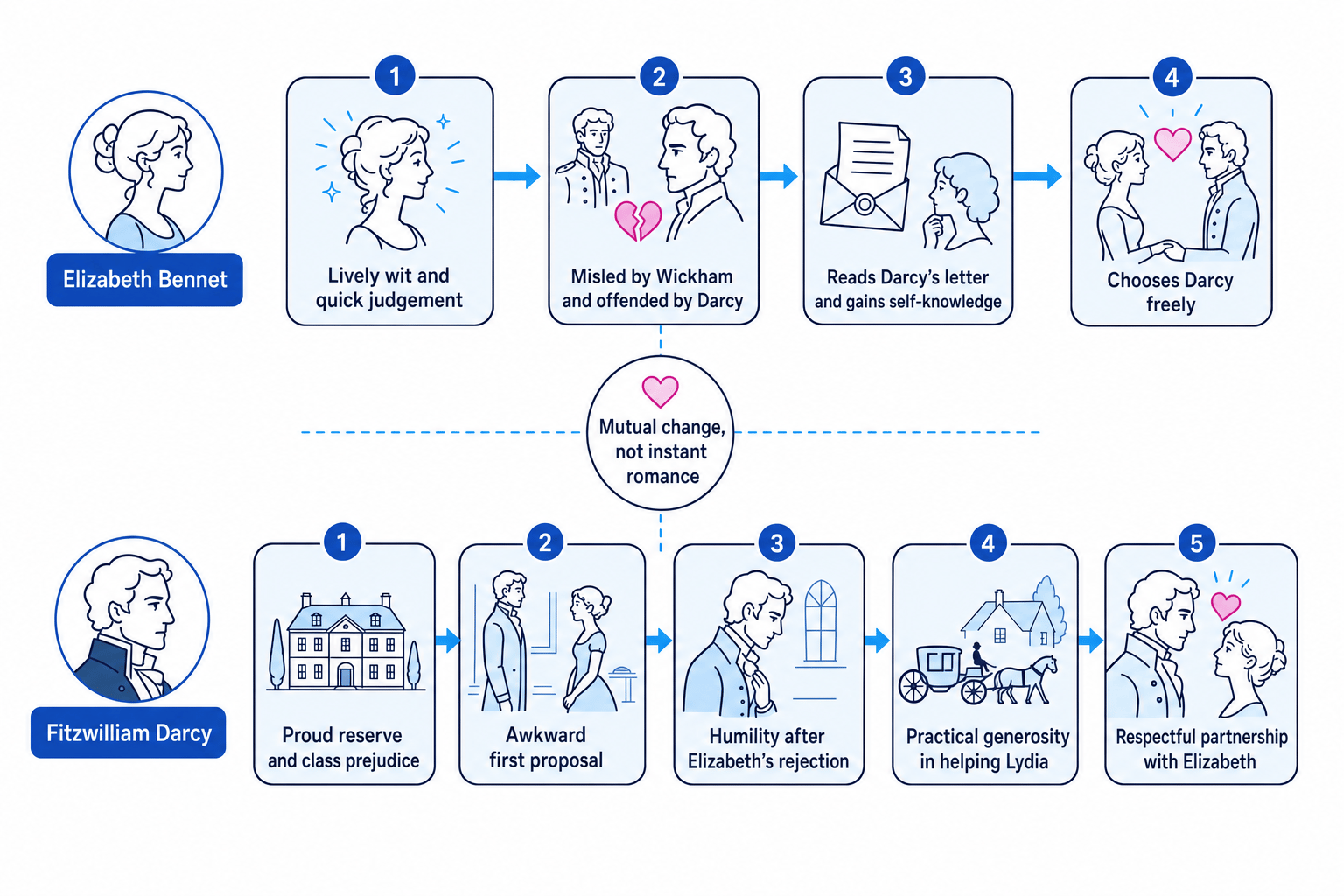
By the end, Darcy admits, “I have been a selfish being all my life, in practice, though not in principle.” This matters because he does not simply become nicer; he becomes self-critical. Austen presents true moral growth as the ability to recognise your faults and act differently.
Calling Darcy simply arrogant
Do not write as if Darcy stays the same throughout the novel. A stronger answer tracks his movement from pride and social prejudice towards humility, generosity and respect for Elizabeth’s judgement.
Jane Bennet and Charles Bingley: goodness and softness
Jane and Bingley are a gentler pairing than Elizabeth and Darcy. Jane is kind and forgiving; Bingley is warm and sociable. The narrator introduces Bingley as having “easy, unaffected manners”, which contrasts strongly with Darcy’s cold first impression.
Jane is sometimes used as a foil to Elizabeth.
Foil
A foil is a character who highlights another character’s qualities through contrast or similarity.
Elizabeth says Jane is “too apt” to like people and that she never sees “a fault in any body”. This shows Jane’s goodness, but also her lack of suspicion. Compared with Jane, Elizabeth seems sharper and more ironic; compared with Elizabeth, Jane seems more generous and emotionally steady.
Bingley is also a foil to Darcy. He is open and charming, but easily influenced. Darcy is proud and reserved, but more decisive once he has changed. Austen does not simply say one is better than the other: she shows that good nature needs judgement, and judgement needs kindness.
Comparing Jane and Elizabeth as foils
-
Choose the contrast: Jane tends to trust people, while Elizabeth tends to judge them quickly.
-
Use evidence from Elizabeth’s comment that Jane never sees “a fault in any body”. This suggests Jane’s moral generosity, but also her vulnerability to being misled.
-
Compare Elizabeth’s “mortified mine” comment about Darcy. Her sharper wit makes her more entertaining, but it also reveals that personal pride affects her judgement.
-
Link to Austen’s purpose: by placing the sisters side by side, Austen explores the difficulty of judging character accurately in a polite society where appearances can deceive.
Charlotte Lucas and Mr Collins: marriage as survival
Charlotte Lucas is one of the most useful characters for writing about marriage and social pressure. She accepts Mr Collins not because she loves him, but because marriage gives her security. Her famous line is: “I am not romantic, you know; I never was. I ask only a comfortable home.”
This is not presented as passionate or ideal, but it is understandable. Charlotte is older than Elizabeth, has little money, and lives in a society where women’s opportunities are limited. Austen uses her to show the practical pressures behind marriage decisions.
Mr Collins is comic, pompous and socially embarrassing. He constantly praises Lady Catherine, his “patroness”, and treats marriage like a transaction. Austen uses satire — writing that mocks foolishness or social problems — to expose his vanity and the absurdity of a society where such a man has power because he will inherit Longbourn.
Lydia Bennet and George Wickham: desire, charm and danger
Lydia is young, impulsive and poorly guided. Her “high animal spirits” make her lively, but also reckless. Her elopement with Wickham creates a crisis because female reputation in Austen’s society is fragile: Lydia’s actions threaten not only herself but all her sisters’ marriage prospects.
Wickham is dangerous because he appears attractive and trustworthy. Austen’s narrator describes his “very pleasing address”, meaning his charming manner. Elizabeth initially trusts him because he performs goodness well. In character terms, Wickham is a warning that appearance and morality are not the same.
Wickham also works as a foil to Darcy. Wickham seems open but is selfish; Darcy seems proud but proves honourable. Austen uses this reversal to challenge first impressions.
A strong Wickham point
If you write about Wickham, do not just call him “the villain”. Explain how Austen makes his charm believable so that Elizabeth’s mistake becomes understandable.
Mr and Mrs Bennet: comic parents, serious consequences
Mr Bennet is witty and detached. His sarcasm is entertaining, but Austen also criticises his failure as a father. He often retreats into mockery instead of taking responsibility for his daughters’ futures.
Mrs Bennet is often comic, especially through her nerves and obsession with marriage. The narrator says: “The business of her life was to get her daughters married; its solace was visiting and news.” This is funny, but it also reveals a real pressure: because the Bennet daughters cannot inherit Longbourn, marriage is an economic necessity.
Together, Mr and Mrs Bennet show weak parenting from opposite directions. Mrs Bennet is foolishly anxious; Mr Bennet is cleverly irresponsible. Lydia’s behaviour partly grows from this lack of guidance.
Lady Catherine de Bourgh: class power and intimidation
Lady Catherine represents aristocratic pride and social control. She expects obedience because of her rank. Her question, “Are the shades of Pemberley to be thus polluted?” shows her obsession with class purity and inheritance.
She also functions as an antagonist: a character or force that creates conflict for the protagonist. Ironically, her attempt to separate Elizabeth and Darcy helps bring them together, because it gives Elizabeth a chance to prove her courage and independence.
Minor characters worth remembering
Mary Bennet often provides comic seriousness. She wants to appear wise, but her speeches can sound awkward and artificial. Kitty is more easily influenced, especially by Lydia. Georgiana Darcy reveals Darcy’s tenderness and loyalty. Colonel Fitzwilliam helps Elizabeth learn more about Darcy’s role in separating Jane and Bingley. Caroline Bingley exposes snobbery and jealousy, especially in her attempts to mock Elizabeth.
You do not need long paragraphs on every minor character. In the exam, use them when they sharpen your point about a major character or theme.
In the exam
-
Make a clear argument about how the character changes or what they reveal, rather than listing personality traits.
-
Use short, accurate quotations you can remember, then analyse a word or method such as irony, dialogue, structure, contrast or narrative voice.
-
Link characters to Austen’s wider ideas: judgement, class, marriage, reputation, money and moral growth.
Check yourself
- How does Elizabeth’s view of Darcy change, and what causes that change?
- Which two characters could you compare as foils, and what does the contrast reveal?
- How does Austen make comic characters like Mr Collins or Mrs Bennet reveal serious social pressures?
