In your AQA GCSE English Literature exam, you are assessed on your ability to construct a cohesive, closed-book argument supported by precise textual evidence. Memorising massive blocks of Shakespearean text is difficult and unnecessary. Instead, your goal is to master a selective bank of versatile, short quotes that you can analyse deeply.
This guide will teach you how to select, "explode", and apply the most high-yielding quotes from Macbeth to achieve top marks in AO1 (textual reference), AO2 (language and structural analysis), and AO3 (historical and social context).
What you'll learn:
- How to select high-yield, versatile quotations that apply to multiple exam questions.
- The "Quotation Explosion" technique to extract maximum linguistic and contextual meaning.
- Key quotes for Macbeth’s ambition, Lady Macbeth’s manipulation, and the theme of guilt.
- How to integrate short, powerful quotes seamlessly into your essay paragraphs.
1. The Strategy of "High-Yield" Quotations
Many students make the mistake of trying to memorise 50 different long quotes. In a high-stress, closed-book exam, this often leads to misquotation or superficial analysis. A far better strategy is to master 10 to 12 high-yield quotations.
High-Yield Quotation
A high-yield quotation is a short, memorable sequence of words (usually between 3 and 8 words) that links to multiple characters, explores central themes, and contains rich literary devices (methods) that can be unpacked in several different ways.
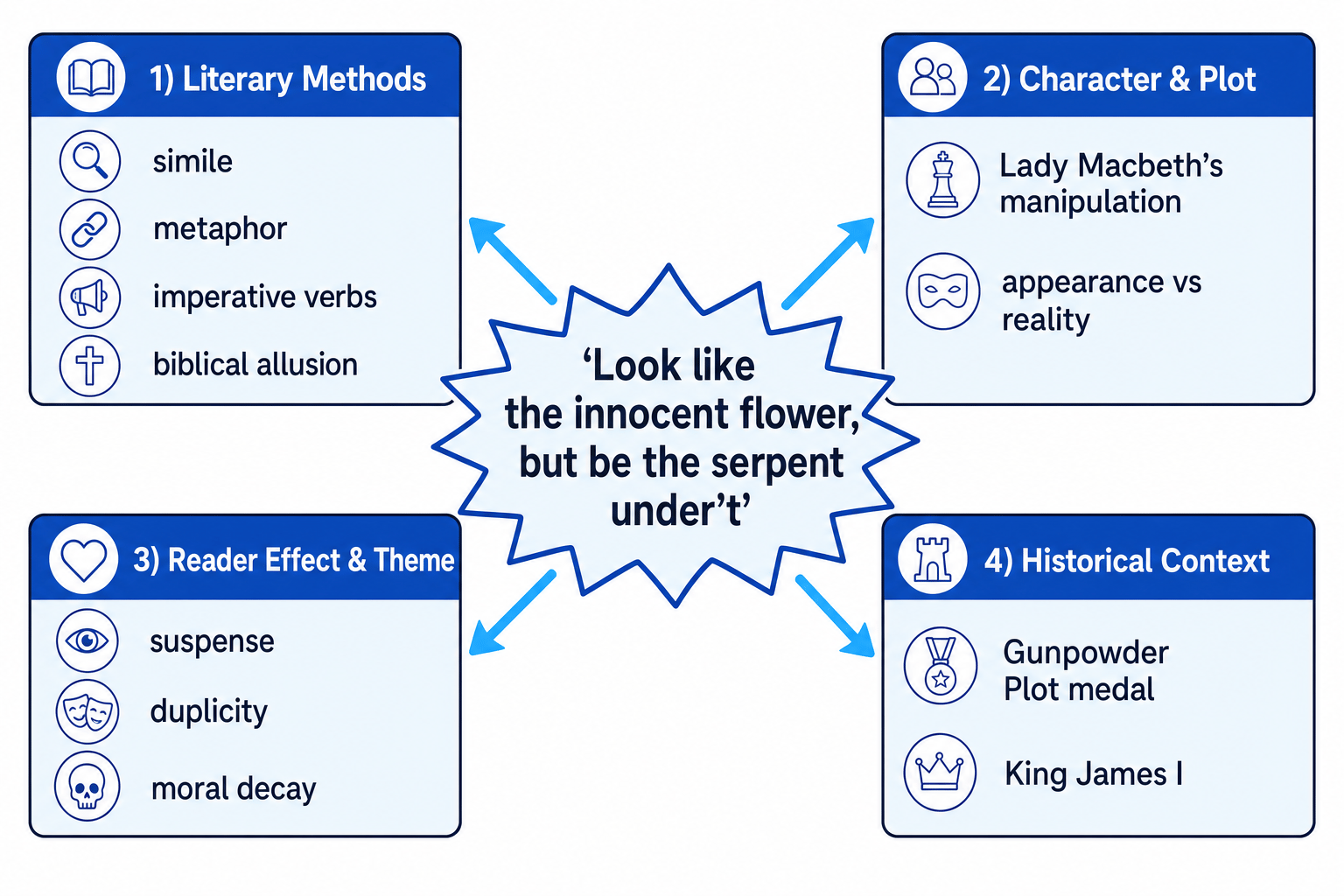
For example, consider the phrase: "Look like the innocent flower, but be the serpent under't" (Act 1, Scene 5).
This single quote is incredibly versatile because it can be used to answer questions on:
- Lady Macbeth: It highlights her manipulative nature and her subversion of typical Jacobean gender expectations.
- Macbeth: It represents the deceptive path he must take to achieve his ambition.
- Themes: It is the ultimate expression of Appearance vs. Reality and Deception.
- Context: The "serpent" refers directly to the medal struck by King James I after the discovery of the Gunpowder Plot in 1605 (which featured a snake hiding under lilies).
To extract the maximum mark from these quotes, you must use the Quotation Explosion technique.
2. Key Theme: Ambition and Corruption
Macbeth's fatal flaw (hamartia) is his overriding ambition. Shakespeare uses specific imagery to show how this ambition corrupts his moral compass and disrupts the Great Chain of Being.
Quote 1: "Stars, hide your fires; let not light see my black and deep desires" (Macbeth — Act 1, Scene 4)
The Battle of Light and Dark
This quote highlights Macbeth's internal conflict. Even before he commits regicide (the murder of a king), he is fully aware of the moral horror of his thoughts. He uses natural imagery to try and mask his sinful intentions from both God and himself.
When analysing this quote, pay close attention to the following layers of meaning:
- The Method (Alliteration & Rhyme): The use of rhyming couplets ("fires"/"desires") mirrors the rhythmic speech of the Witches. This suggests that the Witches have already infected Macbeth’s mind, blurring the lines between his own thoughts and their supernatural influence.
- The Metaphor (Light vs. Dark): "Light" is a metaphor for God, heaven, and moral goodness. "Black and deep desires" represents Macbeth's sinful ambition. By asking the stars to "hide your fires," Macbeth is symbolically trying to exclude God from seeing his treacherous plans, showing his awareness of the divine right of kings.
Missing the Character's Self-Awareness
Students often write that Macbeth is completely evil from the start of the play. However, quotes like this show he has a highly active conscience. He knows his desires are "black and deep" and wants them hidden. Highlighting this moral struggle demonstrates a more sophisticated understanding of his tragedy.
3. Key Theme: Deception and Gender Roles
In Jacobean England, women were expected to be submissive, nurturing, and pure. Shakespeare uses Lady Macbeth to completely subvert these expectations, presenting her as the driving force behind the initial plot to kill Duncan.
Quote 2: "Come, you spirits / that tend on mortal thoughts, unsex me here" (Lady Macbeth — Act 1, Scene 5)
Subversion of Gender
To subvert gender roles means to challenge, reverse, or reject the traditional social expectations associated with being male or female.
- The Method (Imperative Verbs & Soliloquy): Lady Macbeth uses powerful command verbs ("Come," "unsex"). Speaking alone in a soliloquy, her true, dark ambitions are revealed directly to the audience. She commands supernatural forces, which would have shocked a Jacobean audience who believed strongly in the dangers of witchcraft.
- The Concept of "Unsexing": Lady Macbeth believes her feminine nature—associated with maternal care and compassion—makes her too weak to commit murder. By asking to be "unsexed," she demands that the spirits strip away her femininity and replace it with "direst cruelty," which she associates with masculinity.
Contextual Link (AO3)
King James I was obsessed with witchcraft and wrote a book on it called Daemonologie (1597). Lady Macbeth’s summoning of spirits would immediately align her with demonic forces in the minds of a Jacobean audience, foreshadowing her eventual mental collapse.
4. How to Analyse a Quote in an Essay
To secure a Grade 7, 8, or 9, you cannot simply drop a quotation into your essay and state its meaning. You must construct an analytical paragraph that weaves language analysis and context together.
The ideal structure follows a clear progression: Point →\to→ Evidence →\to→ Method →\to→ Effect →\to→ Link (PEMEL). Let’s walk through a worked example of how to execute this level of analysis step-by-step.
Analysing Macbeth's Guilt
Analyse how Shakespeare presents Macbeth's guilt in Act 2, Scene 2, using the quotation: "Will all great Neptune's ocean wash this blood clean from my hand?"
-
State your analytical point clearly (AO1): Start by identifying how the quotation answers the question and what it reveals about the character's psychological state.
Example: "Shakespeare presents Macbeth's guilt as an overwhelming, permanent psychological force immediately after the murder of King Duncan."
-
Integrate the quotation seamlessly into your sentence (AO1): Avoid writing "A quote that shows this is...". Instead, embed the words directly into your own prose.
Example: "Staring at his blood-stained hands, Macbeth desperately asks, 'Will all great Neptune's ocean wash this blood clean from my hand?'"
-
Identify the primary literary methods used (AO2): State the specific dramatic or linguistic device Shakespeare has chosen to employ here.
Example: "Shakespeare employs a dramatic hyperbole and classical imagery to illustrate the sheer scale of Macbeth's moral transgression."
-
Analyse the specific word choices and their deeper implications (AO2): Break down individual words or structural choices, explaining their impact on the audience.
Example: "The reference to 'Neptune,' the Roman god of the sea, suggests that not even a pagan deity has enough power to cleanse him. The symbol of 'blood' represents his inescapable guilt, which is so profound that Macbeth believes it will 'multitudinous seas incarnadine'—turning the entire ocean red. This hyperbole demonstrates that his crime of regicide has corrupted the natural order of the entire universe."
-
Connect the analysis to the wider context and the writer's purpose (AO3): Explain why Shakespeare wrote this for his Jacobean audience.
Example: "For a Jacobean audience, this extreme guilt serves as a powerful warning against treason. By showing that regicide immediately breaks Macbeth’s psyche and estranges him from God's creation, Shakespeare reinforces the sanctity of the Divine Right of Kings and flatters King James I."
5. Key Theme: Madness and the Supernatural
As the play progresses, the psychological toll of their crimes drives both Macbeth and Lady Macbeth into isolation and madness.
Quote 3: "Out, damned spot! out, I say!" (Lady Macbeth — Act 5, Scene 1)
This quote represents the tragic irony of Lady Macbeth’s character arc. Earlier in the play, she dismisses Macbeth’s terror by claiming, "A little water clears us of this deed" (Act 2, Scene 2). By Act 5, she is reduced to sleepwalking, desperately trying to wash imaginary blood from her hands.
- The Method (Prose vs. Iambic Pentameter): Throughout the play, noble characters speak in iambic pentameter (blank verse with a strict, ten-syllable rhythmic pattern). In this scene, however, Lady Macbeth speaks in fragmented, erratic prose. This structural breakdown reflects the complete disintegration of her rational mind.
- The Method (Repetition and Punctuation): The repetition of "out" combined with the fractured, exclamatory punctuation ("!") reveals her rising panic, frustration, and helplessness. The "spot" of blood is no longer physical; it is a permanent stain of guilt on her soul.
Do Not Overcomplicate the Terminology
You do not get extra marks for finding incredibly obscure terms (like "epizeuxis" for repetition). Focus instead on the effect of the method. Explaining how the transition from verse to prose shows a fragmented mind is far more valuable than simply listing Greek rhetorical terms.
In the exam
- Keep quotes short: Memorise phrases of 2 to 5 words. They are easier to remember under pressure and much easier to embed seamlessly into your sentences.
- Explode single words: Zoom in on a specific noun, verb, or adjective inside your quote. For example, in "damned spot", zoom in on "damned" to discuss the theme of Christian damnation and hell.
- Compare early and late quotes: The highest marks are awarded to students who trace a character's journey. Contrast Lady Macbeth's confidence in Act 2 ("A little water clears us...") with her despair in Act 5 ("Out, damned spot!") to show how guilt corrupts her over time.
Check yourself
- Why does Macbeth use the celestial imagery of "stars" and "light" when expressing his dark ambition in Act 1, Scene 4?
- How does Lady Macbeth's use of imperative verbs in Act 1, Scene 5 contrast with her fractured prose speech in Act 5, Scene 1?
- What historical event in 1605 is directly referenced by the metaphor of the "serpent under't" in Lady Macbeth's speech to her husband?
