Studying key scenes in An Inspector Calls is about much more than just memorising the plot. To secure top marks in your GCSE English Literature exam, you must understand how J.B. Priestley structures the play to deliver his powerful political message. By looking closely at how tension rises, breaks, and spikes, you will see how Priestley systematically dismantles Edwardian capitalist complacency.
What you'll learn:
- How Priestley uses the three-act structure to build and manipulate dramatic tension.
- The structural significance of key character confrontations and turning points.
- How to analyse structural devices, including dramatic irony, juxtaposition, and the cliffhanger.
- How to link these dramatic techniques directly to Priestley's socialist message (context).
1. The Architecture of the Play: Tension and Structure
Before we dive into the specific scenes, we need to understand the structural blueprint Priestley uses. Priestley blends three distinct theatrical traditions:
- The Well-Made Play: A popular 19th-century genre characterised by a tight, logical plot, where secrets are slowly revealed, building to a climax. However, while traditional well-made plays end with a neat resolution, Priestley subverts this with a cliffhanger to force the audience to reflect on their own lives.
- The Classical Unities: The play adheres strictly to the three Greek unities of drama: unity of place (the entire play takes place in the Birlings' dining room), unity of time (the action is continuous over one evening), and unity of action (there is one single, driving plotline—the investigation of Eva Smith's death). This creates a claustrophobic, high-pressure environment where the characters cannot escape the Inspector’s scrutiny.
- The Morality Play: A medieval drama that uses allegorical characters to teach the audience a moral lesson. Inspector Goole acts as a modern-day surrogate for God or conscience, calling the characters to repent for their sins.
Juxtaposition
Juxtaposition is the placement of two contrasting ideas, characters, or events close together to emphasise their differences. Priestley uses structural juxtaposition to immediately challenge the capitalist views of Arthur Birling with the socialist views of Inspector Goole.
2. Act One: Capitalist Complacency and the Inspector's "Sharp" Arrival
The play opens on a scene of celebration. The Birling family and Gerald Croft are celebrating Sheila and Gerald's engagement. This beginning establishes the status quo of the wealthy upper-middle class in 1912.
Mr Birling’s Speeches
Arthur Birling dominates the early conversation, lecturing the younger men, Gerald and Eric, on his individualist, capitalist worldview. He confidently proclaims that:
- The Titanic is "unsinkable, absolutely unsinkable".
- The danger of war is "silly little war scares".
- "A man has to make his own way—has to look after himself—and his family too, of course."
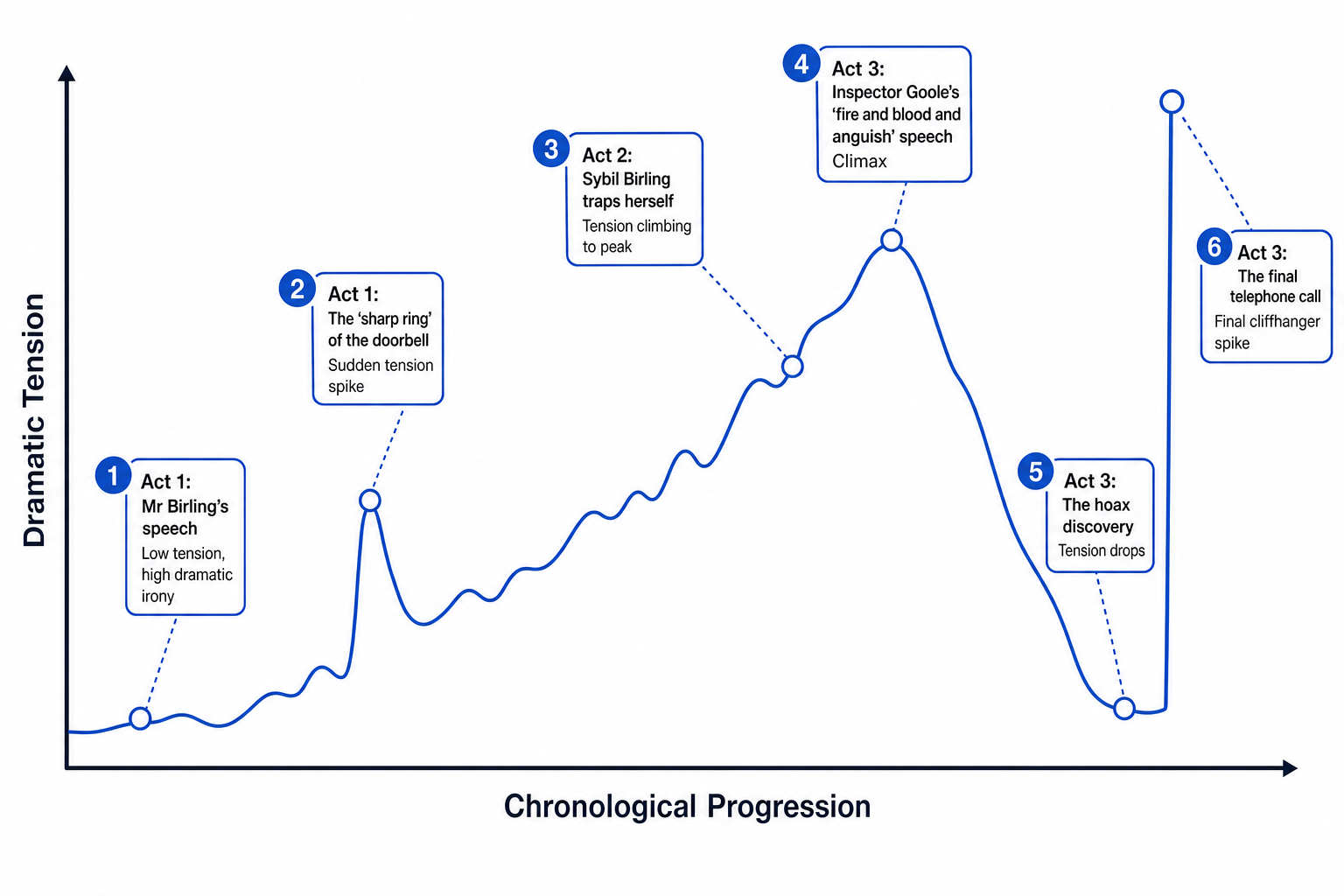
Priestley relies heavily on dramatic irony here. Because the play was first performed in 1945 but set in 1912, the post-World War II audience knew only too well that the Titanic did sink, and that two devastating world wars had occurred. By making Birling so confidently wrong about history, Priestley instantly destroys his credibility as a businessman and a thinker, signaling to the audience that Birling’s capitalist philosophy is equally flawed.
The Timing of the Knock
The Inspector does not arrive at a random moment. The "sharp ring" of the front door bell occurs at the precise second Mr Birling declares that a man must "look after himself". This structural juxtaposition serves as an immediate, physical rebuttal to Birling’s self-centred ideology.
The Entrance of the Inspector
The stage directions note that the light changes when the Inspector enters: "The lighting should be pink and intimate until the Inspector arrives, and then it should be brighter and harder."
This visual shift is highly symbolic. The "pink and intimate" lighting represents the Birlings' rosy, self-satisfied, and sheltered view of the world. The "brighter and harder" light acts like an interrogation lamp, shining a harsh light on their secrets and forcing them to see the stark reality of the social injustices they have caused.
Analyse Stage Directions
In a play, stage directions are just as important as dialogue. When writing about the Inspector's arrival, always analyse the contrast in lighting. It is a visual manifestation of the thematic shift from complacency to accountability.
Analyzing dramatic irony and structural juxtaposition in Act One
Suppose you are answering an exam question on how Priestley presents the conflict between capitalism and socialism. Here is how you can systematically analyse the structural transition in Act One.
- Identify the structural pivot point: Pinpoint the exact moment the transition occurs—the disruption of Mr Birling's capitalist lecture by the Inspector's physical arrival via the "sharp ring" of the doorbell.
- Examine the language and dramatic method: Analyse the language of Birling's speech (e.g., "a man has to mind his own business and look after himself") and contrast it with the sensory disruption of the doorbell's "sharp ring". The adjective "sharp" suggests a piercing incision into the family's comfortable bubble.
- Connect to the historical context (AO3) and writer's intent: Explain why Priestley structured this moment this way. By interrupting Birling's individualistic speech, Priestley structurally asserts that society cannot survive on selfish values. The 1945 audience, having survived the Blitz and voted for a socialist Labour government, would recognize the Inspector as the voice of social reform cutting through outdated Edwardian arrogance.
3. Act Two: Mrs Birling's Trap (The Turning Point of Blame)
As the investigation proceeds through Act Two, the family begins to fracture. The key scene occurs at the end of the Act, when Sybil Birling is interrogated.
Mrs Birling's Hubris
Mrs Birling is cold, unsympathetic, and fiercely protective of her social class. She dismisses Eva Smith as a girl "of that class" and refuses to take any responsibility for turning her away from her charity. She insists that the father of the unborn child is entirely to blame:
"He should be made an example of. If the year's death's due to anybody, it's due to him." "He ought to be dealt with very severely."
Anagnorisis
Anagnorisis is a moment in a play where a character makes a critical discovery, shifting from ignorance to knowledge. Priestley structures the end of Act Two to lead Sybil Birling to a devastating moment of anagnorisis.
Through her arrogant refusal to accept blame, Sybil walks straight into the Inspector’s trap. As the audience and Sheila slowly realise that Eric is the father of the unborn child, Sybil continues to demand a public and severe punishment for the father.
The Climax of Act Two
The tension in this scene builds exponentially. Priestley uses Sheila as a dramatic device to voice the audience's growing panic, as she begs her mother to "stop, stop!".
When Mrs Birling finally realises the truth—that she has just condemned her own son—she is silenced and broken. This scene is structurally vital because it destroys the Birlings’ defense of moral superiority. The very system of judgment they used to dismiss the poor has backfired to destroy their own family.
Confusing the climax of Act 2 and Act 3
Do not confuse the emotional climax of the family's internal collapse with the didactic climax of the play. While the end of Act Two is the dramatic high point for Mrs Birling and Eric, the true thematic climax of the play occurs in Act Three with the Inspector's final speech.
4. Act Three: The Didactic Climax and the Double Twist
Act Three contains the resolution of the investigation, the Inspector's departure, and the final structural twists that define the play's unique form.
The Inspector's Final Speech
Before he leaves, Inspector Goole delivers a powerful, sermon-like monologue. It is the didactic (intended to teach a moral lesson) climax of the play:
"One Eva Smith has gone - but there are millions and millions and millions of Eva Smiths and John Smiths still left with us... We don't live alone. We are members of one body. We are responsible for each other. And I tell you that the time will soon come when, if men will not learn that lesson, then they will be taught it in fire and blood and anguish."
                  THE INSPECTOR'S DIDACTIC SCRIPTURE
               ┌──────────────────────────────────────┐
               │ "We are members of one body."        │
               │  - Direct rejection of capitalism.   │
               └──────────────────┬───────────────────┘
                                  ▼
               ┌──────────────────────────────────────┐
               │ "Fire and blood and anguish."        │
               │  - Prophetic warning of World Wars.  │
               └──────────────────────────────────────┘
This speech is structurally positioned right before the Inspector exits, ensuring his words echo in the minds of both the characters and the audience. Priestley uses tricolon ("millions and millions and millions") and biblical imagery ("fire and blood and anguish") to elevate the speech from a police inquiry to a universal moral imperative. The allusion to "fire and blood and anguish" would hit the 1945 audience with immense force, as they had just lived through the horrors of the First and Second World Wars—catastrophes that Priestley suggests were caused by a lack of social responsibility.
The Double Twist
Once the Inspector leaves, the family splits. Mr and Mrs Birling and Gerald are desperate to prove the Inspector was a hoax to avoid a public scandal. Sheila and Eric, however, have undergone a moral awakening; they understand that whether the Inspector was real or not, they still behaved terribly.
Just as Mr Birling triumphs in his belief that they have escaped scot-free, the telephone rings:
"That was the police. A girl has just died in the Infirmary... And a police inspector is on his way here - to ask some questions."
This final twist is a masterclass in dramatic structure.
The Cliffhanger ending
By ending the play on a cliffhanger, Priestley denies the audience a neat resolution. The Birlings are trapped in a cyclical nightmare because the older generation refused to learn their lesson. This forces the audience to leave the theatre questioning their own social responsibility, transferring the moral duty from the stage into the real world.
In the exam
- Focus on Structure: Do not just write about what characters say; write about when they say it. Discuss the sequencing of the revelations and how Priestley deliberately orders the confessions from the least severe (Birling sacking Eva) to the most severe (Eric's theft and impregnation).
- Contextualise the Reception: Always link structural devices like dramatic irony to the difference between the 1912 setting and the 1945 audience. Explain how this gap makes the audience active participants in the moral judgment of the characters.
- Analyze the Ending: If the essay question is on responsibility, gender, or class, use the double-twist ending to show how Priestley uses structural cycles to warn that society will repeat its worst historical mistakes unless it embraces socialism.
Check yourself
- Why is the transition from "pink and intimate" to "brighter and harder" lighting structurally and symbolically significant?
- How does Priestley use Mrs Birling's pride in Act Two to create dramatic irony and a tragic turning point?
- What does the final telephone call suggest about the consequences of refusing to take social responsibility?
