Preparing for a closed-book exam can feel daunting. You do not need to memorise entire pages of text to succeed. Instead, the secret is mastering a small selection of highly versatile, short quotations—what we call "micro-quotations"—and learning how to unpack them deeply.
What you'll learn
- How to select high-yield quotes that apply to multiple characters and themes
- The art of embedding "micro-quotations" seamlessly into your analysis
- How to link language analysis (AO2) directly to J.B. Priestley’s social and political context (AO3)
The Closed-Book Strategy: "Less is More"
In your GCSE English Literature Paper 2 exam, you will not have a copy of An Inspector Calls. This means you must rely on your memory. Top-grade students do not memorise long, complex sentences. They memorise short, punchy, single words or phrases that can be easily woven into any sentence.
Micro-quotation
A micro-quotation is a very short phrase or single word (typically 1 to 4 words) taken from a text. Because it is brief, it can be easily memorised and seamlessly integrated into your own sentences, allowing you to maintain a fluid academic style.
Using micro-quotations ensures that your writing remains analytical rather than descriptive. Instead of stopping your sentence to drop in a massive quote block, you can construct sentences where the quotation is an active grammatical part of your argument.
Embedding Quotes
Never write: Mr Birling shows he is greedy when he says, "a hard-headed, practical business man."
Instead, embed it: Priestley immediately establishes Birling as an emblem of capitalist greed, presenting him as a "hard-headed, practical business man" whose primary concern is profit over people.
The Ideological Battlefield
Every key quote in An Inspector Calls is a weapon in J.B. Priestley’s ideological war. Written in 1945 but set in 1912, the play is designed to expose the flaws of Edwardian capitalism and promote the benefits of post-war socialism.
The quotes you memorise should reflect this central tension. On one side, you have the individualist, capitalist rhetoric of the Birlings; on the other, you have the collectivist, socialist declarations of Inspector Goole.
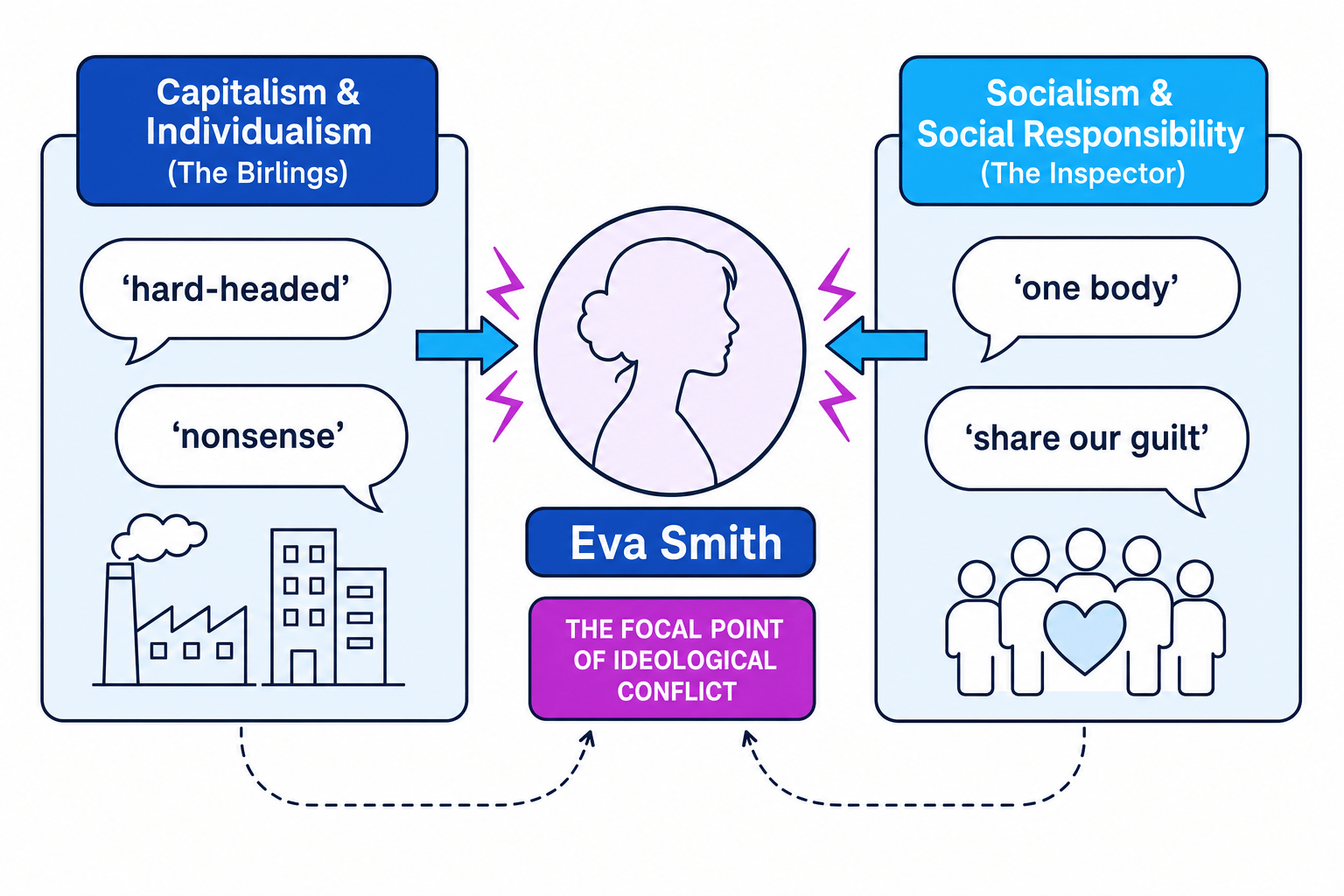
The Central Conflict
Every character's dialogue represents a specific social position. When analysing any quote, ask yourself: Does this quote promote self-interest (Capitalism) or community responsibility (Socialism)? Your analysis should always tie back to this core debate.
Five Core Quotations to Memorise
Here are five essential, versatile quotes. If you know these five thoroughly, you can answer almost any question on characters, responsibility, class, gender, or age.
| Character | Quotation | Key Methods | Central Themes |
|---|---|---|---|
| Mr Birling | "...unsinkable, absolutely unsinkable." | Dramatic Irony, Repetition | Class Pride, Blindness, Capitalism |
| Mrs Birling | "...girls of that class..." | Distancing Language, Cold Tone | Social Class, Prejudice, Apathy |
| Sheila | "These girls aren't cheap labour - they're people." | Juxtaposition, Metaphor | Generational Divide, Social Responsibility |
| The Inspector | "We are members of one body." | Metaphor, Collective Pronoun | Socialism, Unity, Christian Morality |
| The Inspector / Sheila | "...fire and blood and anguish." | Tricolon, Biblical Allusion | Judgment, War, Ultimate Consequences |
Dramatic irony
A literary technique where the significance of a character's words or actions is clear to the audience or reader but remains unknown to the character. Priestley uses this to make the capitalist upper-middle class look foolish and untrustworthy.
Device-Hunting
Students often point out a method (e.g., "Priestley uses repetition when Birling says 'unsinkable, absolutely unsinkable'") but fail to explain the effect. Identifying a device gets you very few marks; you must explain how it helps Priestley construct his political message.
Analysing Quotes Step-by-Step
To achieve Grade 7, 8, or 9, you need to write "explosive" quote analysis. This means taking a small quote and unpacking multiple layers of meaning, looking closely at specific word choices (AO2) and connecting them to Priestley's wider social purpose (AO3).
Let's look at how to walk through a highly developed analytical paragraph using the Inspector’s warning of "fire and blood and anguish."
Analysing a Climax Quotation
-
Contextualise the quotation accurately
Place the quote within the structure of the play. This line is spoken by Inspector Goole in Act 3 during his final, dramatic departure speech. It acts as a final, prophetic warning to the Birling family—and, by extension, to the Edwardian ruling class—about what will happen if they do not change their ways. -
Identify specific linguistic and structural methods
Locate the structural and poetic devices. First, note the polysyndeton (the repetition of the conjunction "and" between each word: "fire and blood and anguish"). Second, identify the tricolon (a rule-of-three list). Third, recognise the biblical allusion to hell and eternal damnation. -
Analyse the layers of meaning and alternative interpretations
Unpack the words. On a literal level for the 1945 audience, "fire and blood and anguish" refers to the devastating collective trauma of World War I and World War II, which occurred after the play's 1912 setting. On a metaphorical level, the nouns "fire," "blood," and "anguish" evoke the flames of hell, suggesting that social irresponsibility is not just a political failure, but a mortal sin. -
Connect the language directly to Priestley's social message (AO3)
Explain the writer's underlying purpose. Priestley, a passionate socialist writing in post-war Britain, is warning his audience that if society continues to adopt Mr Birling’s individualistic "every man for himself" attitude, it will inevitably collapse into self-destruction and warfare. He challenges the post-WWII audience to build a fairer, more socialist society to prevent history from repeating itself.
Deep-Dive: Exploring Mr Birling's Ignorance
Let's look at another classic quote to see how you can apply the same rigorous analytical steps. Early in Act 1, Mr Birling dismisses the threat of war and praises modern technology, famously calling the Titanic:
"...unsinkable, absolutely unsinkable."
To the average reader, this is just a comment about a boat. To a top-tier literature student, it is a masterclass in character assassination.
The Power of Dramatic Irony
Because the audience in 1945 knew the Titanic sank in 1912 (taking over 1,500 lives with it), Birling’s supreme confidence immediately exposes him as completely unreliable.
- The Repetition: The repetition of "unsinkable" combined with the intensifying adverb "absolutely" highlights his utter lack of doubt. He is smug, complacent, and self-assured.
- The Symbolism: The Titanic represents the capitalist system itself—vast, expensive, rigid in its class divisions (with lower-class passengers locked in the lower decks), and believed by the rich to be indestructible. By showing that the Titanic was fragile, Priestley warns that the capitalist system is equally vulnerable to collapse.
The Titanic as Capitalism
Think of the Titanic as a physical metaphor for Edwardian society. It was luxurious on top, crowded and neglected at the bottom, and steered by wealthy men who ignored all warnings of danger. Just as icebergs sank the ship, social unrest and war sank the Edwardian way of life.
In the exam
- Be selective: Do not try to write down every quote you know. Choose one or two high-yield quotes per paragraph and analyse them in extreme, microscopic detail.
- Track character arcs: Use quotes that show change. For example, contrast Sheila's early childish quote "Oh - Gerald - you've got it - is it the one you wanted?" with her mature echo of the Inspector at the end of the play: "I remember what he said, how he looked, and what he made me feel. Fire and blood and anguish."
- Always link to the writer's craft: Do not treat characters as real people. Refer to them as constructs. Use phrases like "Priestley utilizes Birling as a caricature of..." or "The Inspector acts as a dramatic mouthpiece for..."
Check yourself
- Can you identify three distinct themes that you could write about using the single quotation: "These girls aren't cheap labour - they're people"?
- Why is it highly effective to refer to J.B. Priestley's 1945 context when analysing the phrase "fire and blood and anguish"?
- What does the phrase "girls of that class" reveal about Mrs Birling's psychological distance from the working class?
