

William Golding’s Lord of the Flies is an allegorical novel. This means that almost every character, event, and object on the island represents a broader, abstract idea about human psychology, society, and morality. To score highly in your GCSE English Literature exam, you must look beyond the plot of boys stranded on an island and analyze the deeper thematic debates Golding is presenting.
What you'll learn:
- How the conflict between civilisation and savagery shapes the novel's structure.
- Why Golding argues that evil is inherent to human nature rather than an external force.
- How key symbols act as structural anchors for the text's central themes.
- How to write a cohesive, high-scoring essay paragraph linking theme, language analysis, and context.
Civilisation vs. Savagery
At the heart of Lord of the Flies is a fundamental conflict between two competing impulses that exist within all human beings:
- The civilising instinct: The desire to live by rules, obey moral codes, act productively, and protect the weakest members of a group.
- The savage instinct: The desire to gratify immediate, selfish impulses, command authority through violence, and succumb to primal instincts.
Golding uses the island as a microcosm to explore how easily the civilising instinct can be destroyed when the structures of the adult world are removed.
Microcosm
A microcosm is a miniature world, community, or situation that encapsulates the characteristic qualities, features, or conflicts of a much larger one. The deserted island is a microcosm of the wider, war-torn adult world in the mid-20th century.
The Breakdown of Civilised Order
At the start of the novel, the boys attempt to replicate the democratic systems of their British homeland. They elect Ralph as chief and establish the conch as a symbol of free speech and democratic order. Ralph's primary goals are maintaining the signal fire (hope of rescue/link to civilisation) and building shelters (community and protection).
However, as the novel progresses, Jack and his choir boys increasingly reject these rules. Jack’s group undergoes a process of atavism, shedding their school uniforms and choir cloaks to paint their faces and hunt pigs.
Atavism
Atavism is a reversion to something ancient or ancestral; in literature, it refers to characters reverting to a primitive, uncivilised state of being.
By the time the conch is shattered and Piggy is murdered in Chapter 11, the civilised impulse has been completely eradicated, replaced by Jack’s brutal, dictatorial tribe.
The fragile veneer of civilisation
Golding argues that human civilisation is not a permanent state, but a fragile "veneer" (a thin decorative cover) that easily cracks when the threat of punishment is removed. This is illustrated by Roger, who initially throws stones around Henry because "the taboo of the old life" still restrains him, but later deliberately rolls the boulder that kills Piggy.
The Darkness of Man’s Heart (Inherent Evil)
Unlike many adventure stories of his time (such as R.M. Ballantyne's The Coral Island), Golding does not believe that human beings are naturally good. Instead, he presents the terrifying idea that evil is inherent—it is built into our very nature.
The Evolution of the "Beast"
The theme of inherent evil is tracked through the boys' evolving understanding of "the Beast":
- Chapters 1–4: The Beast is imagined by the "littluns" as a physical monster—a "snake-thing" or a creature from the sea.
- Chapters 5–8: The boys debate the Beast's existence. While Jack wants to hunt it and Piggy dismisses it using scientific rationalism, Simon is the only one who begins to grasp its true nature. He suggests that "maybe there is a beast... maybe it's only us."
- Chapter 9: Simon’s hallucination with the pig’s head on a stick—the Lord of the Flies—confirms this truth. The head tells him: "Fancy thinking the Beast was something you could hunt and kill!"
Beelzebub
Beelzebub is a contemporary translation of the Hebrew word for "Lord of the Flies", which is a name traditionally associated with the Devil. By naming the pig's head the "Lord of the Flies", Golding directly links the physical presence on the island to biblical notions of absolute evil and temptation.
The ultimate tragedy occurs when Simon rushes down the mountain to share this revelation with the group. Terrified and whipped into a ritualistic frenzy, the boys—including Ralph and Piggy—mistake Simon for the Beast and murder him. This structural climax proves Simon's theory: the boys became the very monster they feared.
Symbolism: Tracing Themes through Objects
To write a high-scoring essay, you must explore how Golding uses symbolic objects to track the decline of the boys' society. The symbols do not remain static; they change as the themes develop.
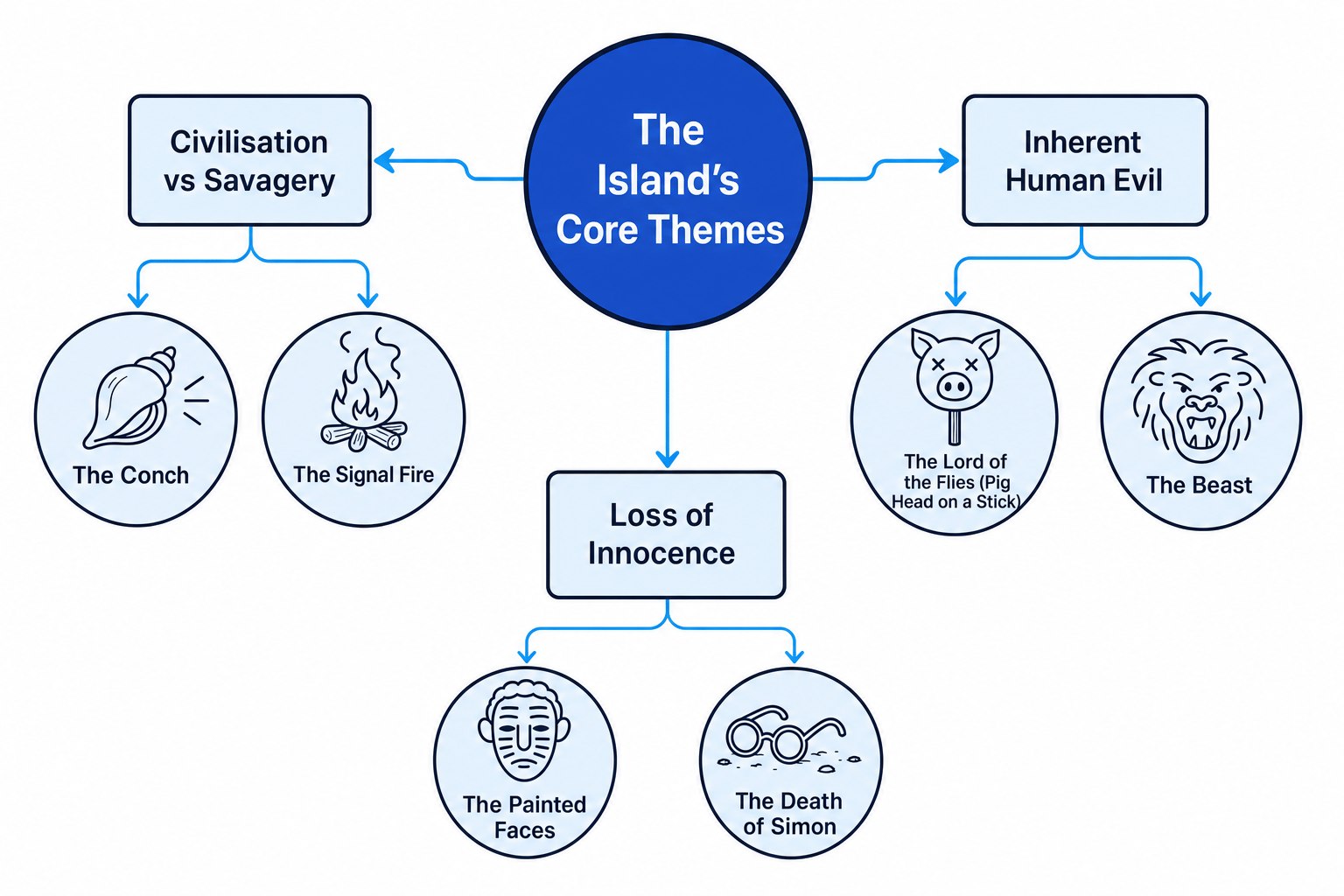
The Conch vs. The Pig's Head
- The Conch: Represents democracy, order, and the rule of law. When it is active, the boys speak in turns. Its physical degradation (fading from pink to white, then shattering into "a thousand white fragments") mirrors the absolute destruction of democratic civilisation on the island.
- The Lord of the Flies: Represents the primal savagery and inherent evil inside human beings. It is a grotesque offering to the imaginary "Beast", proving that Jack’s tribe has replaced rational worship with superstitious bloodlust.
Piggy's Glasses vs. The Painted Faces
- Piggy's Glasses: Represent intellect, science, and rational thought. They are used to light the fire (hope/survival). When one lens is broken by Jack, it symbolises a partial loss of reason. When the glasses are stolen, the island loses all rationality, plunging into total darkness and savagery.
- The Painted Faces: Represent the shedding of individual identity and moral responsibility. The clay paint acts as a mask behind which Jack and his hunters feel liberated from the shame and self-consciousness of civilised rules.
Confusing the Beast with a physical monster
A very common mistake in essays is writing about the Beast as if it were a literal creature on the island. Always remember that the "Beast" is a psychological projection of the boys' own inner savagery and fear. Golding uses the dead parachutist (the "beast from the air") to show that the adult world is suffering from the exact same violent "beast" of war.
Putting it Together: Analyzing Themes in an Essay
When writing about themes in your GCSE exam, you must weave together three core elements:
- AO1: A clear, focused argument (topic sentence) supported by precise, embedded quotations.
- AO2: Close analysis of Golding's language, structural choices, and literary methods.
- AO3: Contextual links (e.g., Golding’s experience in World War II, his religious background, or post-war anxieties).
Analyzing theme and language in a key quote
Let's look at how to construct a high-scoring analytical paragraph on the theme of inherent evil, focusing on Simon's encounter with the Lord of the Flies.
- State your thematic argument (AO1): Golding uses Simon’s hallucinatory confrontation with the Lord of the Flies to reveal that the "Beast" is not an external threat to be conquered, but an inescapable, destructive force residing within human nature itself.
- Introduce and embed the quote, identifying the method (AO1/AO2): This realization is chillingly delivered through the colloquial, mocking voice of the pig’s head, which taunts Simon: "Fancy thinking the Beast was something you could hunt and kill!"
- Analyze the language and structural choices deeply (AO2): The adjective "fancy" conveys a tone of patronizing disbelief, highlighting the foolishness of the boys' attempts to resolve their psychological fears through physical violence. Furthermore, the verbs "hunt" and "kill" reflect the primal impulses of Jack's tribe; Golding uses situational irony here to demonstrate that the very act of hunting the Beast is what releases the "beast" of savagery within the boys.
- Link to Golding’s wider message and context (AO3): Through this, Golding reflects his own post-WWII disillusionment with humanity. Having witnessed the atrocities of war as a naval officer, Golding rejects the optimistic view that society corrupts people; instead, he uses the Lord of the Flies as a devil-like mouthpiece to assert that moral decay begins in the "darkness of man's heart," regardless of how civilised an individual claims to be.
In the exam
- Read the question carefully: If the question asks about a character (e.g., Jack), you must still write about themes. Characters are simply vehicles that Golding uses to convey his thematic messages.
- Track structural shifts: Do not just look at one scene. Explain how a theme develops from the beginning of the novel, through the climax, to the resolution.
- Integrate context naturally: Never "bolt on" historical facts at the end of a paragraph. Ensure your historical or philosophical context directly explains why Golding chose a specific word, symbol, or structural turn.
- Focus on the author's intent: Use phrases like "Golding constructs...", "Golding intends to warn his post-war readers...", or "The symbol of the conch allows Golding to illustrate..." to show the examiner you understand the novel as a deliberate piece of art.
Check yourself
- How does the change in the physical appearance of the conch shell mirror the decline of civilisation on the island?
- Why is it highly significant that the boys who kill Simon are described as a single, collective "mouth" or "beast" rather than named individuals?
- In what ways does the dead parachutist link the boys' actions on the island to the wider adult world?
