

To truly understand William Golding's Lord of the Flies, you have to step inside the mind of a writer who witnessed some of the darkest moments of the twentieth century. Published in 1954, the novel is a direct reaction to the horrors of the Second World War, the rising anxiety of the Cold War, and the complacent attitudes of Victorian literature.
In your GCSE English Literature exam, context is assessed under AO3 (Assessment Objective 3). This does not mean writing a history essay! High-scoring students do not simply "dump" historical facts onto the page; instead, they show how Golding weaves his real-world experiences and beliefs into the very fabric of the characters, symbols, and plot.
What you'll learn:
- How Golding’s experiences in World War II shattered his belief in human goodness.
- Why the geopolitical dread of the Cold War forms the backdrop of the boys' island society.
- How the novel acts as a direct, critical response to Victorian adventure stories.
- How Golding's background as a schoolteacher and his religious views informed his depiction of the "beast within."
1. World War II and the "End of Innocence"
Before the outbreak of World War II in 1939, many people in Britain believed that humanity was steadily progressing toward a more civilized, peaceful future. This optimistic view of progress was completely dismantled by the industrial-scale atrocities of the war.
In 1940, Golding joined the Royal Navy. He saw active combat at sea, took part in the sinking of the German battleship Bismarck, and commanded a rocket-launching craft during the D-Day landings in 1944.
Misanthropy
Misanthropy is a general dislike, distrust, or hatred of the human species, or a belief that human nature is inherently flawed and prone to evil.
Witnessing the violence of war, alongside the revelation of the Holocaust and the devastating atomic bombings of Hiroshima and Nagasaki in 1945, fundamentally altered Golding’s view of humanity. He realized that the capacity for horrific cruelty was not unique to the Nazi regime; rather, it was a universal trait latent within every human being.
The key context takeaway
Golding wrote Lord of the Flies to expose the "beast" inside us all. He famously remarked: "Anyone who moved through those years without understanding that man produces evil as a bee produces honey, must have been blind or metally backward."
2. The Cold War and Nuclear Anxiety
When Lord of the Flies was published in 1954, the world had entered the Cold War—a period of intense geopolitical tension between the democratic Western powers (led by the USA and Britain) and the communist Eastern Bloc (led by the Soviet Union).
This era was defined by the constant threat of mutually assured destruction (MAD) due to the proliferation of nuclear weapons. Public anxiety about a sudden, catastrophic nuclear strike was at an all-time high.
Golding mirrors this exact political climate in the structure of the novel:
- The catalyst for the plot: The boys are on the island because their plane was shot down during an evacuation from a nuclear war in the "grown-up" world.
- The dead parachutist: In Chapter 6, a dead soldier falls from an aerial battle raging in the skies far above the island. This is a crucial symbol of the adult world's self-destruction, proving that the chaotic violence on the island is simply a microcosm of the war being fought by the adults.
Ignoring the adult world
A common mistake in essays is treating the island as entirely separate from reality. Students often write that the boys "revert to savages" while the adult world remains civilised. In truth, Golding uses the dead parachutist to show that the adults are behaving just as savagely as Jack's tribe—they are just using bigger, more destructive weapons.
3. Subverting Victorian Optimism: The Coral Island
To understand the literary context of the novel, we must look at how Golding deliberately subverts Victorian imperialist attitudes.
In 1857, R.M. Ballantyne published The Coral Island, a highly popular adventure novel about three young British boys (named Ralph, Jack, and Peterkin) shipwrecked on a South Pacific island. In Ballantyne's book, the boys are courageous, civilized, and deeply Christian. They easily tame the wild island, defeat the "savage" native peoples they encounter, and proudly represent the "civilizing" power of the British Empire.
Golding found this idealized, colonialist narrative dangerously unrealistic. He wanted to write a realistic book about what would actually happen if ordinary schoolboys were left to their own devices on an island.
The Mirror Image
Think of Lord of the Flies as a dark, cracked mirror held up to The Coral Island. Golding uses the same setting and even the same names (Ralph and Jack) to expose the hypocrisy of the Victorian belief that British boys were inherently superior and immune to moral corruption.
When the naval officer rescues the boys at the end of the novel, he explicitly references Ballantyne's work, saying: "I should have thought that a pack of British boys... would have been able to put up a better show than that—I mean, did you read The Coral Island?" This savage use of dramatic irony highlights the officer's blind belief in national superiority, even as he stands on the beach of an island ruined by tribal warfare, waiting to take the boys back to a cruiser involved in a global conflict.
4. Golding’s Classroom and Original Sin
Golding did not have to look far to observe how young boys behaved when left to establish their own social hierarchies. From 1940 to 1961 (with a break for his war service), he worked as a schoolmaster teaching English and Philosophy at Bishop Wordsworth's School in Salisbury.
His daily observations of adolescent boy dynamics—how easily they formed cliques, how they teased the vulnerable, and how quickly their playground games could turn physical and aggressive—directly informed the characters of Ralph, Jack, Piggy, and Roger.
Additionally, Golding's worldview was deeply influenced by Christian theology, specifically the doctrine of Original Sin.
Original Sin
In Christian theology, Original Sin is the state of sinfulness into which all humans are born, stemming from the biblical "Fall of Man" in the Garden of Eden. It suggests that humans are naturally inclined toward selfishness and evil, rather than being born morally blank or inherently good.
The island itself is initially presented as a pristine, bountiful Eden, complete with fresh water and abundant fruit. However, the boys quickly corrupt this paradise. By the end of the novel, they have set the entire island ablaze. This acts as a powerful allegory for the Fall of Man and the destruction of innocence.
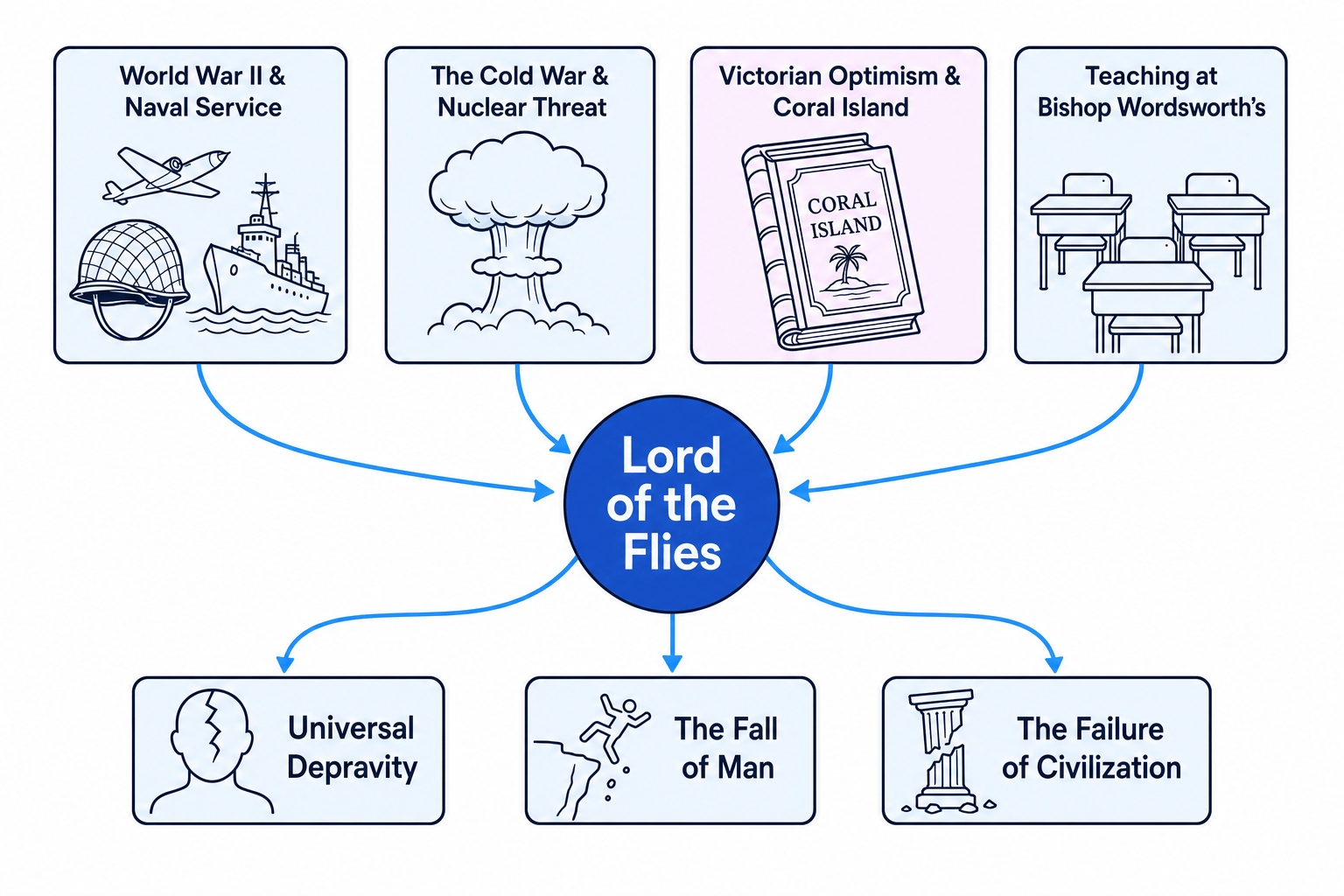
Integrating Context with Language Analysis
To secure the highest marks, your historical and social context must be integrated smoothly with close word analysis (AO2) and your understanding of the characters' developments (AO1). Let's look at how to construct an analytical paragraph that achieves this balance.
Analyzing the dead parachutist and the Cold War
Analyze how William Golding uses the figure of the dead parachutist to explore ideas about conflict and human nature.
-
Formulate an analytical point linking the symbol to the wider theme and context:
Golding introduces the dead parachutist in Chapter 6 as a physical manifestation of the adult world's capacity for violence, explicitly linking the boys' descent into savagery on the island to the global devastation of the Cold War. -
Select and embed a precise, relevant quotation:
The corpse is described as "a sign came down from the world of grown-ups," a grotesque answer to Ralph’s earlier plea for a comforting message from the adult world. -
Analyse the writer’s methods (AO2), naming specific literary devices and their effects:
The phrase "grown-ups" carries bitter irony. While the children look to adults as symbols of "understanding and lawful" civilization, the "sign" they receive is a literal casualty of war, suspended and manipulated by the wind. The verbs used to describe its movement—how the wind "filled" the parachute and made the figure "bow and sink"—create a terrifying, life-like illusion of the "beast." This personification of the dead soldier demonstrates that the true monster on the island is not a mythical beast, but rather the corrupt nature of humanity itself. -
Incorporate the relevant context (AO3) to show how it deepens our understanding of Golding’s message:
By placing a dead soldier on the island, Golding reflects the real-world anxiety of the 1950s nuclear arms race. He subverts the optimistic Victorian tropes of adventure stories by demonstrating that civilization is merely a fragile facade. The parachutist represents a society that has destroyed itself through technological warfare, warning Golding's contemporary post-war audience that unless humanity acknowledges the "beast" of its own innate depravity, global self-annihilation is inevitable.
Avoid 'Context Bombing'
Never start a paragraph with a historical fact like: "During the Cold War, people were scared of nuclear bombs." Instead, start with Golding's ideas or a character's action, then introduce the historical context to explain why Golding chose to represent his characters or setting in that particular way.
In the exam
- Always link context to Golding’s intentions: Whenever you bring up WWII, the Cold War, or The Coral Island, use active verbs like Golding exposes, Golding subverts, Golding warns, or Golding reflects. This reminds the examiner that you are analysing a constructed work of fiction.
- Never write standalone history paragraphs: Ensure that every contextual point you make is anchored directly to a specific quote, character trait, or structural pivot in the text.
- Use the term 'allegory': Lord of the Flies is a political, religious, and moral allegory. Frame your understanding of the novel’s context around this term to show a sophisticated grasp of form.
Check yourself
- How does Golding's use of the names "Ralph" and "Jack" act as a direct response to R.M. Ballantyne's The Coral Island?
- What real-world 1950s fears did Golding tap into by having the boys' plane shot down in a nuclear war?
- In what ways does the character of the naval officer at the end of the novel represent the hypocrisy of the "civilized" adult world?
