

Understanding the plot of William Golding’s Lord of the Flies is about much more than just memorising what happens in each chapter. In GCSE English Literature, you need to see the plot as a deliberate, highly structured vehicle for Golding’s deeper philosophical ideas.
What you'll learn
- How Golding structures the boys' descent from democratic order into savage anarchy.
- The key phases of the narrative arc and their corresponding pivotal moments.
- How to analyse structural devices—such as parallel scenes and foreshadowing—to unlock higher marks in your exam.
Plot as a Vehicle: The Island as a Microcosm
Before we look at the individual stages of the plot, we must understand how Golding constructed this narrative. He did not write a simple adventure story; instead, he wrote a moral allegory.
Allegory
An allegory is a story with a double meaning. On the surface, it is a simple narrative (boys stranded on an island); beneath the surface, it represents deeper political, psychological, or religious ideas (the conflict between civilization and savagery, or the fallen nature of humanity).
To make this allegory work, Golding uses the island as a microcosm.
Microcosm
A microcosm is a miniature world that mirrors the tensions, conflicts, and structures of the wider world.
The island mimics the adult world of the 1950s. While the boys are descending into tribal warfare on the island, the adults are fighting a catastrophic nuclear war in the skies above them. The plot on the island parallels the macrocosm of global conflict.
The Five-Act Narrative Arc
Golding structures his novel almost like a five-act classical tragedy. The tension rises as the fragile democratic order established at the start collapses.
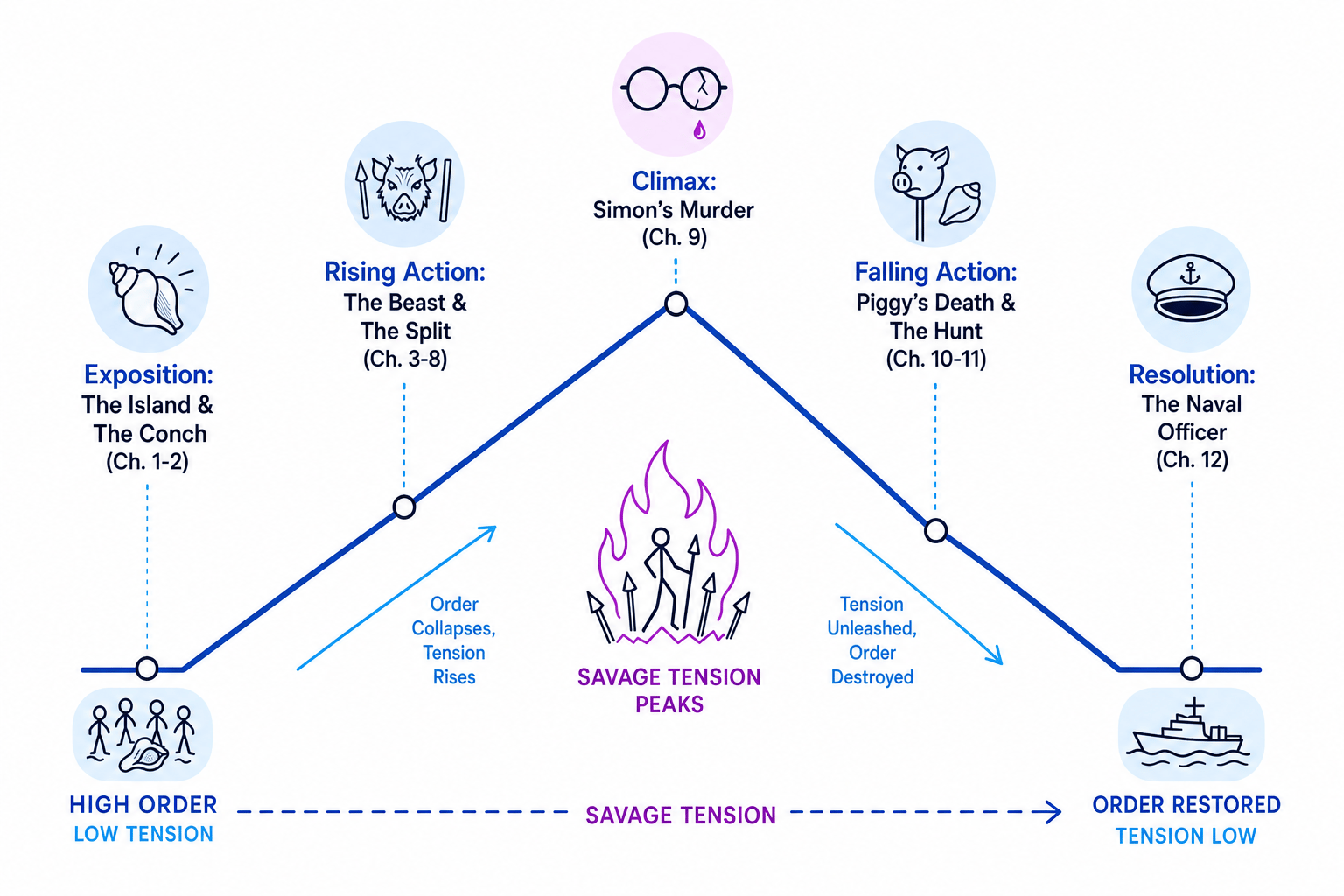
1. Exposition: The Island and the Conch (Chapters 1–2)
A plane carrying a group of British schoolboys is shot down over a deserted tropical island. Two boys, Ralph and Piggy, discover a large cream-and-pink conch shell on the beach. Ralph blows the conch to summon the survivors.
Among those who gather is a choir led by the aggressive Jack Merridew. The boys vote Ralph as their "chief", and Ralph appeases Jack by placing him in charge of the choir, who become the "hunters".
Ralph, Jack, and a sensitive boy named Simon explore the island and confirm it is uninhabited. They establish rules, declaring that whoever holds the conch has the right to speak at assemblies. They build a signal fire on the mountain to attract passing ships. However, their first fire rages out of control, and a young boy with a mulberry-coloured birthmark mysteriously disappears, hinting at the danger to come.
2. Rising Action: The Beast and the Split (Chapters 3–8)
Tension builds as the daily realities of survival set in. Ralph focuses on building shelters, while Jack becomes increasingly obsessed with hunting wild pigs.
The Descent into Savagery
The split between Ralph and Jack is not just a personal rivalry; it represents the structural conflict between the drive for civilised order (Ralph) and the impulse toward primal violence (Jack).
To hunt more effectively, Jack paints his face with clay and charcoal. This "mask" acts as a psychological barrier, liberating him from the moral constraints of British society. While Jack is hunting, he allows the signal fire to go out, causing the boys to miss a passing ship.
Meanwhile, fear spreads among the younger boys (the "littluns") about a terrifying "beastie" on the island. Jack exploits this fear to gain power. In the sky above, a battle takes place, and a dead parachutist drifts down onto the mountain. Sam and Eric (the twins) mistake the corpse for the beast.
At a disastrous assembly, the democratic process collapses. Jack rebels against Ralph's leadership, declaring, "The conch doesn't count on top of the mountain." He forms his own tribe at Castle Rock—a rugged, natural fortress at the other end of the island. Most of the boys abandon Ralph to join Jack’s tribe, lured by the promise of meat, play, and protection from the beast.
3. Climax: Simon's Murder (Chapter 9)
Simon, the novel's spiritual and visionary figure, slips away to his quiet sanctuary in the jungle. There, he encounters the severed pig's head that Jack's hunters left on a stick as an offering to the beast: the "Lord of the Flies". In a hallucination, the head speaks to Simon, confirming that the beast is not an external animal, but the inherent evil inside the boys themselves ("Fancy thinking the Beast was something you could hunt and kill!").
Simon climbs the mountain, discovers the dead parachutist, and realizes the "beast" is merely a dead human. Eager to free the boys from their fear, he stumbles down the mountain in the middle of a fierce storm.
On the beach, Jack’s tribe is performing a wild, ritualistic war dance. Delirious with fear and mob mentality, the boys mistake Simon for the beast. They descend upon him with their bare hands and teeth, brutally tearing him to death on the shoreline.
4. Falling Action: Piggy’s Death and the Hunt (Chapters 10–11)
The physical manifestations of democracy are systematically destroyed. Jack’s tribe raids Ralph's camp to steal Piggy’s glasses—their only means of starting a fire.
Ralph, Piggy, and the twins go to Castle Rock to demand the glasses back, holding the conch aloft as a final appeal to reason. However, Roger, Jack's sadistic lieutenant, deliberately releases a massive boulder from the cliff. The boulder strikes Piggy, shattering the conch into "a thousand white fragments" and throwing Piggy off the cliff to his death on the rocks below.
Sam and Eric are captured and forced to join the tribe. Ralph is left entirely alone, hunted like an animal by Jack’s tribe.
5. Resolution: The Naval Officer (Chapter 12)
Jack orders the tribe to set the jungle on fire to smoke Ralph out of hiding. Ralph runs for his life through the burning forest, pursued by the screaming savages. He collapses on the beach, exhausted and expecting death.
When he looks up, he sees a British naval officer standing over him. The officer's ship had spotted the massive smoke cloud from the jungle fire. Ironically, the fire lit to destroy Ralph is the very thing that rescues them.
The officer, seeing a pack of dirty, painted children with spears, gently chides them for not putting up a "better show" of British order. Confronted with the reality of his rescue and the horrors he has witnessed, Ralph weeps for "the end of innocence, the darkness of man’s heart, and the fall through the air of the true, wise friend called Piggy."
Key Structural Devices
Golding does not just move the plot forward chronologically; he weaves structural devices throughout the novel to deepen his allegorical message.
Parallel Scenes
Golding uses repeating, parallel scenes to measure the boys’ moral decay.
- The Hunts: The hunts progress from a failure to kill (Chapter 1, where Jack hesitates), to the successful slaughter of a pig (Chapter 4), to the sadistic torture of a sow (Chapter 8), to the hunting of a human being, Ralph (Chapter 12).
- The Assemblies: The structured, democratic meetings of Chapter 1 slowly devolve into the chaotic, hostile meetings of Chapter 5, before being completely replaced by Jack’s tyrannical assemblies at Castle Rock.
Foreshadowing
Foreshadowing is a vital structural tool in Lord of the Flies. It builds tension by dropping subtle hints about future tragedies.
- Early in Chapter 1, Jack is described as "shadowy" and Roger as having an "inner intensity of avoidance and secrecy."
- In Chapter 2, the wild forest fire that kills the boy with the birthmark foreshadows the massive, destructive fire in Chapter 12.
- In Chapter 4, Roger throws stones at Henry but intentionally aims to miss because "the taboo of the old life" still protects the child. This directly foreshadows Chapter 11, where Roger, freed from those social taboos, drops the massive boulder that kills Piggy.
Tracing Structural Escalation
When writing about the plot in your GCSE exam, you must show how Golding builds structural escalation. You should never just summarise the plot; you must explain how the progression of events reveals Golding's underlying message (AO2).
Tracing structural escalation through the hunts
Analyze how Golding structures the hunting scenes to demonstrate the collapse of civilization.
-
Identify the baseline (The hesitation in Chapter 1): In the initial exploration, Jack cornered a piglet but "paused" and failed to strike because of "the unbearable blood." Structurally, this establishes the starting point: the boys are still bound by the moral rules of society.
-
Analyze the turning point (The painted mask in Chapter 4): Jack paints his face, creating "a mask that drew their allegiance." When they successfully kill a pig, they chant: "Bash the pig. Spill her blood." The structure shifts here; the introduction of the mask acts as a catalyst, allowing the boys to detach from their civilized identities and celebrate violence.
-
Examine the climax of savagery (The sow hunt in Chapter 8): The hunters pursue a nursing mother sow. The description is highly sexualised and sadistic: they "wedded her in lust" and Roger drives his spear "right up her ass." Structurally, this extreme escalation shows that hunting is no longer about survival or meat; it is about sheer domination and the infliction of pain.
-
Connect to the ultimate resolution (The human hunt in Chapter 12): The progression culminates in the tribe hunting Ralph "like a pig." Golding uses the same language of the hunt to describe the pursuit of the former chief. This final structural step proves that once the barriers of civilization are entirely broken, humans will inevitably turn their destructive instincts on one another.
The 'And Then' Trap
A very common mistake in GCSE essays is writing a purely chronological summary of the plot (e.g., "First Ralph is elected chief, and then they build a fire, and then Jack lets it go out..."). This is called narrative telling and will limit your mark. Instead, write about why Golding structures the novel this way. Use analytical phrases like: "Golding structures this transition to show..." or "This scene acts as a structural parallel to..."
In the exam
- Focus on structural pivots: When discussing any character or theme, pinpoint exactly where they sit on the narrative arc. Is their action occurring before or after the pivotal turning point of Simon’s death?
- Anchor your analysis with short quotes: Because the exam is closed-book, memorise short, multi-purpose quotes that represent structural shifts, such as "the conch exploded" or "the mask was a thing on its own."
- Always link plot to context (AO3): Remember that Golding wrote this in the aftermath of WWII. When discussing the plot's descent into violence, mention how Golding wanted to show that even "civilised" British boys contain the same capacity for evil as the Nazis or the forces involved in the global war.
Check yourself
- Why is the destruction of the conch shell timed to happen at the exact same moment as Piggy’s death?
- How does the arrival of the naval officer at the end of the novel create a sense of dramatic irony?
- In what ways does the final fire in Chapter 12 contrast structurally with the first fire lit in Chapter 2?
