

When William Golding wrote Lord of the Flies in 1954, he was not just trying to tell an exciting adventure story about shipwrecked schoolboys. Fresh from his experiences fighting in the Royal Navy during World War II, Golding wanted to explore the dark depths of human nature.
To do this, he did not write realistic, complex psychological portraits. Instead, he designed his characters to function as living symbols.
What you'll learn
- How to analyse the characters as constructs and symbols rather than real people.
- The allegorical roles of Ralph, Jack, Piggy, Simon, and Roger.
- How to trace character relationships and their symbolic degeneration across the novel.
- How to write high-scoring exam responses by linking character choices to Golding’s wider social and political message.
Characters as Symbols: The Key to AO2
To get the highest marks in your GCSE, you must never treat the boys on the island as real, living children. Instead, refer to them as constructs.
Construct
A construct is a character created deliberately by an author to represent a specific idea, theme, or political viewpoint.
Golding uses his characters to build an allegory.
Allegory
An allegory is a story that can be interpreted to reveal a hidden, deeper moral, spiritual, or political meaning.
In Lord of the Flies, the deserted island functions as a microcosm of the wider world.
Microcosm
A microcosm is a miniature representation of something much larger—in this case, the boys' society on the island mirrors the adult world, which is simultaneously destroying itself in a nuclear war.
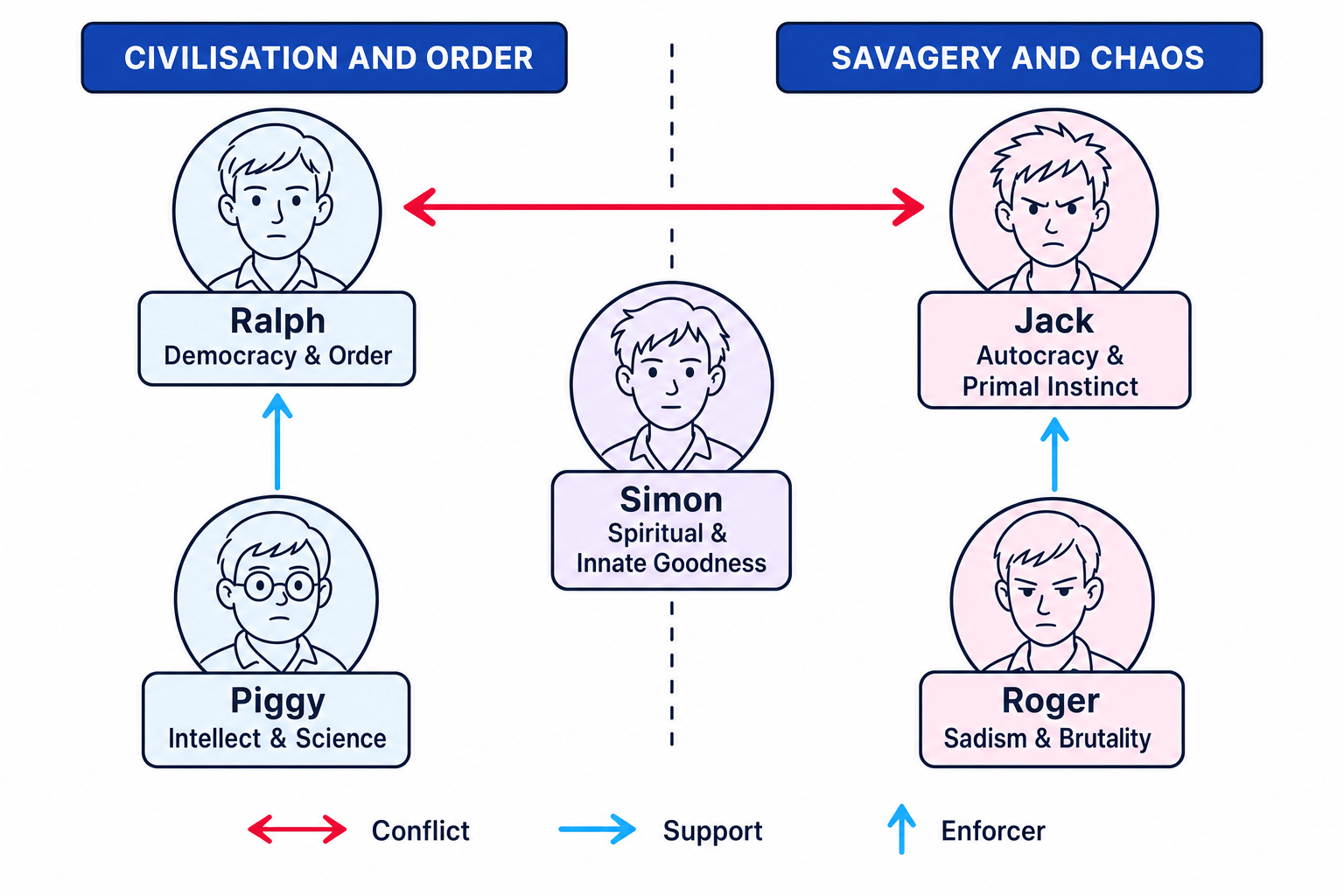
The Core Characters
Let's look at each character's allegorical role, their key symbols, and the crucial quotations you must memorize.
Ralph: Democracy and Order
Ralph is elected leader at the start of the novel. He represents the civilised, democratic impulse in humanity. He is committed to building shelters, keeping the fire lit, and using the conch to ensure everyone has a voice.
- Allegorical Role: Democracy, leadership, civilisation, and the rule of law.
- Key Symbol: The conch shell (representing order, speech, and democratic process).
- Key Quotes:
- "We've got to have rules and obey them. After all, we're not savages." (Chapter 2 - ironic foreshadowing of their eventual descent).
- "Ralph wept for the end of innocence, the darkness of man’s heart, and the fall through the air of a true, wise friend called Piggy." (Chapter 12).
Ralph's Flaw
Ralph is not perfect. He represents the 'everyman'—decent and well-meaning, but vulnerable to temptation. He briefly participates in the wild dances and even plays a passive role in Simon's murder. Golding suggests that without strong societal structures, even democratic leaders can slip into savagery.
Jack: Autocracy and Savagery
Jack Merridew begins the novel as the proud head boy and choirmaster. He quickly becomes obsessed with hunting and meat, eventually shedding his civilised clothing and painting his face. Jack represents the primal, dictatorial forces within humanity.
- Allegorical Role: Dictatorship (autocracy), military force, primal savagery, and the 'Id' (the impulsive, animalistic part of the human psyche).
- Key Symbol: Painted face mask (which hides his conscience and liberates him from civilised shame), spears, and the pig's head.
- Key Quotes:
- "I ought to be chief... because I'm chapter chorister and head boy, and I can sing C sharp." (Chapter 1 - arrogance and early desire for power).
- "The mask was a thing on its own, behind which Jack hid, liberated from shame and self-consciousness." (Chapter 4 - the turning point of his descent).
Piggy: Intellect and Scientific Rationalism
Piggy is the intellectual outsider. He is physically weak, suffers from asthma ("ass-mar"), has poor eyesight, and is overweight. Despite his physical vulnerabilities, he is the only boy who understands the scientific world and thinks logically.
- Allegorical Role: Science, rationalism, technology, and the 'Superego' (the conscience and moral compass).
- Key Symbol: Glasses (specs), which are used to start the fire and symbolise intellectual insight.
- Key Quotes:
- "What are we? Humans? Or animals? Or savages? What's grown-ups going to think?" (Chapter 5 - his constant reliance on adult authority).
- "The true, wise friend" (Chapter 12 - Ralph's final realization of Piggy's worth).
Ignoring Piggy's Flaws
While Piggy is highly intelligent, do not treat him as a perfect hero. Golding makes him ineffective at communicating with the other boys because he lacks empathy and social tact. He relies blindly on rules and adult authority, failing to understand the raw emotional power of Jack's tribal appeal.
Simon: Innate Goodness and Spirituality
Simon is a quiet, sensitive boy who suffers from epilepsy. Unlike the other boys, who are kept in line by rules, Simon is naturally good. He is deeply connected to nature and is the only character who recognises the true nature of the "beast."
- Allegorical Role: Spiritual truth, innate human goodness, and a Christ-like figure.
- Key Symbol: His secret glade in the forest (representing a cathedral or sanctuary).
- Key Quotes:
- "Maybe there is a beast... maybe it's only us." (Chapter 5 - Simon's intuitive understanding of human evil).
- "You'll get back all right." (Chapter 7 - Simon prophetically reassures Ralph of his survival, notably omitting himself).
Roger: Pure Malice and Sadism
Roger is initially introduced as quiet and secretive, but he quickly develops into the most terrifying figure on the island. He becomes Jack’s executioner, finding sadistic pleasure in inflicting pain on others.
- Allegorical Role: Sadism, brutality, lawlessness, and state-sanctioned violence.
- Key Symbol: The lever used to drop the boulder that kills Piggy.
- Key Quotes:
- "Roger's arm was conditioned by a civilization that knew nothing of him and was in ruins." (Chapter 4 - throwing stones at Henry, but intentionally missing due to lingering societal conditioning).
- "With a sense of delirious abandonment, Roger leaned all his weight on the lever." (Chapter 11 - the murder of Piggy, showing his total descent into evil).
Character Relationships and Conflict
The central conflict of the novel is dramatised through the deterioration of the relationship between Ralph and Jack.
This is not just a personal rivalry; it is a battle for the souls of the boys on the island. When Ralph and Jack first meet, they share a mutual respect. However, as the pressures of survival mount, their differing values tear them apart.
Let’s look at how to analyse a character's development and relationship dynamics in an essay.
Analysing a character's psychological shift
Suppose you are asked to analyse how Golding presents the change in Roger from Chapter 4 to Chapter 11. Here is how you can build a step-by-step, high-level analysis.
-
Establish the starting point of the character's development: In Chapter 4, Roger throws stones at the young boy Henry, but intentionally aims to miss. Golding writes that "round the squatting child was the protection of parents and school and policemen and the law." You must identify that Roger is still restrained by the invisible boundaries of civilised society, showing that evil is present but still suppressed by social conditioning.
-
Contrast this with the character's climax/endpoint: By Chapter 11, Roger is perched above the tribe and intentionally rolls a massive boulder down, killing Piggy and shattering the conch. Golding notes that Roger acts with "delirious abandonment." This vocabulary choice shows that the restraint of civilisation has completely dissolved, replaced by a joyful surrender to primal violence.
-
Identify the author's primary method: Golding uses the physical action of throwing stones as a motif (a recurring symbol) to trace the decay of morality. The transition from deliberately missing a child with small pebbles to deliberately crushing a child with a massive boulder acts as a physical measurement of the boys' moral collapse.
-
Connect the character shift to context and Golding's message: Golding lived through the horrors of World War II and witnessed how easily ordinary people could participate in state-sanctioned atrocities (like the Holocaust). By showing Roger's rapid transformation from a quiet schoolboy to a remorseless killer once the "policemen and the law" are removed, Golding warns his post-war readers that the impulse for cruelty lies dormant in everyone, waiting for civilised structures to fail.
In the exam
To achieve a Grade 7 or above when writing about characters, keep these three structural strategies in mind:
- Write about characters as tools: Always use the writer’s name. Instead of writing "Piggy is very smart but wears glasses," write "Golding constructs Piggy as a physical representation of scientific rationalism to show how vulnerable intellect is when confronted by raw, unconditioned savagery."
- Trace the arc: A good essay should show how a character changes from the exposition (the start) through the rising action to the climax and resolution. Mention at least two distinct parts of the novel to demonstrate your deep structural understanding.
- Embed short, explosive quotes: Do not write out long, three-line block quotes. Instead, weave single words or short phrases directly into your sentences (e.g., Roger acts with "delirious abandonment" because his arm is no longer "conditioned by... civilisation"). This keeps your writing analytical and precise.
Check yourself
Before moving on to the theme guides, make sure you can answer these three questions confidently:
- How does the change in the condition of Piggy's glasses mirror the breakdown of order and intellect on the island?
- Why does Golding use Simon’s death as the absolute turning point (climax) of the novel?
- What does Roger’s relationship with Jack tell us about the nature of dictatorial power?
