

Welcome to your study guide for William Golding’s 1954 masterpiece, Lord of the Flies. This novel is a staple of GCSE English Literature (AQA Specification 8702, Paper 2, Section A). It is a dark, gripping, and deeply philosophical story that explores the fragility of human civilization and the darkness that lies within us all.
In this overview, we will establish the foundational concepts of the text, look at its overall structure, and explore how you need to approach this novel to secure the highest marks in your exam.
What you'll learn:
- The core premise of the novel and how it functions as an allegory.
- The structural "descent" from order to savagery on the island.
- The critical exam skills and Assessment Objectives (AOs) required for a top-grade response.
What is Lord of the Flies?
At its simplest, Lord of the Flies tells the story of a group of British schoolboys who find themselves stranded on an uninhabited tropical island after their plane is shot down during an unnamed nuclear war. With no adult survivors, the boys must work together to survive and secure their rescue.
However, what starts as a sunny adventure quickly deteriorates into a nightmare of fear, division, and tribal violence.
To understand why Golding wrote this story, we must look at two essential literary concepts: allegory and microcosm.
Allegory
An allegory is a story, poem, or picture that can be interpreted to reveal a hidden, deeper meaning—typically a moral, political, or psychological one. Every character, setting, and object in an allegorical text represents an abstract idea.
Microcosm
A microcosm (literally "small world") is a miniature representation of something much larger. In Lord of the Flies, the isolated island acts as a microcosm of the wider adult world, which is simultaneously destroying itself in a global war.
Golding did not write this novel simply to tell an entertaining story about stranded children. He wrote it as a direct challenge to the optimistic Victorian view that humanity is inherently civilized. Having served in the Royal Navy during World War II, Golding witnessed first-hand the horrors of war and Nazi concentration camps. He came to believe that the potential for evil exists inside every single human being.
The Structural Arc: The Descent into Savagery
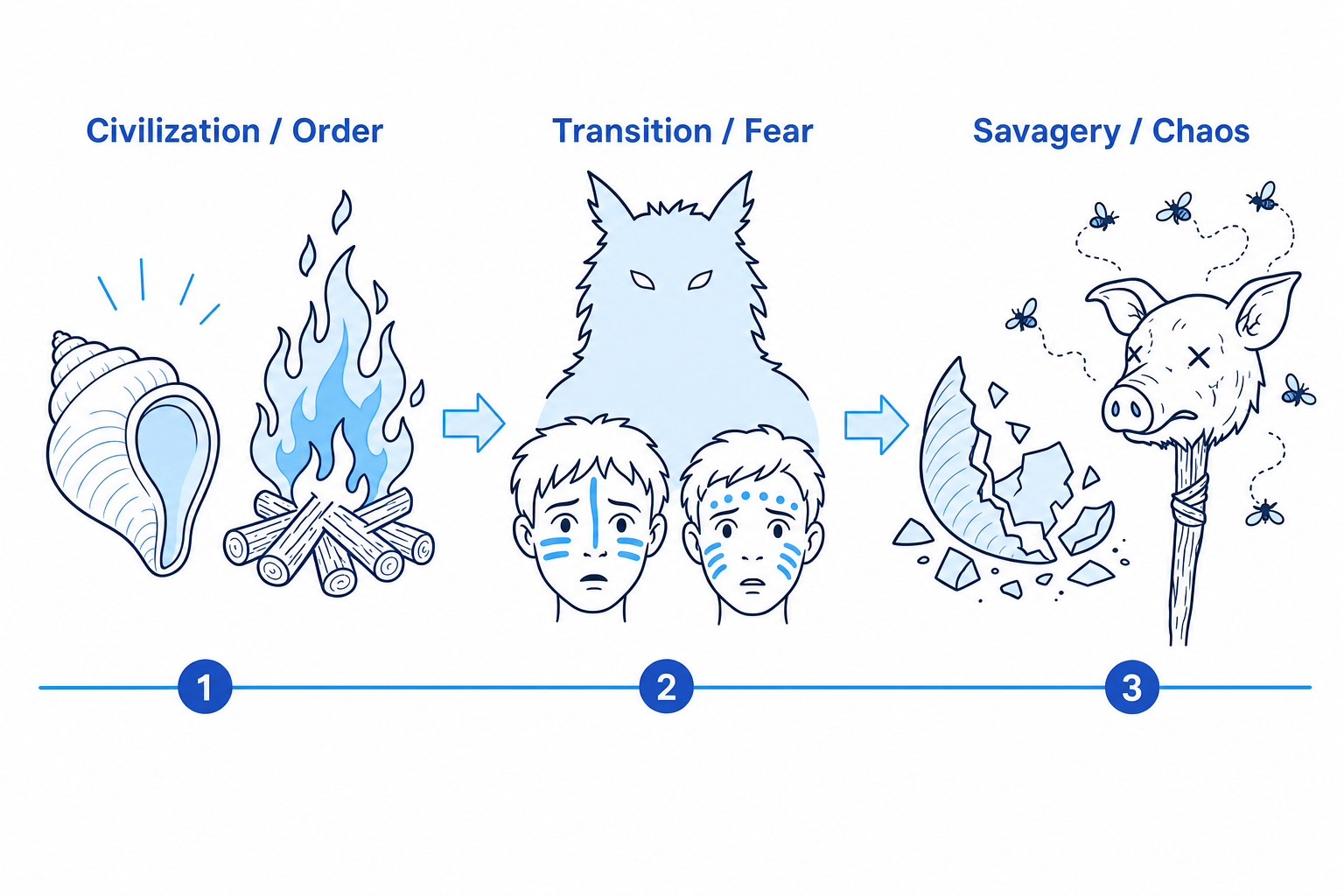
The novel is structured symmetrically to show a gradual, terrifying descent from civilization to complete savagery. We can trace this decay through three distinct stages:
1. Civilization and Order (Chapters 1–4)
The boys attempt to recreate British democratic society. They elect Ralph as chief, establish the conch shell as a symbol of free speech and order, and build a signal fire to attract rescue ships. At this stage, they are still bound by the rules of the society they left behind.
2. Transition and Fear (Chapters 5–8)
Fear begins to erode their civilization. The boys become obsessed with an imaginary "Beast" on the island. Jack, who champions hunting and survival over rescue, uses this fear to manipulate the boys. He encourages them to paint their faces, acting as a "mask" that frees them from their personal conscience and shame.
3. Savagery and Chaos (Chapters 9–12)
All remnants of civilization break down. This stage is marked by the brutal, ritualistic murders of Simon (the spiritual, intuitive boy) and Piggy (the voice of science, intellect, and reason), alongside the physical destruction of the conch shell. The novel ends with a terrifying, island-wide manhunt for Ralph, which is only halted by the sudden arrival of a British naval officer.
Golding's Central Message
Golding's ultimate message is that human evil is not an external force (like a physical monster or "Beast"). Instead, it is a disease inherent in human nature itself. When the rules, laws, and structures of civilization are removed, our primitive instincts of violence, selfishness, and tribalism will inevitably take over.
The Core Conflict: Civilization vs. Savagery
At the heart of the novel is a fierce ideological struggle between two opposing impulses:
- The Civilizing Impulse: Represented by Ralph and Piggy. This impulse is characterized by a desire for order, democracy, moral law, long-term planning (the signal fire), and the protection of the weak.
- The Savage Impulse: Represented by Jack and Roger. This impulse is characterized by immediate gratification, tribalism, brute force, the desire for power, and a rejection of moral constraints.
Throughout the novel, these impulses clash over key symbols:
| Symbol | What it Represents | What Happens to It |
|---|---|---|
| The Conch | Democracy, order, rule of law, and free speech. | Shattered into "a thousand white fragments" when Piggy is killed. |
| Piggy’s Glasses | Science, intellect, rational thinking, and truth. | Broken progressively; eventually stolen by Jack's tribe to make fire. |
| The Signal Fire | Hope of rescue, connection to civilization, and future-mindedness. | Allowed to go out in favour of hunting; later replaced by a destructive forest fire. |
| The Lord of the Flies (The pig's head on a stick) | The physical manifestation of the Beast; the inherent evil inside humanity. | Left rotting in the forest, surrounded by flies, speaking to Simon in his hallucination. |
Mastering the GCSE Exam
Because the GCSE English Literature exam is closed book, you will not have a copy of the text in front of you. You will be given a single essay question focused on a specific character or theme (for example, fear, power, savagery, or the presentation of Ralph).
To score highly, your essay must address the three main Assessment Objectives (AOs) tested in Paper 2:
- AO1 (Clear Argument and Evidence): You must present a coherent, structured, and personal argument. You must support your points with precise, memorable quotations that you have memorized.
- AO2 (Analysis of Writer's Methods): You must show how Golding uses language, structure, and symbolism to convey his ideas. Do not just spot devices (e.g., "Golding uses a metaphor here"); explain the effect of those devices on the reader and how they link to the wider themes.
- AO3 (Contextual Relationships): You must link the ideas in the novel to the context in which it was written. This includes the aftermath of World War II, the rise of totalitarian regimes, the Cold War nuclear threat, and Golding's background as a schoolteacher working with boys.
The 'Device Spotting' Trap
Many students list literary terms without explaining why the writer used them. Pointing out that Golding uses personification is worthless unless you explain what that personification reveals about a character's state of mind or the deteriorating atmosphere on the island. Always use the formula: Method →\to→ Effect →\to→ Meaning.
How to Analyze a Theme or Character Prompt
Let’s look at how to construct a high-scoring analytical paragraph from scratch. We will use a standard GCSE style prompt and break down the intellectual steps required to construct a top-tier paragraph.
Analyzing the Breakdown of Order
Prompt: Explore how Golding presents the breakdown of order on the island.
Here is how you should construct your response step-by-step:
- Formulate a clear thesis statement (AO1/AO3): Start with a direct, conceptual answer to the prompt. Link the breakdown of order to Golding's wider moral purpose.
- Draft: "Golding presents the breakdown of order on the island as an inevitable consequence of human nature when societal rules are removed, reflecting his post-WWII belief that civilization is merely a thin veneer masking a primal urge for violence."
- Select precise evidence (AO1): Choose a highly symbolic moment where the breakdown is stark, and introduce a memorized quotation.
- Selection: The moment the conch is destroyed.
- Quote: "the conch exploded into a thousand white fragments and ceased to exist."
- Analyze the writer's methods deeply (AO2): Look at specific words and their connotations, identifying the structural and symbolic methods.
- Analysis: The verb "exploded" suggests a violent, irreversible destruction. The phrase "a thousand white fragments" emphasizes the complete and chaotic ruin of democratic order. The colour "white" links to purity and peace, which are now shattered.
- Link back to context and the author's purpose (AO3): Explain why Golding structured the text this way. What does he want his audience to realize?
- Link: By destroying the conch alongside Piggy (intellect), Golding warns his mid-20th-century readers that without rationalism and democratic law, society will collapse into a brutal dictatorship, echoing the rise of fascist regimes in Europe.
In the exam
- Plan your thesis first: Spend 333 to 555 minutes planning your main argument before you start writing. Decide on three main points that trace the character or theme across the beginning, middle, and end of the novel.
- Prioritize short, versatile quotations: You do not need to memorize long blocks of text. Short phrases of 222 to 555 words (like "mankind's essential illness", "solidarity of assemblies", or "liberated from shame") are much easier to remember and can be integrated seamlessly into your sentences.
- Focus on Golding's choices: Avoid talking about the boys as if they are real people. Refer to them as constructs created by Golding to represent ideas. Use active verbs like "Golding demonstrates...", "Golding manipulates...", or "Golding foreshadows...".
Check yourself
- Why did Golding's experience in World War II change his perspective on human nature?
- What are the major differences between the leadership styles of Ralph and Jack, and how do they represent the main conflict of the novel?
- Why is Simon's death structurally and symbolically considered the ultimate turning point of the novel?
