What you'll learn
- What kind of text The Strange Case of Dr Jekyll and Mr Hyde is, and why that matters.
- How Stevenson builds the novella around mystery, secrecy and delayed revelation.
- The central ideas you should keep in mind before studying plot, characters, themes and methods in detail.
- How to turn “overview” knowledge into clear GCSE analysis.
What “overview” means
An overview is your big-picture understanding of a text. It is not just “what happens”. It includes the type of text, the main conflict, the way the story is told, and the broad ideas the writer explores.
Overview
An overview is a clear, general understanding of a whole text: what it is about, how it is constructed, and why those choices matter.
For GCSE, a strong overview helps you avoid simply retelling the story. Instead, you can write about Stevenson’s choices: how he presents secrecy, how he delays the truth, and how the novella reflects Victorian fears about identity, science and morality.
The novella at a glance
Robert Louis Stevenson’s The Strange Case of Dr Jekyll and Mr Hyde was published in 1886. It tells the story of Mr Utterson, a respectable lawyer, who investigates the disturbing connection between the admired Dr Henry Jekyll and the violent, mysterious Mr Edward Hyde.
Novella
A novella is a short novel: longer and more developed than a short story, but usually more focused and compressed than a full-length novel.
Because it is a novella, Stevenson keeps the story tight. There are not many subplots. Almost every detail — the will, the door, the letters, the locked cabinet — pushes the reader towards the final revelation.
The whole text in one sentence
Stevenson presents a respectable Victorian man whose attempt to separate his good and evil sides exposes the danger of repression, secrecy and unchecked scientific ambition.
The diagram below gives you the “big picture” of the novella’s characters, structure and main ideas.
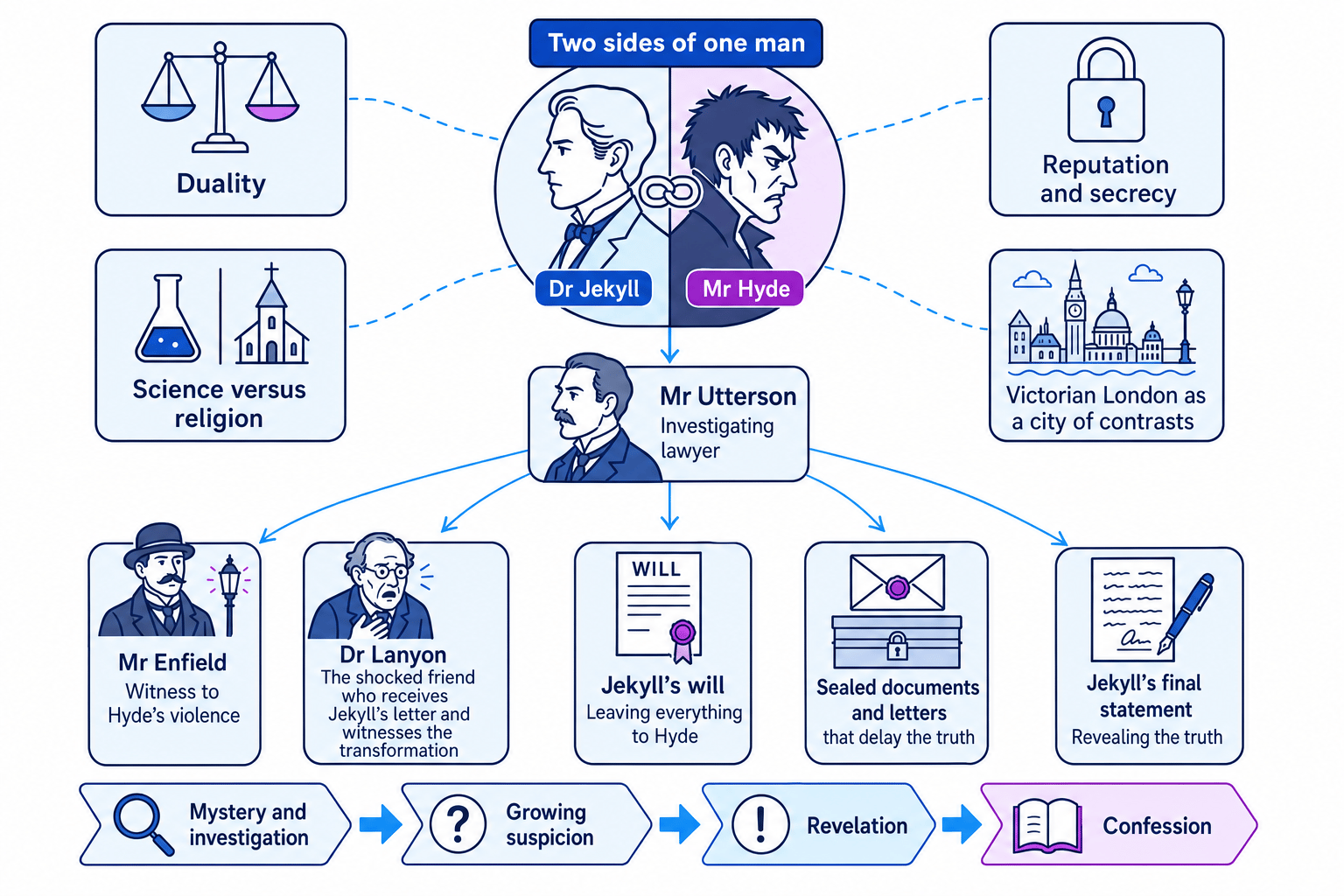
Genre: Gothic mystery
Genre
A genre is a type or category of writing, such as Gothic fiction, detective fiction, tragedy or romance.
Jekyll and Hyde is often described as a Gothic novella.
Gothic
Gothic fiction is writing that uses fear, darkness, mystery, violence and the unnatural to explore disturbing ideas.
Stevenson uses Gothic features such as night-time settings, locked rooms, secrecy, violence and frightening descriptions of Hyde. For example, Hyde is described as having “Satan’s signature upon a face”, linking him to evil through a religious image. The phrase does not just tell us Hyde is unpleasant; it makes him seem morally and spiritually corrupted.
The novella also works like a mystery. Utterson follows clues, hears stories from others, reads documents, and tries to understand the connection between Jekyll and Hyde. The reader discovers the truth slowly, almost as if solving a case.
Think of the title
The word “Case” in the title can suggest both a legal investigation and a medical case study. That fits Utterson, the lawyer, and Jekyll, the doctor.
The central conflict: divided human nature
The key conflict is not just “Jekyll versus Hyde”. It is the conflict inside one person.
Duality
Duality means two opposing sides existing together. In this novella, it mainly refers to the idea that human beings contain both good and evil.
Jekyll eventually claims that “man is not truly one, but truly two”. This is one of the most important ideas in the novella. Stevenson explores whether evil is something outside us, or something hidden within ordinary, respectable people.
However, be careful: Stevenson does not present Jekyll as completely innocent and Hyde as completely separate. Jekyll chooses to create Hyde and chooses to enjoy the freedom Hyde gives him. Hyde is frightening partly because he reveals what Jekyll has tried to hide.
Splitting Jekyll and Hyde too simply
Do not write as if Jekyll is purely good and Hyde is purely evil. A stronger answer explains that Hyde emerges from Jekyll’s own desires, so Jekyll remains morally responsible.
Structure: mystery first, confession last
Structure
Structure means the order, shape and organisation of a text: what the writer reveals, delays, repeats or places at important moments.
Stevenson does not begin with Jekyll explaining his experiment. Instead, the novella begins with Utterson and Enfield discussing a strange door. This makes the reader curious before they understand what is really happening.
The truth is delayed until the end, through Dr Lanyon’s narrative and Jekyll’s final statement. This delayed structure is important because it makes secrecy part of the reading experience. We feel the confusion, suspicion and fear that the characters feel.
Frame narrative
A frame narrative is a structure where one story contains other stories or documents inside it. In this novella, Utterson’s investigation frames later written accounts by Lanyon and Jekyll.
This structure matters because the final confession forces the reader to reinterpret everything that came before. Earlier details — Hyde’s appearance, Jekyll’s strange will, Lanyon’s shock — suddenly make sense.
Connecting overview to analysis
-
Start with the big idea: Stevenson explores the danger of hidden evil within respectable society, rather than presenting evil as something completely separate.
-
Choose a precise quotation that fits this idea: Jekyll’s statement that “man is not truly one, but truly two” directly expresses the theme of duality.
-
Analyse the method: the contrast between “one” and “two” creates a clear opposition, while the repetition of “truly” suggests Jekyll believes he has discovered a deep truth about human nature.
-
Link to structure: because this statement appears near the end, the reader only fully understands the mystery after witnessing the damage caused by Jekyll’s secrecy.
-
Connect to context: Stevenson is writing in a Victorian society that valued reputation and self-control, so Jekyll’s hidden life exposes the pressure beneath public respectability.
Context: Victorian respectability and anxiety
Context
Context means the historical, social and cultural background that shapes how a text was written and received.
The novella was written in the Victorian period, when public reputation mattered greatly, especially for middle-class professional men like doctors and lawyers. Jekyll is respected because of his wealth, education and social status. That makes his hidden life more shocking.
Stevenson also writes during a time of scientific development and religious uncertainty. Jekyll’s experiment crosses moral boundaries: he wants scientific power over the human soul. This creates anxiety because science appears exciting but also dangerous when separated from responsibility.
Victorian London is also important as a setting. Stevenson presents a city of contrasts: respectable streets and sinister doors, wealthy homes and threatening night-time spaces. This mirrors the double nature of Jekyll himself.
Methods to watch for
Methods
Methods are the writer’s choices, including language, form and structure. In essays, you should explain how these choices create meaning.
A few methods are especially useful for an overview:
- Symbolism: when something represents a bigger idea. The door can suggest hidden sin, secrecy and access to another side of life.
- Foreshadowing: hints that prepare the reader for later events. Jekyll’s will, which leaves everything to Hyde, hints that their relationship is deeply unnatural.
- Contrast: placing opposites together. Stevenson repeatedly contrasts respectability with violence, public identity with private desire, and light with darkness.
- Documentary structure: the use of letters, statements and written evidence. This makes the novella feel like an investigation while also delaying the truth.
Symbolism
Symbolism is when a person, object, place or action represents a larger idea beyond its literal meaning.
Foreshadowing
Foreshadowing is when a writer plants hints about something that will become important later.
Use short quotation fragments
Because the exam is closed book, memorise short, flexible fragments such as “truly two”, “ape-like fury”, “Satan’s signature” and “I bring the life of that unhappy Henry Jekyll to an end”.
Why this overview matters for AQA
In AQA Paper 1, the 19th-century novel question gives you an extract and asks you to write about the extract and the novel as a whole. That means you need both close analysis and whole-text understanding.
A good answer does three things:
- builds a clear argument about Stevenson’s ideas;
- analyses language, form and structure rather than just naming techniques;
- links ideas to relevant Victorian context where it genuinely helps your interpretation.
You do not need to force context into every sentence. Use it when it explains why Stevenson’s ideas would feel powerful, frightening or challenging to a Victorian reader.
In the exam
-
Begin with a clear overview sentence about Stevenson’s main idea, such as duality, secrecy, reputation or dangerous science.
-
Use the extract for close analysis, but keep linking out to the whole novella: earlier clues, later revelations, or repeated symbols.
-
Avoid plot summary. For each quotation, explain Stevenson’s method and its effect on the reader, then link back to the question.
Check yourself
- What makes Jekyll and Hyde a Gothic novella rather than just a crime story?
- Why does Stevenson delay Jekyll’s confession until the end?
- How does the idea of duality connect to Victorian respectability?
