

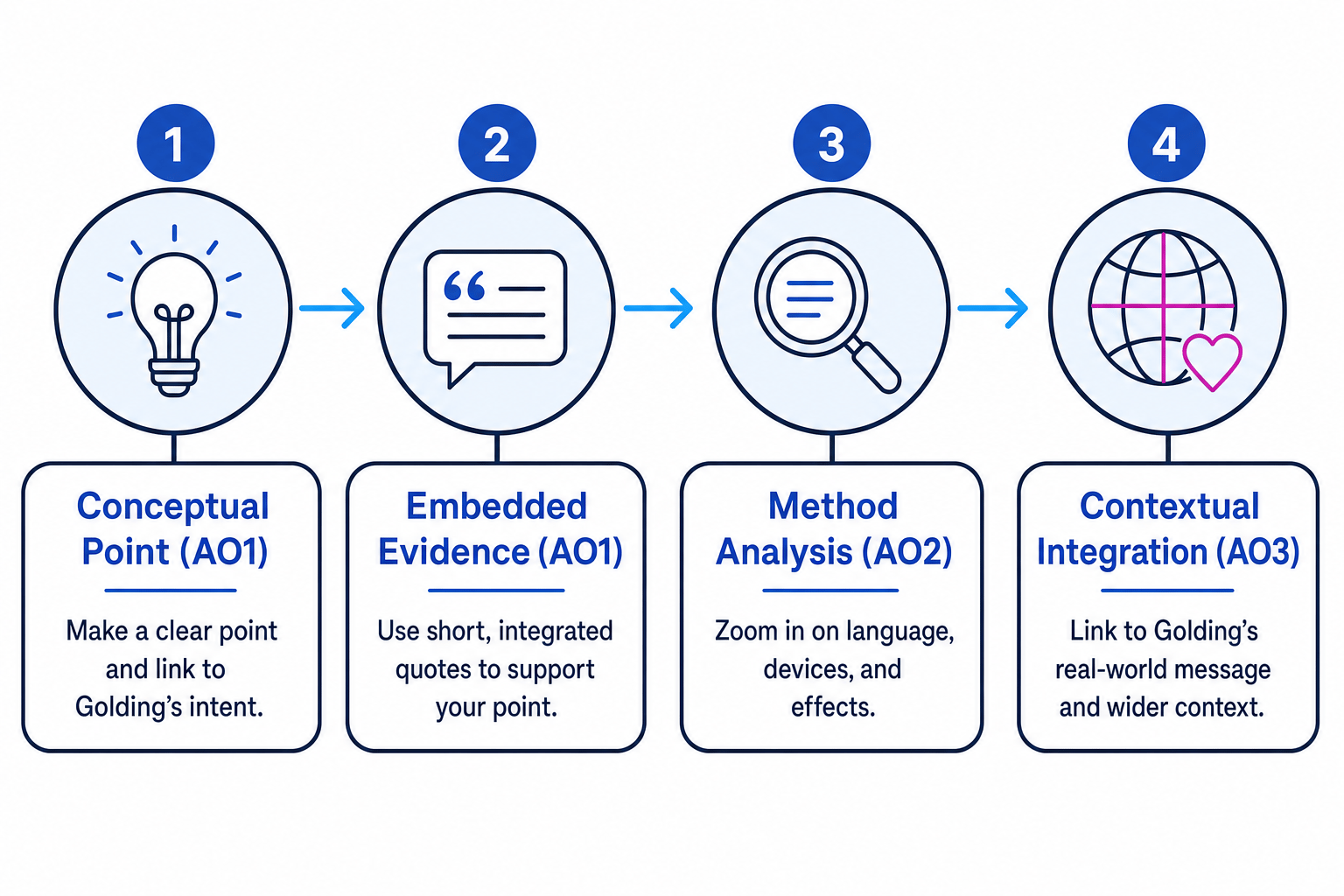
Mastering the Paragraph Loop: Worked Example
To see how these elements combine, let’s work through the creation of a high-scoring analytical paragraph.
We will use the following essay prompt: "How does Golding present the theme of savagery in Lord of the Flies?"
We will focus our paragraph on a key moment in Chapter 4: Jack painting his face.
The Power of the Painted Face
Jack’s clay mask is not just camouflage for hunting pigs. Symbolically, it acts as a psychological barrier that shields his conscious mind from societal guilt, allowing him to bypass his moral conditioning and commit acts of absolute savagery.
Constructing an analytical paragraph on Jack's descent into savagery
-
Establish a conceptual topic sentence (AO1): Start by identifying how Golding uses Jack's physical transformation to represent a deeper psychological shift.
Draft: Golding introduces the painted mask not merely as physical camouflage, but as a symbolic device that represents the liberation of the boys' latent, savage instincts.
-
Embed precise evidence (AO1): Introduce a short, highly specific quote into a grammatically correct sentence. Avoid writing "This is shown in the quote..."
Draft: This is clear when Jack paints his face with clay, and Golding describes how "the mask was a thing on its own, behind which Jack hid, liberated from shame and self-consciousness."
-
Analyse the writer's methods and key words (AO2): Identify the key literary devices and zoom in on specific words. Explain the exact mechanism by which they create meaning for the reader.
Draft: The personification of the mask as "a thing on its own" suggests that the savage persona has consumed Jack’s true identity, stripping away his individuality. Furthermore, the adjective "liberated" is highly ironic; while it implies a positive release from restraint, here it signifies a freedom from moral accountability. By shedding "shame," Jack escapes the democratic social structures of the old world, paving the way for unchecked violence.
-
Integrate contextual purpose (AO3): Tie your linguistic analysis directly to Golding's wider philosophical message. Why did he want the post-WWII reader to see this?
Draft: Through this symbolic shedding of guilt, Golding warns his post-World War II contemporary readers that civilization is merely a thin veneer. Having witnessed the atrocities of the Holocaust, Golding uses Jack’s mask to demonstrate how easily human beings can abandon their moral conditioning when sheltered by anonymity and collective madness.
Incorporating Context (AO3) Naturally
One of the most common ways students lose marks is by "bolting on" random historical facts at the end of a paragraph. For example, writing: "This shows Jack is savage. Also, World War II happened in 1939 and Golding was in the Navy." This does not show conceptual understanding.
To score highly, your contextual references must explain why Golding wrote the book the way he did.
Bolting on context
Never write a paragraph of pure history. If your sentence doesn't mention Golding, the reader, or the text, it is likely "bolted-on" context. Instead of "Golding was in the Royal Navy," write "Golding's experiences in the Royal Navy during World War II disillusioned him, leading him to construct the island as a microcosm of global conflict..."
Key Contextual Links for Lord of the Flies
- The Illusion of British Exceptionalism: In Chapter 2, Jack boasts: "We've got to have rules and obey them. After all, we're not savages. We're English, and the English are best at everything." Golding uses this ironic statement to critique Victorian colonial attitudes and the naive belief (championed in adventure books like The Coral Island) that British boys were inherently moral and superior.
- The Cold War and Nuclear Anxiety: The boys' plane is shot down during an unnamed nuclear war. By showing the boys duplicating the same destructive patterns on the island as the adults are playing out in the skies above, Golding implies that the "beast" is not outside of us, but is an inherent part of human nature.
The Microcosm
Think of the island as a snow globe. It is a tiny, self-contained world (a microcosm) that mirrors the larger, chaotic adult world outside. When the boys wage war on the island, they are duplicating the exact same geopolitical violence that the adults are fighting in the sky above.
Avoiding Common Essay Pitfalls
When writing a literature essay under timed conditions, it is easy to slip into bad habits. Keep these essential tips in mind to protect your marks:
The 'Beastie' Trap
Do not write about the "Beast" as if it is a real monster. From Chapter 5 onwards, Simon realizes the beast is "only us." Your essay must treat the beast as an externalized symbol of "mankind's essential illness"—the latent evil residing within all human hearts.
Use tentative language
To sound like a perceptive critic, use tentative verbs such as "suggests," "implies," "conveys," "symbolises," or "demonstrates." Avoid absolute phrases like "this proves that." Literature is open to interpretation, and the examiners love to see you exploring multiple possibilities!
In the exam
- Spend 5 minutes planning: Do not start writing immediately. Read the question, write down your 3-stage thesis, and select 3 or 4 key quotes you can remember accurately before starting your introduction.
- Anchor your introduction with a thesis: Ensure your very first paragraph answers the prompt directly and names Golding's overarching moral purpose.
- Embed your quotations: Never use a quote as a standalone sentence. Always weave it into your own analytical prose to maintain a sophisticated academic register.
- Use "Golding" as the active subject: Instead of writing "Piggy's glasses are broken," write "Golding symbolically shatters Piggy's glasses to represent the systematic destruction of rationalism and science on the island."
- Keep your conclusion brief: Do not introduce new points in your final paragraph. Simply summarise how your three main points have proven your initial thesis.
Check yourself
- Can you explain the difference between a simple plot description and treating the novel as a "construct"?
- Why is it incorrect to write a paragraph focusing solely on World War II history without linking it to Golding’s literary choices?
- How does the transition from Jack's initial desire for rules in Chapter 2 to his painted face in Chapter 4 show a structured progression in an essay about savagery?
