

Welcome to your study guide for the AQA Telling Tales anthology! If your school has chosen this text for Section A of Paper 2 (Modern Texts), you are exploring a rich collection of ten modern short stories.
Short stories are unique literary forms. Unlike novels, they must establish characters, build tension, and deliver profound thematic messages within a highly compressed space. To succeed in the exam, you must understand not just what happens in these stories, but how the writers construct their narratives to deliver these messages.
This overview will guide you through the structure of the exam, the essential thematic connections between the stories, and how to plan a top-tier comparative essay.
What you'll learn
- How the AQA Telling Tales exam question is structured and assessed.
- The three core thematic clusters that connect all ten stories.
- How to strategically select and pair stories to answer any exam prompt.
- A step-by-step method for planning a high-scoring comparative essay.
Understanding the Exam Structure
Before diving into the stories, you need to know exactly how AQA will assess you on this anthology.
Anthology
An anthology is a curated collection of literary works—in this case, ten short stories—chosen by the exam board to be studied together because they share overlapping themes, structures, or cultural contexts.
On Paper 2, Section A, you will have a choice of two questions on Telling Tales. You only answer one of them. The question will always follow a specific formula:
- It will name one specific story from the anthology.
- It will identify a core theme or relationship (e.g., family tension, the transition from innocence to experience, or the impact of the past).
- It will ask you to write about the named story, and then compare it to one other story of your choice from the anthology.
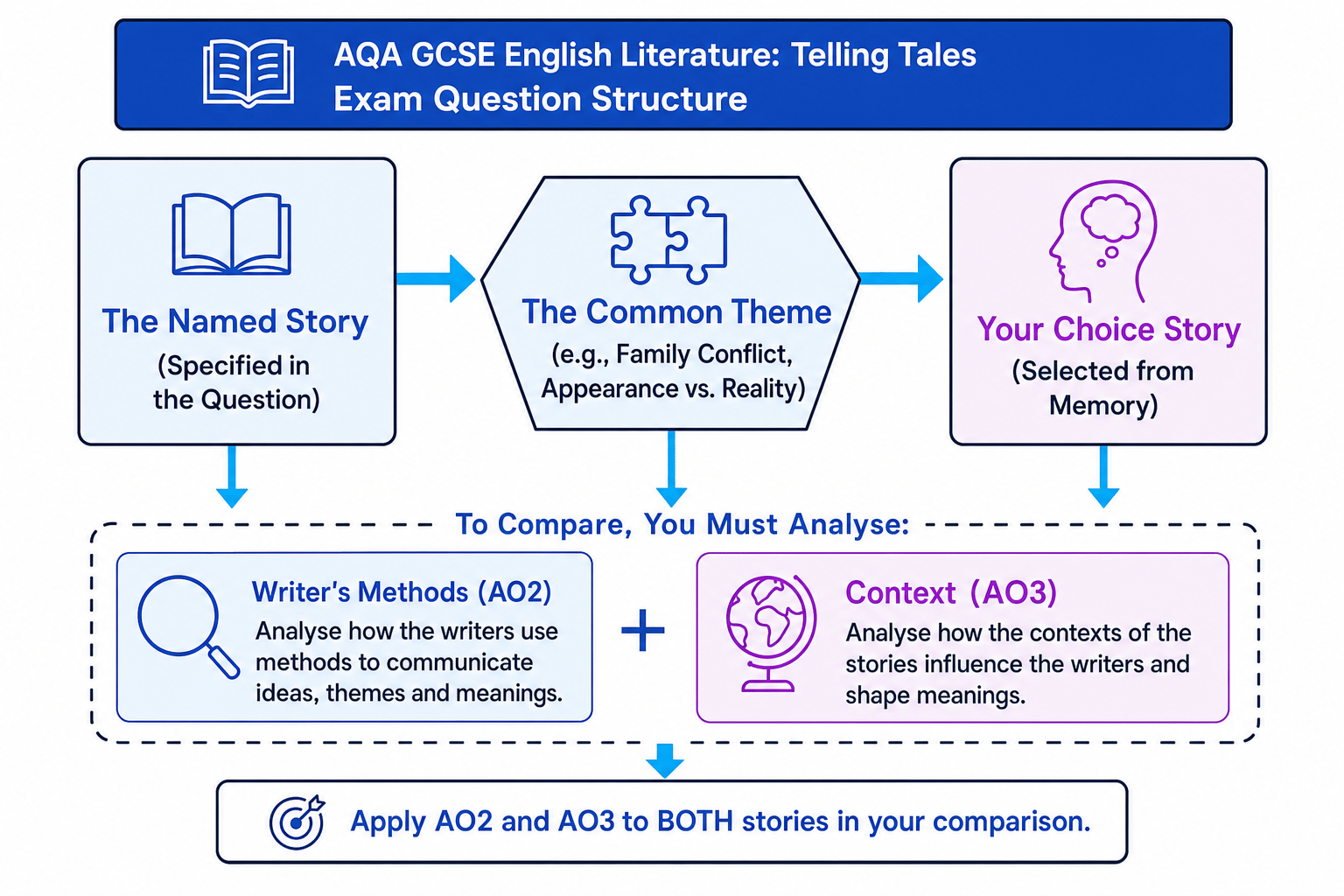
Because this is a closed-book exam, you will not have the anthology with you in the exam hall. This means you must memorize a small bank of short, versatile quotations from across several stories.
The Golden Rule of Selection
You do not need to memorize every line of all ten stories. Instead, group the stories into thematic clusters and memorize 3–4 high-impact, short quotes for each key story. This ensures you can pair any "named story" with an appropriate "choice story" on exam day.
The Three Core Thematic Clusters
To compare the stories effectively, you must understand how they talk to one another. The ten stories in Telling Tales can be grouped into three major thematic clusters.
1. Family Dynamics and Generational Conflict
These stories explore how family members communicate (or fail to communicate), how grief fractures relationships, and how children clash with parental expectations.
- 'Chemistry' (Graham Swift): Explores how a grandfather, mother, and young narrator deal with grief, and how the introduction of a new partner (Ralph) disrupts their delicate family unit.
- 'A Family Supper' (Kazuo Ishiguro): Set in Japan, it focuses on the quiet, tense generational divide between a traditional father and his Westernised children, haunted by the mother's death.
- 'Your Shoes' (Michèle Roberts): A dramatic monologue of a mother dealing with the sudden runaway of her teenage daughter, exposing obsessive parenting and a complete breakdown of communication.
2. Appearance vs. Reality (Deception and Discovery)
These stories deal with characters discovering uncomfortable truths about people, society, or themselves.
- 'The Darkness Out There' (Penelope Lively): Follows two teenagers who visit an old woman, Mrs. Rutter. They expect her to be a sweet, stereotypical grandmother, only to discover she harbor a cruel, dark past from World War II.
- 'My Polish Teacher's Tie' (Helen Dunmore): Explores how staff in a school judge a visiting Polish teacher based on his cheap attire and accent, highlighting social prejudice and the value of genuine human connection.
- 'The Destructors' (Graham Greene): Set in post-war London, a gang of boys systematically destroys a beautiful 17th-century house. It explores the loss of innocence and the bizarre, detached logic of youth in a damaged world.
3. Identity, Culture, and Social Class
These stories focus on marginalized characters fighting against social structures, colonial exploitation, or cultural assimilation.
- 'The Gold Watch' (Mulk Raj Anand): A depiction of a clerk, Sunder Singh, who is forced into early retirement by his colonial employers. It exposes the cold, dehumanizing nature of British colonial rule in India.
- 'Invisible Mass of the Back Row' (Claudette Williams): Explores the journey of Hortense, a young girl emigrating from Jamaica to 1960s England, dealing with institutional racism and the painful loss of her cultural identity.
- 'Americanised' (Beryl Gilroy): Focuses on a family dealing with the overwhelming influence of American consumerism and culture, highlighting the tension between traditional heritage and modern assimilation.
How to Structure Your Comparison
A common pitfall is writing about the first story completely, then writing about the second story, and adding a brief comparison at the end. This is known as a "split essay" and limits your marks.
The Split Essay
Do not write two separate mini-essays. Your comparison must be integrated throughout. The best way to do this is to structure your essay by sub-themes (ideas), comparing how both writers address that sub-theme in each paragraph.
To compare successfully, you must analyze how both writers use their methods to shape meaning.
Writer's Methods
A writer's method (AO2) is any conscious choice made by the author to create meaning. This includes language features (metaphors, similes, sensory imagery), structural choices (foreshadowing, narrative perspective, flashbacks), and form (the short story structure, dramatic monologues).
When you compare, use transitional comparative phrases such as similarly, in contrast, whereas, likewise, or conversely to signpost your links to the examiner.
Essay Planning in Action
Let’s walk through how to construct a comparative plan when presented with an exam-style question.
Developing a Comparative Essay Plan
The Prompt: How do writers present characters experiencing a clash between generations? Write about 'Chemistry' and one other story of your choice.
Here is how you can systematically build a high-scoring comparative plan:
-
Step 1: Deconstruct the named story ('Chemistry') Identify the core conflict and key methods in the named text. In Chemistry, the generational clash is between the grandfather (representing the past, stability, and quiet craftsmanship) and the mother's new partner, Ralph (representing intrusive modernity, noise, and disruption of the family dynamic). The young narrator feels caught in the middle.
- Key Method: The metaphor of "chemistry" and "algebra" to represent invisible bonds and cold, rigid changes.
- Key Quote: "She was. And then she wasn't. It was like chemistry."
-
Step 2: Select the best comparison story from memory Select a story that offers either a powerful parallel or a sharp contrast. A Family Supper by Kazuo Ishiguro is an ideal choice. It also features a tense generational divide, a widowed father, and adult children who have drifted away.
- Contrast: While Chemistry features loud, overt arguments between Ralph and the grandfather, A Family Supper presents a quiet, deeply restrained conflict masked by polite ritual and unspoken words.
- Key Quote: "My father was a formidable man... I did not meet his eyes."
-
Step 3: Formulate a comparative thesis statement A thesis statement is your overarching argument. It must directly answer the prompt and link both stories.
- Draft Thesis: While both Swift in 'Chemistry' and Ishiguro in 'A Family Supper' present generational clashes as deeply painful experiences rooted in unresolved grief and shifting family roles, Swift utilizes domestic intrusion to represent overt hostility, whereas Ishiguro uses cultural tradition and silence to highlight an insurmountable emotional chasm.
Quick Quote Check
Short quotes of one to three words are easier to remember and much more powerful when integrated directly into your own sentences. For example: Rather than quoting a whole block, write: Ishiguro highlights the father's intimidating nature, describing him as a "formidable man" whose presence demands submissive silence.
In the exam
- Read both questions carefully: Spend 2 minutes deciding which question gives you the best opportunity to showcase your knowledge. Look at the named story and ensure you have a strong "choice story" to pair with it.
- Draft a quick 5-minute plan: Do not skip this! Write down your comparative thesis and map out three conceptual paragraphs that compare the stories side-by-side.
- Write a sharp, direct introduction: State your thesis immediately. Name both stories, the authors, and outline how they present the central theme differently or similarly.
- Weave AO2 and AO3 together: Ensure every paragraph analyzes a specific method (AO2) and links it to why the writer wrote it—their social, historical, or cultural context (AO3).
- Keep your comparison balanced: Aim to write roughly equal amounts on both the named story and your chosen story.
Check yourself
- Which two stories from the anthology would you pair to explore the theme of deception and hidden truth?
- Can you explain the difference between a "split essay" and an "integrated comparative essay"?
- Choose any three stories from the anthology. Can you write down three precise quotes from memory for each one?
