

William Golding’s Lord of the Flies is a carefully structured novel. To write a top-tier essay, you cannot view the plot as just a random sequence of events. Instead, you must understand how Golding systematically dismantles democracy, reason, and morality.
By focusing on a few key chapters, you can track the shifts in characters, symbols, and themes that show humanity's capacity for evil.
What you'll learn
- How to analyse the structural shift from democratic order to primal savagery.
- Why specific turning points (Chapters 1, 5, 8, 9, and 12) act as a map for Golding’s deeper moral message.
- How to connect structural shifts to key contextual influences like the Cold War and Golding's teaching career.
The Structural Architecture of the Island
Before we dive into the specific chapters, we need to understand how Golding structures his narrative. The novel functions as a specific type of story where characters and settings represent abstract ideas.
Allegory
An allegory is a narrative that has a deeper, symbolic meaning beneath its surface story. In Lord of the Flies, the boys' descent into savagery is an allegory for the inherent evil within human nature and the fragile nature of democratic civilisation.
To make this allegory work, Golding creates a self-contained world to experiment with human behaviour.
Microcosm
A microcosm is a miniature world or community that represents the features and struggles of the wider world on a larger scale. The isolated island is a microcosm of global society during the Cold War.
The novel’s structure is a steady downward spiral. It begins with democratic hope, passes through fear and superstition, descends into physical violence, and ends with a dark, ironic rescue.
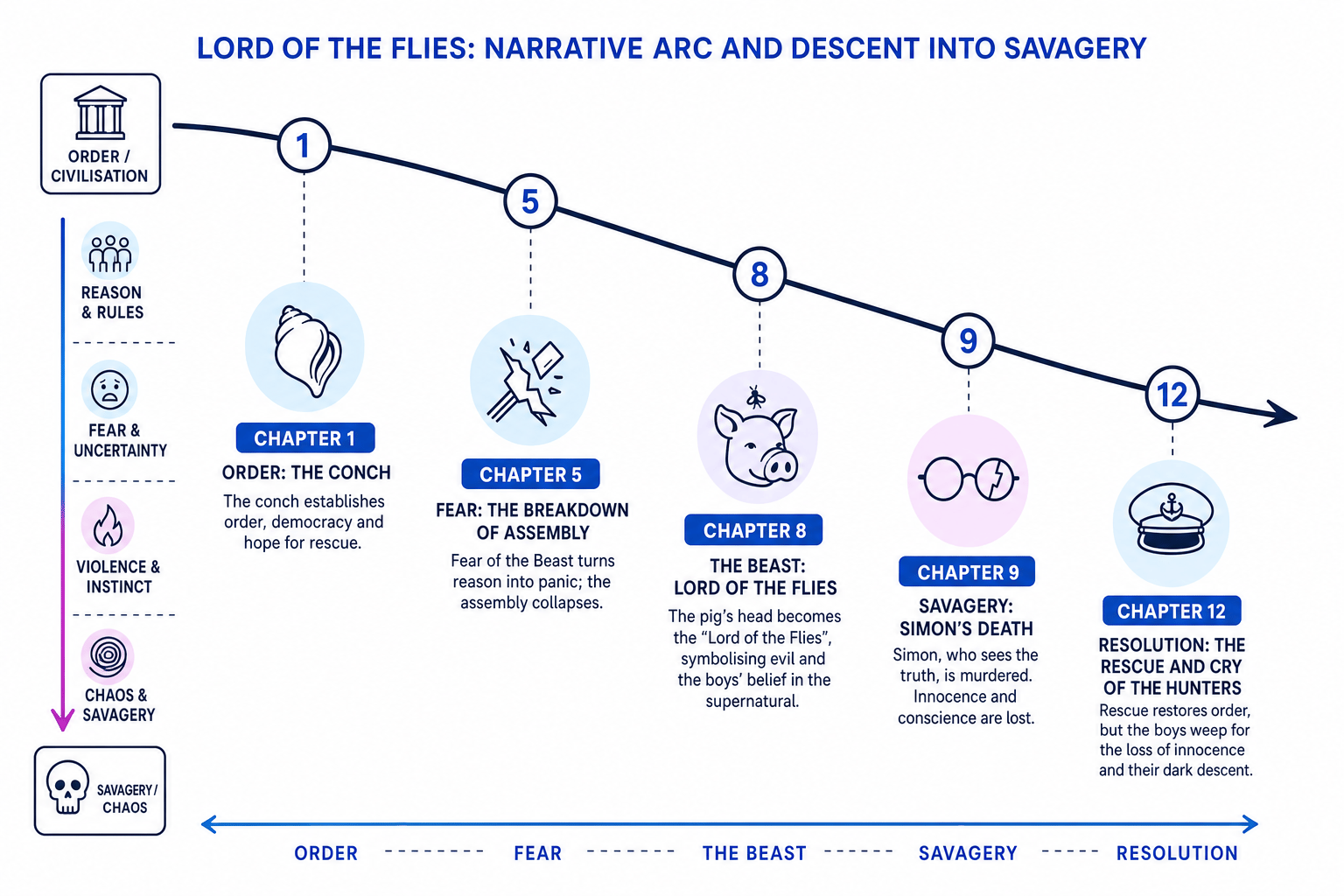
Chapter 1: The Sound of the Shell (Order & Hope)
Chapter 1 introduces us to the island and establishes the initial democratic order.
Key Events & Symbols
- The Conch is Found: Discovered by Ralph and Piggy, the conch becomes the ultimate symbol of democracy, order, and the right to speak.
- The Election: Ralph is chosen as chief, representing rational, democratic leadership, while Jack is positioned as a potential authoritarian rival.
- The First Exploration: Ralph, Jack, and Simon climb the mountain. They are "partners" at this stage, and Jack is unable to kill a trapped pig because of "the enormity of the knife descending".
Analytical Focus: The Fragility of Civilisation
Golding shows that civilisation is not natural to the boys; it is a learned habit. When Jack fails to kill the pig, he is still bound by the moral codes of home. However, his vow that "next time there would be no mercy" foreshadows his rapid descent into violence.
The dual nature of the island
From the very first chapter, Golding contrasts the beauty of the island with its underlying hostility. He describes the heat as "a threatening weight" and the coconut trunks as "decaying". This structural technique is called foreshadowing—hinting at the dark tragedy to come.
Chapter 5: Beast from Water (The Breakdown of Reason)
Chapter 5 is the psychological turning point of the novel. Ralph calls a late-afternoon assembly to restore order, but the meeting quickly dissolves into fear and chaos.
Key Events & Symbols
- The Assembly: Ralph tries to address practical issues (water, shelters, sanitation) but the focus shifts to the "beast".
- Simon's Epiphany: Simon tries to explain what the beast really is: "Maybe there is a beast... maybe it's only us."
- The Split: Jack rejects the rules, shouting, "Bollocks to the rules! We're strong—we hunt!" The assembly breaks up in panic.
Analytical Focus: The Loss of Rationality
The title "Beast from Water" symbolises fear arising from the unknown, unconscious depths of the human mind. Piggy represents scientific rationalism ("Life... is scientific"), while Jack represents primal instinct. When Jack dismisses the rules, the fragile democratic framework established in Chapter 1 is shattered.
Misunderstanding the Beast
Many students write that the beast is a physical monster on the island. Remember, there is no physical beast! Golding uses the "beast" to symbolise the innate capacity for evil within every human heart. Make sure you refer to the beast as a psychological projection of the boys' fear.
Chapter 8: Gift for the Darkness (The Birth of Savage Ritual)
In Chapter 8, the boys split into two distinct factions. Jack forms his tribe of "hunters" at Castle Rock, and the "beast" is given a physical, grotesque form.
Key Events & Symbols
- The Sow's Head: Jack’s tribe brutally slaughters a nursing sow and impales her head on a sharpened stick as a "gift" for the beast.
- The Lord of the Flies: Simon remains behind and hallucinates that the pig’s head is speaking to him, calling itself the "Lord of the Flies" (a literal translation of the Hebrew word Beelzebub, a name for the devil).
Analytical Focus: Atavism and Evil
The killing of the sow is highly symbolic. The hunters do not kill for food; they kill with a primal, sexualised frenzy, showing they have reverted to an uncivilised state.
Atavism
Atavism is the reversion to something ancient or ancestral. In literature, it refers to characters losing their civilised conditioning and returning to a primitive, savage state of being.
When the Lord of the Flies speaks to Simon, it confirms what Simon suspected in Chapter 5: "I’m part of you... I'm the reason why it's no go? Why things are what they are?" This chapter cements the novel's central theme that evil comes from within, not from external forces.
Chapter 9: A View to a Death (The Climax of Savagery)
Chapter 9 is the dramatic climax of the novel. It features the ultimate triumph of Jack’s savage regime and the sacrificial murder of Simon.
Key Events & Symbols
- The Storm: The weather worsens, creating an oppressive, terrifying atmosphere (pathetic fallacy).
- The Dance: Jack hosts a feast. Terrified by the storm, the boys form a protective circle and perform a frenzied chant: "Kill the beast! Cut his throat! Spill his blood!"
- Simon’s Death: Simon crawls out of the forest to tell the boys that the beast on the mountain is only a dead parachutist. In their ritualistic panic, the boys mistake him for the beast and tear him to pieces with their bare hands and teeth.
Tracing Simon's death
Note how Simon's body is carried out to sea by the tides, surrounded by "bright phosphorescent points" of light. Golding uses this gentle, almost holy imagery to frame Simon as a spiritual, Christ-like martyr who died trying to deliver the truth.
Chapter 12: Cry of the Hunters (The Irony of Rescue)
The final chapter represents the complete collapse of Ralph’s world and a deeply ironic resolution.
Key Events & Symbols
- The Hunt for Ralph: Jack’s tribe hunts Ralph like a pig, setting the entire island on fire to smoke him out.
- The Rescue: Just as Ralph is about to be killed, he collapses on the beach at the feet of a British naval officer, who has been drawn by the smoke of the destructive forest fire.
- The Weeping: Instead of celebrating, Ralph weeps for "the end of innocence, the darkness of man’s heart".
Analytical Focus: The Double Irony
There are two major layers of irony in this chapter that you must analyse to get top marks:
- The Fire: The signal fire that Ralph desperately tried to maintain to get rescued was ignored. It is Jack's destructive, murderous forest fire—set to kill Ralph—that ultimately attracts the rescue ship.
- The Officer: The naval officer represents the "civilised" adult world, yet he is a military officer participating in a massive, destructive global war. He chastises the boys for not showing "a better show," failing to realise that his own adult world is engaged in the exact same savage behaviour on a global scale.
Worked Example: Analysing Structure and Theme in Chapter 9
Let's look at how to construct a high-scoring analytical paragraph tracing the descent into savagery in Chapter 9.
Analysing the descent into savagery in Chapter 9
Read this short extract from Chapter 9:
"The circle became a horseshoe. A thing was crawling out of the forest. It came darkly, uncertainly. The shrill screaming that rose before the beast was like a pain. The beast stumbled into the horseshoe."Question: How does Golding use language and structure to present the breakdown of civilisation in this passage?
- Identify the central method and meaning: Golding uses animalistic language ("a thing", "crawling") and structural pacing to show how the boys have completely lost their capacity for rational thought, reducing a human boy (Simon) to a monstrous threat.
- Select and analyse your evidence: Focus on the word "thing". By stripping Simon of his name and humanity, the boys justify their violence. The adverb "darkly" suggests both physical darkness and the moral blindness of the hunters.
- Connect to Golding’s wider message and context (AO3): Explain how this scene acts as the climax of the novel’s structural descent. Golding, having witnessed the horrors of World War II, uses this horrific moment to show that when fear takes over, even "civilised" democratic citizens (represented by the schoolboys) can commit acts of extreme atrocity.
Model Response Paragraph:
In Chapter 9, Golding uses structural pacing and dehumanising language to depict the absolute collapse of civilisation on the island. During the frenzied ritual dance, Simon is described not as a boy, but as "a thing... crawling out of the forest." The noun "thing" strips Simon of his individual identity, illustrating how the collective herd-mentality of the tribe has completely replaced rational, individual thought. This is a crucial turning point in the novel's allegorical structure; the boys have moved from the structured democratic assemblies of Chapter 1 to a state of primitive atavism. The adverb "darkly" reinforces this transition, symbolizing the moral "darkness of man’s heart" that Golding believed was inherent in human nature. Having witnessed the atrocities of World War II, Golding structures Simon's death to show that without the constraints of societal rules, humanity will inevitably lapse into terrifying, self-destructive violence.
In the exam
If you get a question on themes (like conflict, evil, or leadership) or characters (like Ralph or Jack), use these key chapters to structure your essay chronologically:
- Paragraph 1 (The Beginning): Focus on Chapter 1. Show how the character or theme starts in a state of order, hope, and democratic expectation.
- Paragraph 2 (The Middle): Focus on Chapter 5 or Chapter 8. Discuss the breakdown of rational thought, the rise of fear, and the physical emergence of the savage tribe.
- Paragraph 3 (The Climax): Use Chapter 9 to show the absolute peak of violence and what happens when the "beast" takes complete control.
- Paragraph 4 (The Resolution): Conclude with Chapter 12. Analyse the deep irony of the rescue and what the character's final state tells us about Golding’s overall moral message.
Check yourself
- Why is the conch's destruction in Chapter 11 (just before the final chapter) structurally necessary for the events of Chapter 12?
- How does the weather change from Chapter 1 to Chapter 9, and what structural purpose does this serve?
- What is the difference between how Ralph and Jack react to the "beast" in Chapter 5?
