

An outstanding essay does not happen by accident; it is the result of a precise, strategic plan. In your AQA GCSE English Literature Paper 2 exam, you will have 45 minutes to write an essay on Lord of the Flies. Spending 5 to 7 minutes of that time building a robust, thoughtful plan is the single most effective way to secure a Grade 9.
A great plan ensures your writing is focused, sustained, and structured around a clear argument. It prevents you from simply retelling the plot and forces you to think about William Golding’s deeper intentions.
What you'll learn
- How to construct a powerful, thesis-led argument that answers the prompt directly
- How to structure your essay chronologically to match Golding's narrative arc
- How to integrate evidence, literary methods, and historical context into every paragraph
The Core Foundations of Planning
Before putting pen to paper, you must understand what the examiner is looking for. AQA rewards a conceptualised response—this means you are not just describing what happens on the island, but rather why Golding wrote the novel and how he uses his characters and settings to convey a broader message about humanity.
To achieve this, your essay plan must target three major areas:
- Clear Line of Argument (AO1): Your essay must have a backbone. This starts with a strong thesis statement and flows through structured topic sentences.
- Analysis of Writer's Craft (AO2): You must identify Golding's methods (symbolism, motifs, foreshadowing, character constructs) and analyze their effects.
- Integration of Context (AO3): You must link your points to Golding’s context—his experience of the horrors of World War II, the rise of Cold War anxieties, and his critique of the flawed nature of Western society.
Construct
A construct is a character deliberately built by an author to represent a specific theme, ideology, or social group, rather than a real, living person. In Lord of the Flies, none of the boys are just "children"—they are literary constructs designed to illustrate facets of human nature.
Thesis Statement
A thesis statement is a one- or two-sentence summary of your central, overarching argument. It directly answers the essay prompt and acts as the guiding anchor for every single paragraph you write.
The Anatomy of a High-Scoring Essay Plan
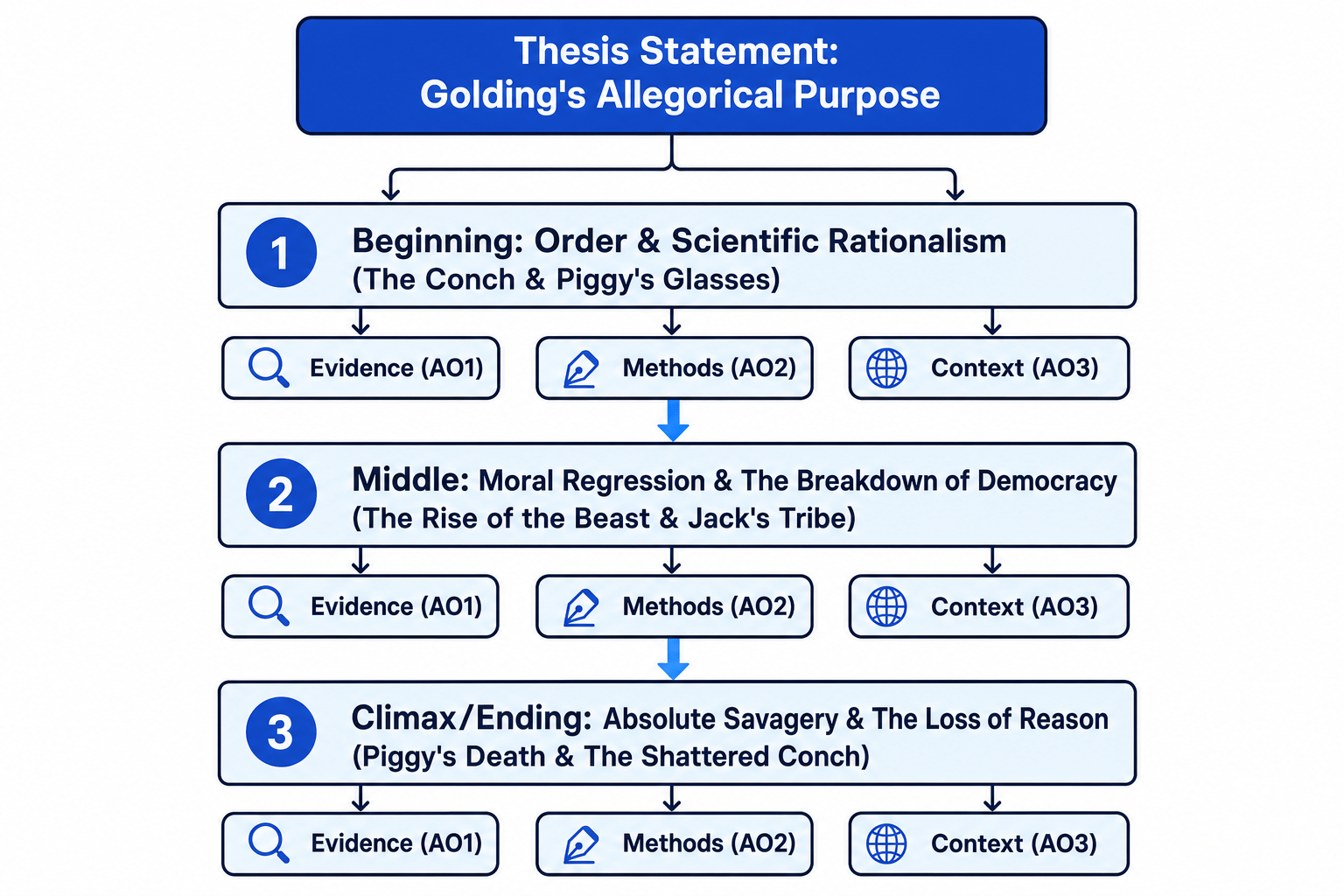
To pick up maximum marks, your essay should follow a logical, structural trajectory. Instead of jumping randomly from quote to quote, map your essay to mirror the chronological progression of the novel. Golding structured the text to show a gradual, terrifying descent from order to chaos, and your essay should reflect that descent.
Chronology is Structure
Structuring your essay chronologically (Beginning →\to→ Middle →\to→ End) naturally shows the examiner that you understand the novel's structure (AO2). It allows you to track the gradual degeneration of the boys' society and Golding's unfolding moral warning.
Planning an essay on Piggy and Rationalism
Let us walk through how to build a high-scoring plan for this common exam prompt:
"Explore how Golding presents Piggy as a symbol of rationalism and its vulnerability in the novel."
-
Formulate your Thesis Statement (AO1 & AO3)
Action: Draft a direct answer to the prompt that links Piggy's character to Golding's allegorical intentions. Do not just say "Piggy is smart and gets bullied."
Drafting: "Golding presents Piggy as a construct representing scientific rationalism, intellect, and the civilised democratic order. Ultimately, Piggy's physical vulnerability and tragic demise serve as Golding’s pessimistic warning that human reason and intellect are fragile and easily destroyed when mankind is freed from the moral constraints of civilisation." -
Establish your Chronological Three-Part Structure
Action: Break the novel's timeline into three logical stages that track the journey of Piggy and his symbolic representation.- Paragraph 1 (The Beginning): The introduction of intellect and order. Piggy as the advisor to Ralph, establishing democracy and scientific thought (the conch and specs).
- Paragraph 2 (The Middle): The marginalisation and decay of intellect. The breakdown of democratic order, the physical damage to Piggy's glasses, and the rise of Jack’s primal, irrational savagery.
- Paragraph 3 (The Ending/Climax): The absolute destruction of reason. Piggy's violent death, the total obliteration of the conch, and the triumph of pure, unbridled savagery.
-
Populate each Paragraph block with Evidence, Methods, and Context
Action: For each of the three stages, select precise quotes, identify the writer's methods, and link them directly to Golding's historical and philosophical context.- Paragraph 1 Plan:
- Evidence (AO1): "the fat boy", "closed circuit" of Piggy's mind, "specs".
- Methods (AO2): Symbolism of Piggy's glasses (insight/science) and physical vulnerability (asthma, weight).
- Context (AO3): Post-Enlightenment reliance on scientific rationalism; the vulnerability of intellectuals under totalitarian regimes (like the rise of Nazism in the 1930s).
- Paragraph 2 Plan:
- Evidence (AO1): "acting like a crowd of kids", "one side [of the glasses] was broken".
- Methods (AO2): Juxtaposition between Piggy's adult-like pragmatism and the boys' childish regression. Symbolism of the broken lens (the partial loss of collective reason).
- Context (AO3): Golding’s critique of how easily democratic systems can be fractured when demagogues (like Jack) exploit fear (the Beast) to gain power.
- Paragraph 3 Plan:
- Evidence (AO1): "the conch exploded into a thousand white fragments", "legs twitched".
- Methods (AO2): Climax, sudden violent imagery, symbolic death of intellect coinciding with the destruction of the conch.
- Context (AO3): Golding's post-WWII disillusionment; his belief that without societal rules, human nature reverts to primal savagery. Reason cannot survive in a state of total moral lawlessness.
- Paragraph 1 Plan:
Pitfalls to Avoid in Your Planning
Many students write plans that actually hold them back. Keep your plans brief, focused, and conceptual.
The 'Quote-Dump' Plan
Avoid simply writing a list of random quotes you remember. If your plan is just a list of quotes without a clear thesis statement linking them together, your essay will lack direction, leading to a fragmented, narrative response rather than an analytical one.
The 5-Minute Rules
Your plan should take no longer than 5 minutes. Use single words, abbreviations, and arrows. For example:
- P1→P1 \toP1→ Conch & Specs →\to→ Order & Science →\to→ "specs" →\to→ WWII context. This keeps your hand moving and saves your energy for the actual essay.
Do Not Treat Characters as Real People
Never write "Piggy made a mistake by not being more athletic." Piggy did not make a choice—Golding did. Always use the writer's name to frame your points: "Golding purposefully constructs Piggy's physical weakness to..." This keeps your focus firmly on AO2 and AO3.
In the exam
Follow this step-by-step routine as soon as you open the exam paper and select your Lord of the Flies question:
- Deconstruct the prompt: Underline the key focus words (e.g., "fear," "leadership," "Simon") and the prompt's direction.
- Write down your Thesis Statement first: Do not start planning paragraph details until you know your overall argument.
- Map three chronological paragraphs: Sketch a quick three-step timeline (Beginning, Middle, End) on your exam paper.
- Jot down 2 key quotes per paragraph: Write just 2-3 words of each quote to anchor your memory.
- Annotate your plan with "M" and "C": Next to each paragraph, write one Method (M) and one Contextual link (C) to ensure you are hitting AO2 and AO3 throughout.
Check yourself
- Can you explain the difference between a character biography and treating a character as a "construct"?
- Why is a chronological structure (Beginning →\to→ Middle →\to→ End) highly recommended for a Lord of the Flies essay?
- What are the three essential components that must be present in every single planned paragraph?
