

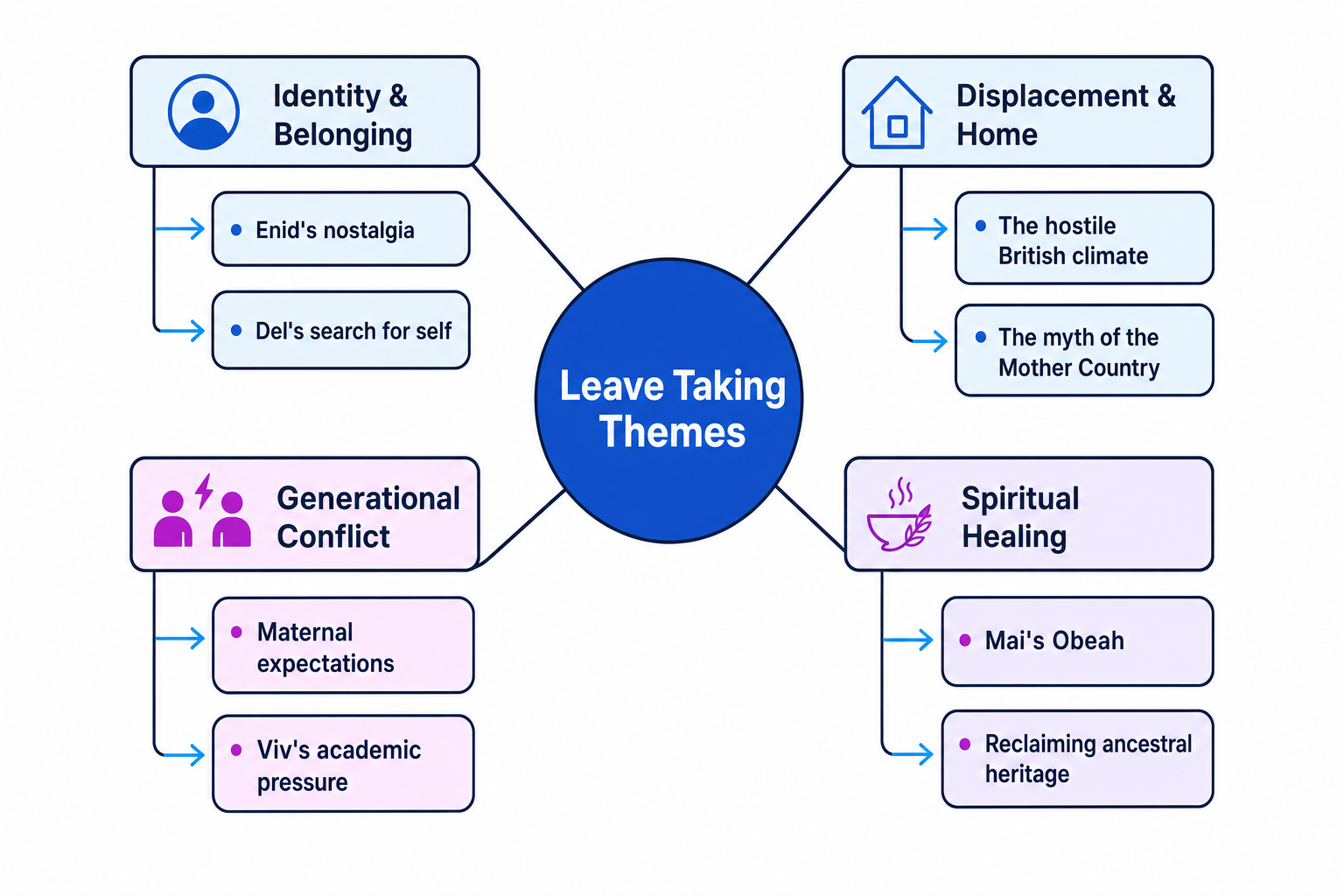
Winsome Pinnock's landmark play Leave Taking (first performed in 1987) is a rich, poignant exploration of the British-Caribbean diaspora experience in West London during the late 20th century. By focusing on the lives of Enid, her daughters Viv and Del, and their neighbors, Pinnock exposes the emotional, social, and cultural challenges faced by different generations of immigrant families.
Understanding these themes is vital for your GCSE exam, as your essay question will ask you to analyze how Pinnock presents one of these key ideas or a character's relationship to them.
What you'll learn
- How Pinnock presents the psychological impact of migration, displacement, and the myth of the "Mother Country."
- The tension between first-generation assimilation and second-generation rebellion.
- How maternal love can mutate into overbearing control under the pressure of systemic racism.
- The role of cultural heritage, ancestral memory, and spiritual healing in reclaiming identity.
Theme 1: Identity and Belonging
At the heart of Leave Taking is the question: Who am I, and where do I belong? Pinnock presents identity not as a fixed state, but as a painful negotiation, particularly for the children of immigrants.
Diaspora
A diaspora refers to a scattered population whose origin lies in a separate geographic locale. In this play, it refers to the Afro-Caribbean community that moved to the UK during the Windrush era.
The First-Generation Struggle: Enid
Enid represents the Windrush generation, who arrived in Britain in search of opportunities. She defines her identity through work, duty, and clean living. To survive in a hostile, white-dominated society, Enid believes she must assimilate (blend in) and conform.
- She tells her daughters, "I work hard for what I got."
- Her identity is bound up in her sacrifice: she scrubs hospital floors to secure a future for her children.
- However, this requires suppressing her Caribbean heritage, a choice that leaves her emotionally repressed.
The Second-Generation Struggle: Del and Viv
Enid’s British-born daughters experience a deep crisis of belonging, often referred to as a "hyphenated" or dual identity. They are caught between their mother's Caribbean values and the reality of growing up Black in London.
- Del rejects her mother's respectability politics. She is acutely aware of the racism around her and refuses to assimilate. She exclaims, "You think because I was born here I'm English? I'm not." Del feels disconnected from both England and Jamaica, a state of painful limbo.
- Viv attempts to fulfill her mother's dreams through academic success. However, her education is deeply Eurocentric. She memorizes historical dates like "William the Conqueror 1066", illustrating how her schooling alienates her from her own history and ancestors.
The hyphenated identity
Pinnock shows that the second generation cannot simply 'be' British or Caribbean. Their struggle is to forge a new identity that honors their heritage while navigating the hostile landscape of their birth country.
Theme 2: Displacement and "Home"
The characters in Leave Taking are haunted by the concept of "home." What makes a place home? Is it where you are born, where you live, or a mythic place you have left behind?
The Myth of the "Mother Country"
Post-war immigrants from the Caribbean were raised to believe that Britain was their "Mother Country." They expected a warm welcome and prosperity. The reality, however, was cold, grey, and hostile.
- Enid recalls her shock at arriving in England, noting how the physical coldness of the climate reflected the emotional coldness of the society: "This country is cold, cold."
- Pinnock contrasts this with Jamaica, which Enid remembers with nostalgic warmth: "In Jamaica we used to have a yard... here you got to stay inside." The physical confinement of their London flat symbolizes their social and cultural restriction.
The Realization
By the end of the play, Enid must confront the truth that her dream of returning "home" to Jamaica is an illusion.
- She admits, "I wanted to go back. But there was nothing to go back to."
- The tragedy of displacement is that by leaving Jamaica, she lost her connection to it; yet by living in Britain, she was never fully accepted. Home is no longer a physical place, but a state of mind that must be rebuilt.
Nostalgia vs. Reality
Do not assume Pinnock is simply romanticizing Jamaica. Through the character of Brod, we learn that life in Jamaica was also full of poverty and hardship. The characters' nostalgia is a coping mechanism for the racism and isolation they experience in London.
Theme 3: Generational Conflict and Motherhood
The conflict between Enid and her daughters is not just a standard clash of teenagers and parents; it is a cultural and historical chasm.
Motherhood as a Shield
Enid’s parenting is strict, controlling, and protective. Having experienced the hostility of British society firsthand, she believes that any slip-up from her daughters will lead to ruin.
- Her love is expressed through anxiety. She demands perfection, particularly from Viv, policing her clothes, her company, and her studies.
- When her daughters rebel, Enid feels personally betrayed. She views their rejection of her rules as a rejection of her sacrifices: "I wanted you to have a better life."
Rebellion as Self-Preservation
For Del and Viv, breaking free from Enid’s expectations is essential for finding their own voices.
- Del’s pregnancy and her departure from the family home are acts of defiance against Enid’s rigid moral code.
- Viv’s eventual choice to step away from her intense study regime shows her realizing that academic achievement cannot cure her identity crisis.
Theme 4: Cultural Healing and Ancestral Memory
If displacement and conflict are the wounds of the play, cultural heritage and spirituality are the cure. Pinnock uses the character of Mai, an Obeah woman, to show how reconnecting with Caribbean traditions offers a path to healing.
Obeah
Obeah is a system of spiritual and healing practices developed by enslaved West Africans in the West Indies. It involves herbalism, communication with spirits, and ritual. In the play, it represents a vital connection to African and Caribbean roots.
Mai as the Spiritual Anchor
While Enid tries to forget the past to fit into Britain, Mai keeps the past alive. Her room is filled with the smells of herbs and potions, a sensory oasis in the middle of drab East London.
- Mai understands that the daughters' psychological struggles stem from a disconnect from their roots. She tells them, "You have to look back before you can go forward."
- When Enid eventually visits Mai, it is a turning point. Enid must strip away her British respectability and confront her deep-seated grief and fear.
The Resolution of Healing
The climax of the play involves a ritualistic reconciliation. By acknowledging their shared heritage and the trauma of migration, the women are able to begin healing their fractured relationships. Reclaiming their history allows them to face the future in Britain on their own terms.
Structuring a thematic analysis of displacement
An essay question asks: Explore how Pinnock presents the theme of displacement in Leave Taking.
Here is how you can write a high-scoring paragraph analyzing Enid's sense of displacement.
- Formulate a clear thesis point linking the character to context (AO1/AO3): Begin by stating how Pinnock uses Enid to represent the disillusionment felt by the Windrush generation, who swapped their tropical home for a cold, hostile Britain.
- Integrate a short, precise quote and identify the writer's language method (AO2): Introduce Enid's recollection of arriving in England: "This country is cold, cold." Identify the use of repetition and the physical motif of coldness.
- Analyze the deep psychological effects of the method and link to the wider play (AO2/AO1): Explain that the repetition of "cold" emphasizes not just the physical climate, but the cold reception of the British public. The cold acts as a sensory metaphor for isolation and exclusion, contrasting sharply with the warmth of her Jamaican memories and highlighting the emotional cost of her displacement.
Contextual Integration (AO3)
In the exam, never just "dump" historical facts about the Windrush generation. Always tie the context directly to the writer's choices. For example: “Pinnock uses Enid's obsession with academic success for Viv to reflect the intense pressure felt by Windrush parents, who believed educational conformity was the only shield against institutional racism in 1980s Britain.”
In the exam
- Analyze the question's key term: If the question asks about "belonging," brainstorm how this affects at least two different characters (e.g., Enid's desperate bid for British respectability vs. Del's rejection of it).
- Structure chronologically or conceptually: Track how a theme develops. For example, show how the theme of identity starts as a source of conflict at the beginning of the play, but moves toward reconciliation and healing by the end through Mai's influence.
- Focus on the "Why": Why did Pinnock write this play in the late 1980s? She wanted to give a voice to Black British experiences that were ignored by mainstream British theatre. Always link your thematic analysis back to her purpose as a playwright.
Check yourself
- Why does Viv memorize the dates of English kings, and what does this show about her sense of identity?
- Contrast Enid's attitude toward Mai at the beginning of the play with her attitude at the end. What does this change reveal about Enid's journey?
- How does the physical setting of Enid’s flat mirror her emotional state?
