In the GCSE English Literature exam, you are assessed on your ability to analyze characters not as real historical figures, but as deliberate artistic creations. Shakespeare uses these characters to explore heavy themes like political power, loyalty, honor, and betrayal.
What you'll learn
- How Shakespeare constructs characters to represent competing political and moral ideologies.
- How to analyze the fatal flaws (hamartia) and internal conflicts of Brutus, Caesar, Cassius, and Antony.
- How to compare and contrast characters to show deep understanding of Shakespeare's structural choices.
Understanding Character Construction in Shakespeare
To achieve the highest marks (Grades 7–9), you must treat characters as constructs.
Construct
A construct is a character designed by an author to represent a specific abstract idea, theme, or political viewpoint, rather than simply existing to mimic a real person.
When writing your essay, always use the writer-focused analytical model: “Shakespeare constructs Brutus to represent...” rather than “Brutus is...”
Key Literary Terms for Character Analysis
- Tragic Hero: A noble protagonist who starts in a position of high status but falls to ruin due to a combination of external forces and their own internal flaws.
- Hamartia: A Greek tragic term meaning a "fatal flaw" or error in judgment that leads directly to a character's downfall.
- Hubris: Excessive pride or dangerous self-confidence, which often leads characters to ignore warnings and meet a tragic end.
- Foil: A character who contrasts sharply with another character in order to highlight their particular qualities.
To help you visualize how these characters interact and conflict with one another, study this relationship map:
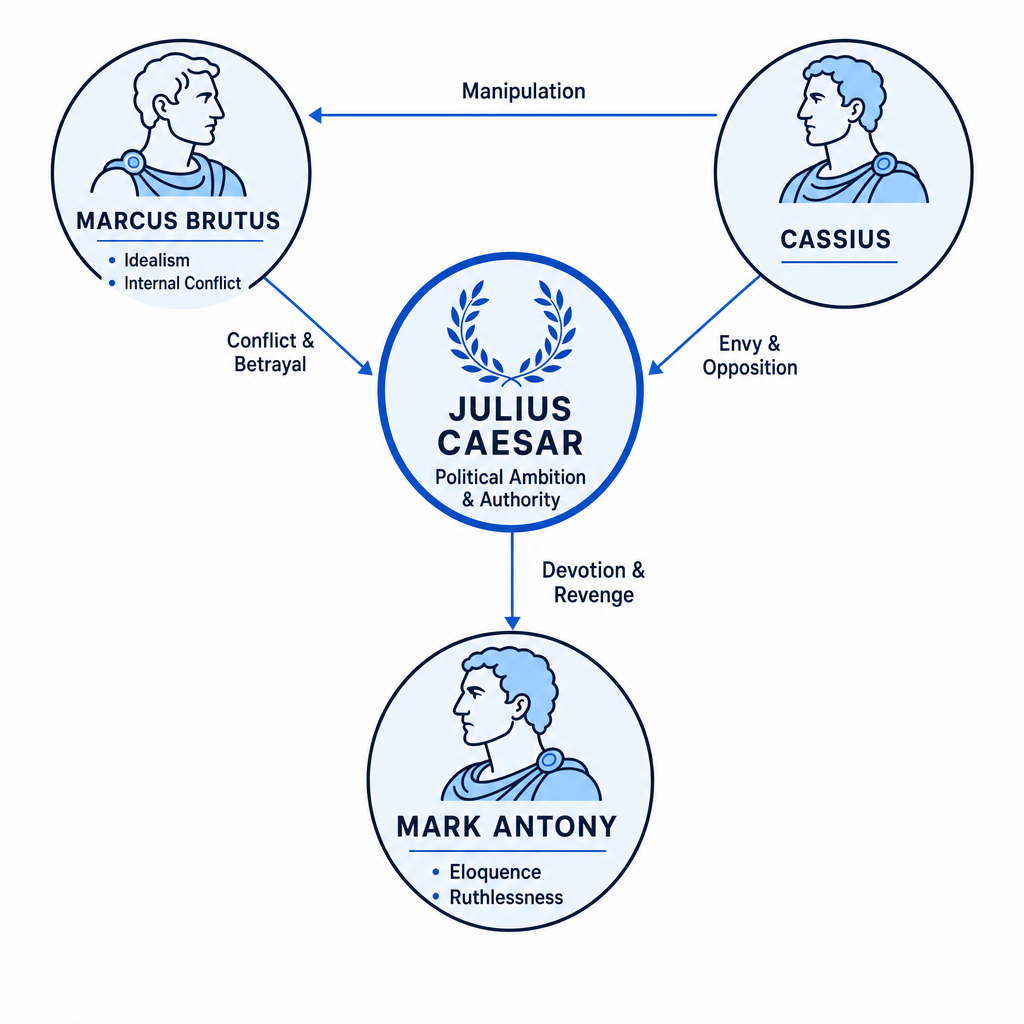
Marcus Brutus: The Conflicted Idealist
Marcus Brutus is the emotional and moral center of the play. He is a classic tragic hero torn between his private love for Caesar and his public duty to Rome.
The Paradox of Brutus
Brutus's greatest strength is his honor, but it is also his fatal flaw (hamartia). His naive belief that everyone else is as honorable as he is makes him incredibly easy to manipulate.
Key Characteristics:
- Honor-Driven: Brutus declares, "I love / The name of honour more than I fear death" (Act 1, Scene 2). He acts strictly out of a desire to protect the Roman Republic from tyranny.
- Conflicted: Shakespeare uses soliloquies (speeches where characters speak their thoughts aloud to the audience) to expose Brutus’s inner turmoil. Before the assassination, he confesses, "It must be by his death" (Act 2, Scene 1), even though he has "no personal cause to spurn at him."
- Politically Naive: Brutus repeatedly makes poor strategic decisions because he assumes others share his high moral standards. He spares Mark Antony’s life and allows him to speak at Caesar's funeral—choices that ultimately lead to the conspirators' destruction.
Julius Caesar: The Flawed Colossus
Julius Caesar is the titular character, yet he only appears in a few scenes before his murder in Act 3. Despite his early death, his physical and political presence dominates the entire play.
Key Characteristics:
- Hubris and Imperiousness: Caesar speaks of himself in the third person ("Caesar shall forth"), aligning himself with the gods or a force of nature. He famously boasts, "I am constant as the northern star" (Act 3, Scene 1) right before he is stabbed, demonstrating supreme irony.
- Physical Frailty: Shakespeare intentionally contrasts Caesar’s god-like self-image with his physical weaknesses. He is deaf in one ear, suffers from the "falling sickness" (epilepsy), and nearly drowned in the Tiber River. This physical vulnerability highlights the delusion of his absolute power.
- Superstitious yet Dismissive: While Caesar is anxious about omens (like Calpurnia’s dream), his overwhelming pride forces him to dismiss them to avoid looking cowardly: "Cowards die many times before their deaths; / The valiant never taste of death but once" (Act 2, Scene 2).
Viewing Caesar as a Simple Villain
Do not write that Caesar is a tyrant. Shakespeare leaves his actual ambition ambiguous. We never actually see Caesar act tyrannically; we only hear Cassius and Brutus fear that he might become a tyrant. Shakespeare wants the audience to wonder whether the assassination was actually justified.
Cassius: The Pragmatic Machiavellian
Cassius is the structural foil to Brutus. Where Brutus is guided by abstract ideals of honor, Cassius is driven by intense personal envy and practical, Machiavellian politics.
Machiavellian
A term describing a politician or character who is cunning, scheming, and unscrupulous, believing that "the end justifies the means."
Key Characteristics:
- Envious of Caesar: Cassius cannot tolerate a man of equal birth ruling over him. He bitterly recalls saving Caesar from drowning, complaining that Caesar has now "become a god" while Cassius is a "wretched creature" (Act 1, Scene 2).
- Perceptive and Manipulative: Cassius is highly skilled at reading human nature. Caesar famously observes that "Yond Cassius has a lean and hungry look; / He thinks too much: such men are dangerous" (Act 1, Scene 2). Cassius exploits Brutus’s love of honor by planting forged letters urging him to save Rome.
- Pragmatic and Realistic: Cassius does not care about honor in war; he cares about winning. He wants to kill Antony alongside Caesar and advises against letting Antony speak to the plebeians, recognizing the danger of Antony's rhetorical skills.
Mark Antony: The Ruthless Orator
Mark Antony begins the play as a loyal, pleasure-loving companion to Caesar, but transforms after the assassination into a dangerous, calculated politician.
Key Characteristics:
- Deeply Loyal: Antony’s grief over Caesar is genuine. In his private soliloquy over Caesar’s body, he laments, "O, pardon me, thou bleeding piece of earth, / That I am meek and gentle with these butchers!" (Act 3, Scene 1).
- Master Rhetorician: Antony uses brilliant language to manipulate the Roman mob during his funeral oration. By repeating the phrase "Brutus is an honourable man" while showing the crowd Caesar’s bloody cloak, he uses verbal irony to turn the public against the conspirators without violating his promise not to speak ill of them.
- Cold and Ruthless: Once in power as part of the Triumvirate, Antony is shown casually condemning his own family members to death to secure his political position (Act 4, Scene 1), proving him to be just as dangerous as the conspirators feared Caesar would be.
Contrasting Cassius and Antony
Compare Cassius and Antony in your essays. Both are highly pragmatic and manipulative, but Cassius uses his skills to build a conspiracy, whereas Antony uses his to destroy it and seize power for himself.
Worked Example
Analyzing internal conflict in Brutus's soliloquy
Analyze how Shakespeare presents Brutus's internal conflict in Act 2, Scene 1:
"It must be by his death: and for my part, / I know no personal cause to spurn at him, / But for the general. He would be crown'd: / How that might change his nature, there's the question."
-
Identify the core argument and character motivation: Determine what Brutus is trying to justify to himself. In this opening line, he immediately declares his conclusion ("It must be by his death"), establishing that he has chosen political duty over personal loyalty. Note that he admits he has "no personal cause" against Caesar, highlighting that his conflict is entirely ideological, not personal.
-
Examine the language and structural choices: Analyze the grammatical structure of his reasoning. The use of the caesura (the pause created by the colon after "death") shows a sudden shift from his decisive conclusion to his anxious, defensive reasoning. The phrase "But for the general" uses the Elizabethan concept of the "general good" (the commonweal). This reveals his philosophical justification: he is acting on behalf of the Roman republic, not out of malice.
-
Analyze key verbs and modal verbs: Look closely at the word "would" in "He would be crown'd". The modal verb "would" suggests certainty of Caesar's ambition, yet this is immediately followed by the speculative verb "might" in "How that might change his nature". Shakespeare uses this linguistic shift to expose the core weakness in Brutus’s logic: he is planning to assassinate his close friend based not on what Caesar has done, but on what he might do if crowned.
-
Connect the analysis to the historical/social context (AO3): Relate this internal struggle to the anxieties of Shakespeare's audience. For a Jacobean audience living under King James I, the prospect of assassinating a monarch was terrifying and viewed as a sin against God (the Divine Right of Kings). By showing Brutus's agonizing internal debate, Shakespeare acknowledges the immense gravity of regicide, framing it as a tragic intellectual error rather than a simple act of evil.
In the exam
- Never treat characters as real historical figures: Always write about them as constructs built by Shakespeare to explore specific ideas (e.g., "Shakespeare uses Antony's manipulation of the plebeians to warn the Jacobean audience about the dangers of demagoguery and populist politics").
- Contrast characters to show structural appreciation: To gain top marks for AO2, contrast Brutus's naive idealism with Cassius's cynical pragmatism. Showing how they act as foils for one another proves you understand the deliberate structure of the play.
- Use highly precise quotations: You don't need long blocks of text. Short, sharp quotes (such as "constant as the northern star", "lean and hungry look", or "bleeding piece of earth") are much easier to remember and allow you to perform close-word analysis more effectively.
Check yourself
- Why does Shakespeare choose to emphasize Caesar's physical weaknesses (like his epilepsy and partial deafness) right alongside his boasts of being god-like?
- In what ways does Mark Antony's behavior in Act 4, Scene 1 (assessing who to execute) challenge the audience’s initial sympathy for him as Caesar’s loyal friend?
- How does Cassius's motivation for wanting Caesar dead differ fundamentally from Brutus's motivation?
